

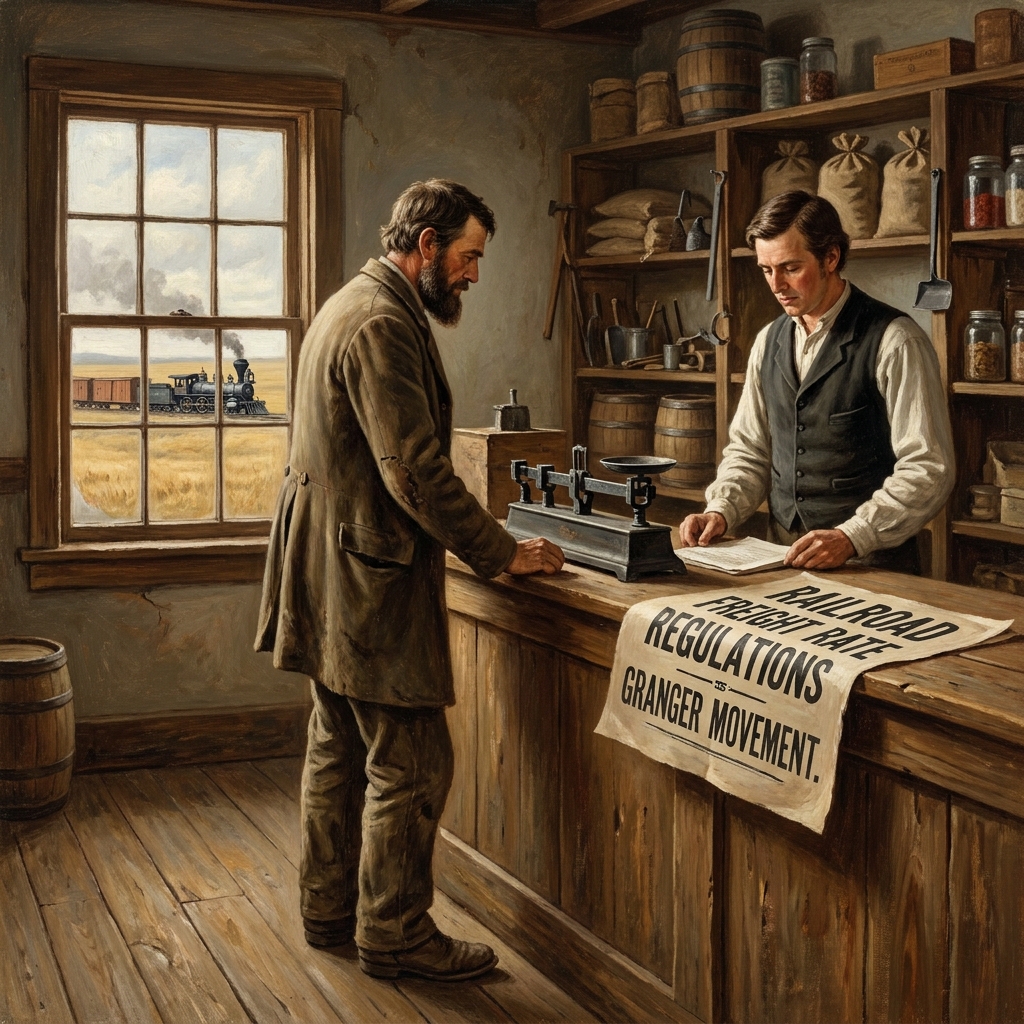
Teaching 8th grade students about the Grange and Populism is an essential part of US history. This post explores the Farmers and Reform: The Grange and Populism lesson to help students understand the rise of agricultural activism and economic reform during the Gilded Age.
Common misconceptions regarding Gilded Age farmers
In the middle of the eighth grade year, when you are deep into the Growth and Conflict curriculum, there is a tendency for students to look at the Industrial Revolution and see only the big players. They fixate on the tycoons of oil, steel, and rail, assuming the rest of the country simply stood back and let the rapid changes happen. This leads to a persistent, frustrating misconception: students often view 19th-century farmers as passive victims of industrialization who had no agency. They see the rising railroad prices and the high cost of equipment and assume that the rural population just folded. If you do not explicitly break this down, your students will finish the year thinking that the American economy was a monologue written by corporations, rather than a dialogue between those corporations and the people who fought back.

This is precisely where Farmers and Reform: The Grange and Populism shifts the narrative. It forces them to look at the farmers not as victims, but as organizers who understood that economic power requires collective action. By providing a clear look at how farmers responded to the encroaching influence of monopolies, the material effectively dismantles the idea that there was no organized resistance to the Gilded Age corporate machine.
What the lesson actually asks students to do
The lesson does a great job of grounding these abstract political concepts in tangible, classroom-friendly scenarios. It introduces the cooperative movement with a simple piece of math: farmers in the Midwest were paying 50 dollars for basic seed supplies, but by pooling their money and buying in bulk, they could cut their costs by 20 dollars. It is a simple arithmetic problem that acts as an entry point into the far more complex world of Grangerism and Populism. Your students will engage with terms like Cooperative, which the lesson defines as a group of people working together to buy supplies or sell goods to get better prices than they could alone.
From there, the lesson shifts to political concerns. It provides a worked example showing how farmers advocated for legislation to regulate railroad freight rates. The term Regulation is defined as the government creating rules to control how a business operates. This is essential for students to see the connection between their personal economic struggles and the creation of government policy. The guided practice even puts the class into a role-play situation where they have to address the stress of land mortgages and interest rates. It is an effective way to show that when these farmers organized, they were not just complaining; they were attempting to fundamentally change the way economic laws functioned in their communities.
Aligning with state standards
This lesson is built to support the study of CA.HSS-8.12.8. This specific California-adopted standard asks that students identify the characteristics and impact of Grangerism and Populism. It is a standard about recognizing that these movements were not just social clubs, but active political participants that forced the government to acknowledge the plight of laborers and farmers. The standard ensures that students understand the transformation of the American economy during this period, and it is the same requirement taught by teachers in San Bernardino City Unified, Montebello Unified, Dos Palos Oro Loma Joint Unified, and Norris Elementary School District. When you cover this, you are meeting a foundational expectation for eighth graders to grasp how corporate power and citizen-led reform movements intersected during the late 1800s.
Where students slip
The biggest challenge I have observed with this topic is the tendency for students to confuse a monopoly with a cooperative. They hear the word corporation and their eyes glaze over, or they try to apply modern economic terms to a 19th-century context that does not fit. The definition provided in this 8th grade Grangerism lesson regarding Monopoly is very helpful here: a situation where a single company controls all or nearly all of the supply of a product or service. If a student can see the difference between that total control and the collective power of a cooperative, they are well on their way to mastering the lesson objective. I find that taking ten minutes to map out the ‘Grangerism vs. Monopoly’ dynamic on the whiteboard pays off immensely when they start the guided practice.
This lesson fits well as a whole-class assignment because it provides enough structure for students who need extra support while keeping the scenarios grounded enough for those who are ready for more analysis. If you have a student who missed the week, the step-by-step introduction to cooperatives and the clear vocabulary definitions make it a very accessible makeup assignment. It also makes for a strong plan for a substitute day because the progression is logical: it moves from the immediate need for cheaper seeds to the broader, systemic changes involving federal regulation. It turns what could be a dry lecture on law into a story about survival and organized protest.
The takeaway is simple: the legacy of the Grangers is that individual voices, when pooled together, have the power to regulate industry and hold banks accountable. By the time students work through the final questions, they should see clearly that the strategies used in the 1880s are still mirrored in our communities today. It transforms the lesson from a dated historical narrative into a relevant case study on active citizenship.
Related lessons
Growth and Conflict: The Rise of American Capitalism, Examines the expansion of industry and corporate influence in America
The Rise of Jacksonian Democracy, Covers political shifts and power changes in the early republic
Growth and Change in the Early Republic, Details economic and social developments following the American Revolution