


We have all seen it in the classroom. A student stands up for a speech, clicks to a slide, and puts up a wall of text that repeats exactly what they are saying. The visual does not add anything. It is just decoration. If you want to move your ninth graders past the stage of using slides as a teleprompter, Strategic Digital Media in Presentations is worth a look.
This high school English language arts lesson focuses on the core concept that digital media should act as a bridge between a student’s claims and the audience’s understanding. Instead of letting students treat images and audio as afterthoughts, the lesson forces them to think about how a specific chart or sound clip makes their argument stronger. The lesson defines Strategic Media as the thoughtful selection of images, audio, or interactive elements to clarify findings and enhance persuasion. It also introduces the idea of Graphical Data as information displayed in a visual format, such as a chart or graph, to make complex statistics easier to read, and it touches on the importance of Audience Engagement as a way to hold the listener’s attention during a talk.
How the standard shapes instruction
The lesson is built around CA.ELA.SL.9-10.5, which asks students to make strategic use of digital media in presentations to enhance understanding of findings, reasoning, and evidence and to add interest. This is the California-adopted standard, and it is taught consistently across districts like Victor Valley Union High School District, Kern High School District, Golden Plains Unified, and Patterson Joint Unified. The standard, which also appears as CCSS.ELA-LITERACY.SL.9-10.5 in other frameworks, asks students to move beyond decoration. It requires that the digital media actually serve a purpose in the presentation. Whether it is text, graphics, audio, or interactive elements, the goal is always to make the evidence or reasoning more accessible to the audience.
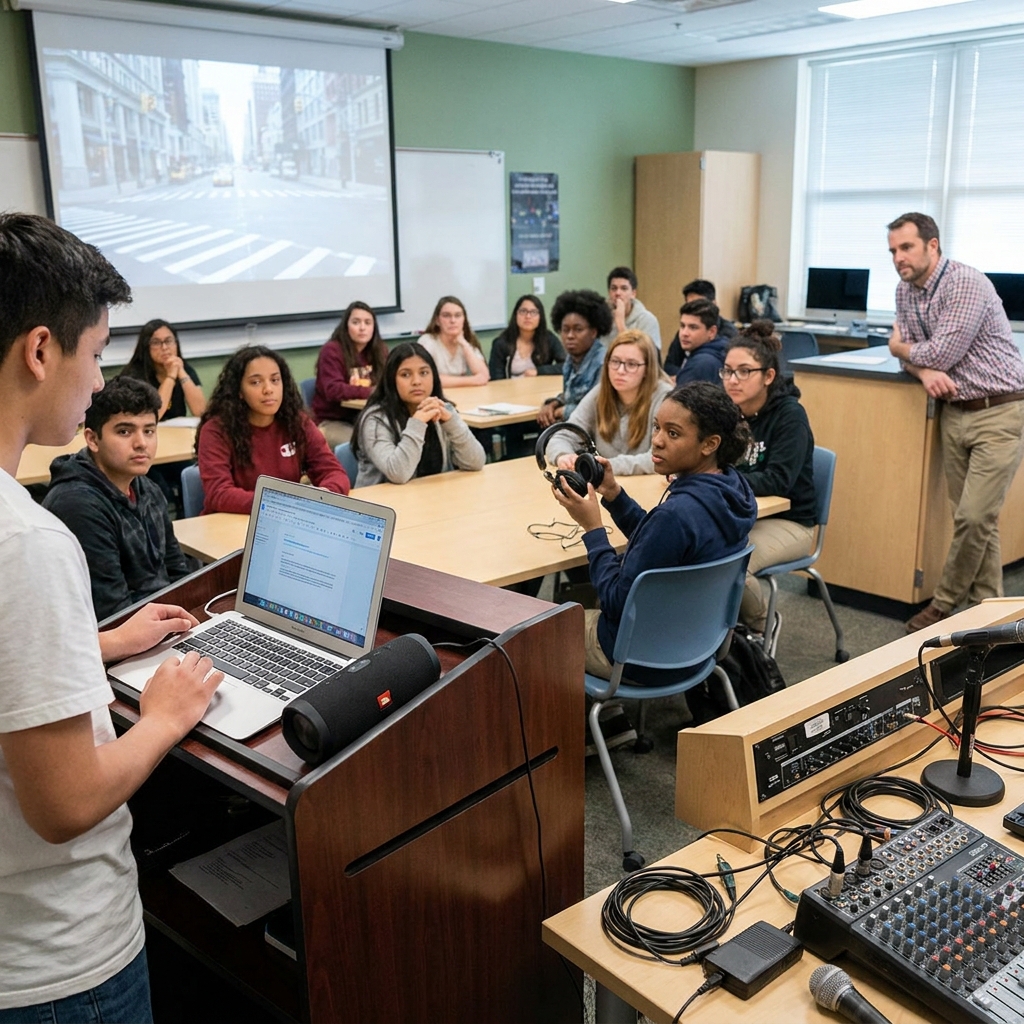
What the lesson actually asks students to do
The lesson begins by asking students to think about how they use data in science. It brings up a clear, relatable example about climate change. If a student presents a 5-year climate trend, a simple list of spoken numbers is boring and hard to follow. A chart, however, allows viewers to see patterns in global temperatures that a spoken list might miss. The prior knowledge section argues that selecting the right visual aids helps the audience trust the evidence. By the time students reach the worked example, they see a presenter using a laser pointer to highlight specific features on an interactive 3D digital globe. This shows the students exactly how a tool can clarify spatial relationships in data, giving them a concrete image of what a high-quality presentation looks like.
Thinking through the guided practice
In the guided practice, the lesson asks students to apply their knowledge to a new scenario: a speech about the decline of local biodiversity. The task is to draft a speech about the loss of bees in the area and, specifically, to select a visual to show this trend over the last 5 years. This is a solid test of their understanding because it forces them to make a choice. They cannot just pick a generic picture of a flower or a bee. They have to decide what kind of visual aids for student presentations will prove the decline in bee populations. It is a good exercise in selection and relevance.

The lesson is straightforward and fits well into about 45 minutes of instruction. It works best as a whole-class assignment when you are preparing for a research project or a persuasive speech, but it is also excellent for independent study for a student who missed the week of drafting presentations. If you have a student who is struggling with how to organize their thoughts, this lesson gives them a clear framework for when to include media and why. It is one of the more practical lessons for high schoolers because it treats digital literacy as a real-world communication tool rather than just another assignment to turn in. Choosing media wisely ensures the message is heard by anyone, a skill they will carry forward long after they leave your room.
Related lessons

Integrating and Evaluating Diverse Sources, Synthesizing evidence from multiple sources for effective academic research

Evaluating Arguments, Analyzing the validity of claims in formal persuasive speeches

Mastering Rhetorical Adaptability, Tailoring communication styles for various audiences and presentation goals