

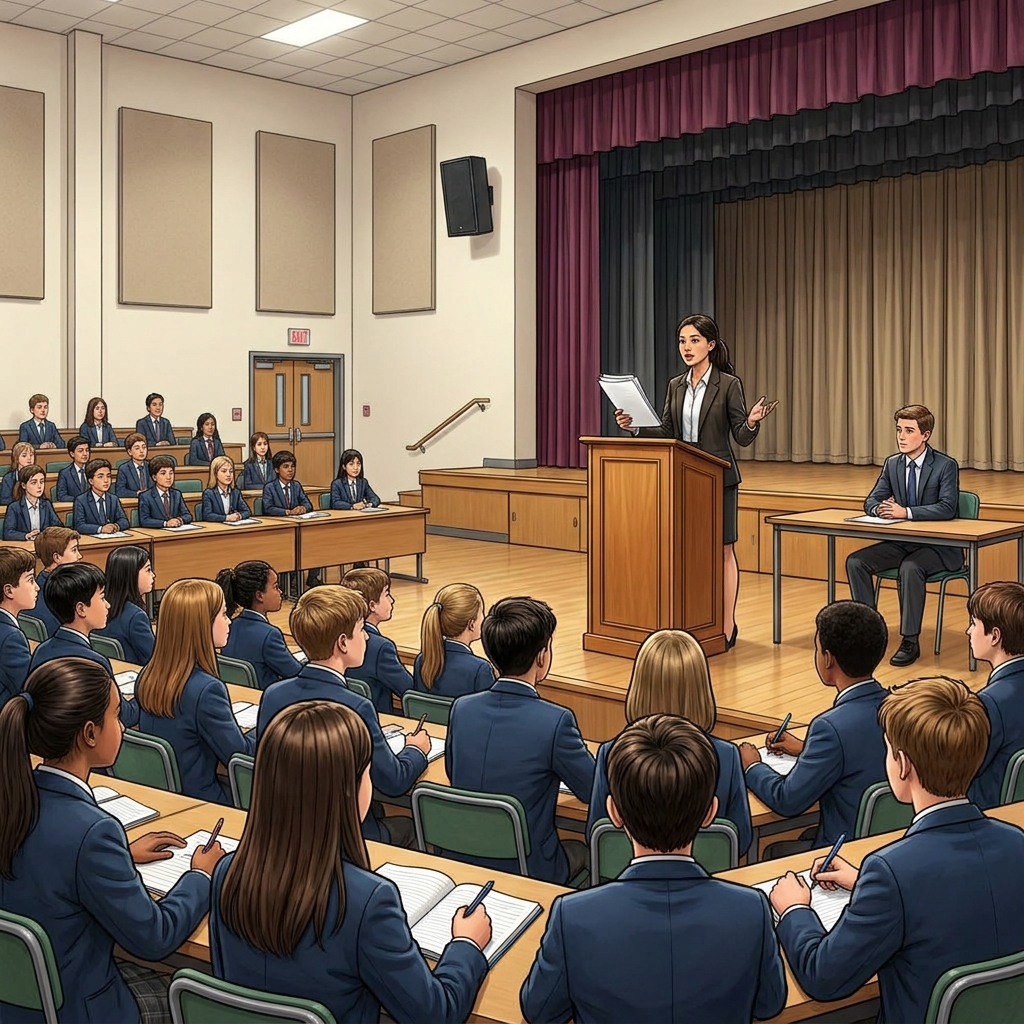
A parent once asked me why their seventh grader seemed so talented at debating their bedtime but struggled to write a single coherent paragraph for a school assignment. It is a common frustration because students often have plenty of passion but lack the tools to structure that passion into a formal argument. This 7th grade ELA lesson helps students move past casual complaining and into the world of structured, persuasive communication. The lesson is straightforward, lasting about 45 minutes, and works well for a whole-class assignment or for a student who needs to catch up on speaking and listening standards.
When you open Constructing and Delivering a Persuasive Speech, you will see a clean arc that starts with prior knowledge. The material asks students to consider the concept of a school uniform policy. It is a classic debate topic because it forces students to weigh the idea of focusing on learning versus individual fashion choices. This sets the stage for the core goal of the lesson, which is to build a persuasive speech by creating a clear thesis and using strong, logical evidence.
How the lesson builds student arguments
The lesson uses a specific example to show how a claim should function. It suggests this sentence: ‘Our school should start a community garden because it provides fresh food and teaches students about nature.’ This is a strong thesis statement because it includes both the main claim and two distinct reasons to support it. To reach this level of clarity, students need to understand three specific terms. First, a thesis statement is defined as a single sentence that clearly states your main opinion or claim about a topic. Second, a counter-argument is an opposing claim that you address and refute to make your own argument stronger. Finally, vocal variety refers to changing the volume, speed, and tone of your voice to keep your audience interested. These definitions are essential for students to use when they prepare their own talks.

This material covers CA.ELA.SL.7.4, the California-adopted standard which asks students to present claims and findings by focusing on salient points with relevant facts and details, while also using appropriate eye contact, volume, and clear pronunciation. The standard also adds a specific requirement for students to plan and deliver an opinion speech that differentiates between and addresses alternate or opposing claims, supported by sound reasoning. This same standard, which includes the related CCSS.ELA-LITERACY.SL.7.4 requirement for presenting claims with coherent descriptions and facts, is taught in San Ramon Valley Unified, San Bernardino City Unified, Sierra Sands Unified, and Turlock Unified to ensure consistency across the state. I find that the hardest part for students is actually addressing the counter-argument. They tend to ignore the other side entirely, so I usually stop them during the planning phase to make sure they can explain why the opposition holds a specific view before they tear it down.
Putting the theory into practice
After the students understand the structure, they move to a guided practice section. Here, they imagine a classmate is giving a speech about why the school should have a longer lunch break. They need to analyze that hypothetical speech to see if the speaker has a clear thesis and if they are using effective delivery techniques. It is a safe, low-stakes way to practice evaluation before they have to stand up and speak themselves. If you are looking for a persuasive speaking lesson for 7th grade to use during a substitute day, this fits the bill perfectly because the instructions are clear enough that students can work through the analysis independently.

The lesson ends by reminding students that this is a life skill. Whether they are convincing their parents to let them stay out later, explaining an idea to a teacher, or advocating for a cause, being able to state a point clearly is a powerful tool. I suggest giving students a few minutes to rehearse their speech in front of a mirror or a partner after they finish the draft. The vocal variety component is often overlooked until they hear themselves speak, so having them record a quick audio clip can make a huge difference in their self-reflection process.
Related lessons

Collaborative Discussion and Adjusting Perspectives, Discussing ideas and adjusting viewpoints in a collaborative group setting

Evaluating Arguments and Evidence, Analyzing how evidence supports claims within a persuasive argument
Building on Ideas in Collaborative Discussions, Developing new ideas by building on peer contributions during discussion