


Breaking down the basics of descriptive language, I find myself constantly reminding the kindergartners that we have more words in our toolkit than just the ones we use for our basic needs. Helping five-year-olds move beyond the simplest nouns requires a bit of gentle nudging, and that is exactly where Using Big Words steps in. This kindergarten English language arts lesson is not about overwhelming children with complex grammar rules, but about giving them the confidence to pick words that actually mean something to the person listening. When we talk about “big, happy words,” we are really just guiding them toward the idea that adjectives are the spice in their sentences.
The standard at play here is CA.ELA.L.K.1, which covers the conventions of standard English grammar and usage. In California, this specific standard expects students to demonstrate command when writing or speaking, and the California addition explicitly calls for the use of frequently occurring adjectives. Whether you are teaching in Moreno Valley Unified, Clovis Unified, McFarland Unified, or Murrieta Valley Unified, the focus is the same: making sure students can describe the world around them in ways that go beyond simple identification.
Walking through the lesson arc
The lesson starts with a simple premise: I can use big, happy words to describe things. It sets a comfortable tone right away. Teachers know that kindergarteners often get stuck using the same handful of words to describe every toy, friend, or snack they see. This lesson provides a bridge between those plain descriptions and more precise language. You begin by prompting students to think about things they like. Maybe a shiny truck, a soft blanket, or a sweet apple. The goal is to get them to recognize that those words, shiny, soft, sweet, do the heavy lifting in their sentences.
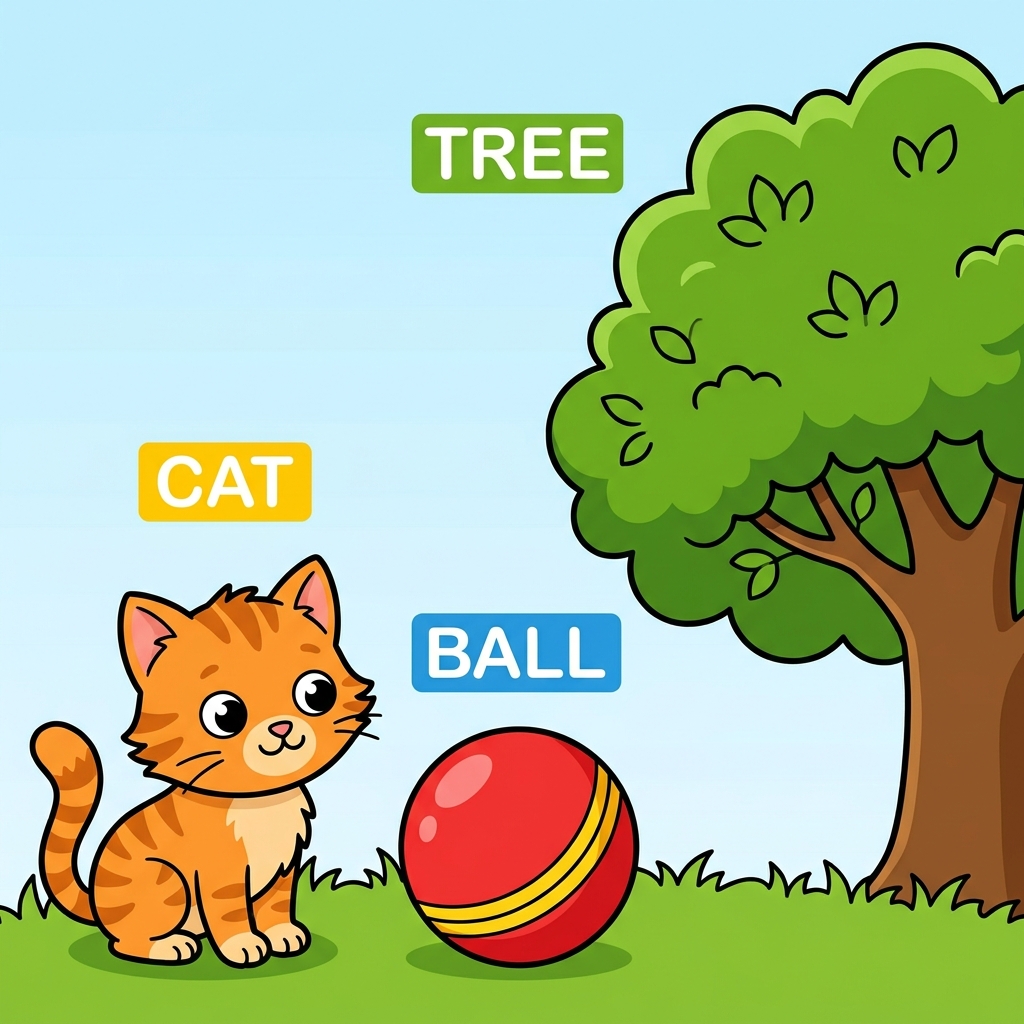
The instructional design here is quite clean. It does not try to lecture the students; it moves them through a process of identifying and then applying those descriptive terms. It is effective because it honors the fact that children are already doing this, they just need the label for it. By focusing on happy words, the lesson keeps the affective experience of the student front and center. When a student chooses a word like “bumpy” to describe an orange or “bright” to describe the sun, they are actively participating in the grammar development that kindergarten vocabulary development aims for.
Refining the practice
The practice section of the lesson provides a structure where students can take those initial thoughts and turn them into full, descriptive sentences. One of the common sticking points I notice is that kids often try to string too many adjectives together, creating a pile-up of descriptors that makes it harder to understand their main point. The lesson helps mitigate this by keeping the focus on individual items and specific attributes. If a student is describing a cat, they might focus on “soft” or “fast” rather than trying to fit every adjective they know into one thought.

I find this material particularly useful for a student who missed the previous week of foundational work or for a teacher who needs a quick, effective whole-class assignment that doesn’t require a massive setup. It is also excellent for independent study settings where you need a learner to practice independently for a few minutes. The pacing is quick, about 15 minutes, which respects the limited attention spans we manage every single day. The lesson does not bog them down in worksheets that require too much writing; it keeps the focus on the actual act of speaking and intentional word choice.
There is a risk, of course, in introducing adjectives this early. Some students might try to overuse them to the point where their actual message gets lost. I suggest using this lesson as a starting point for a conversation about how words change the way we feel about what we are hearing. When you add “happy” words to a sentence, the whole room feels a bit more positive. This is where you can show your students that grammar is not just a dry set of rules but a way to shape their own stories and observations.
If you have students who are struggling with basic sentence structure, don’t rush through the vocabulary part. The beauty of this lesson is that it is flexible. You can pause it, ask the kids to name three more “happy” words that aren’t on the screen, and bring that list back to your classroom wall. By grounding the theory in their lived experience, you make the concept of adjectives sticky. It is one thing to learn the definition of an adjective, but it is entirely another to realize that the words they choose can change how a friend sees their favorite toy. This kind of practice is why I advocate for simple, targeted lessons that focus on the nuts and bolts before trying to move into more abstract linguistic concepts.
Keep an eye on how they use these words during independent writing blocks later in the week. That is the true measure of whether the lesson has stuck. If you see “big, happy words” cropping up in their journals or in their afternoon share-out, you know they have internalized the lesson objectives. The lesson is meant to be a stepping stone toward more complex writing, but for now, let them have fun with the adjectives. It makes the writing feel less like a chore and more like a tool they get to use for their own expression.
Related lessons
New Words and Word Parts, Introduces basic strategies for understanding new vocabulary and word segments
Why Did the Story Happen?, Explores identifying cause and effect relationships in short narratives
How Are They Alike?, Teaches comparing and contrasting items based on visible attributes