

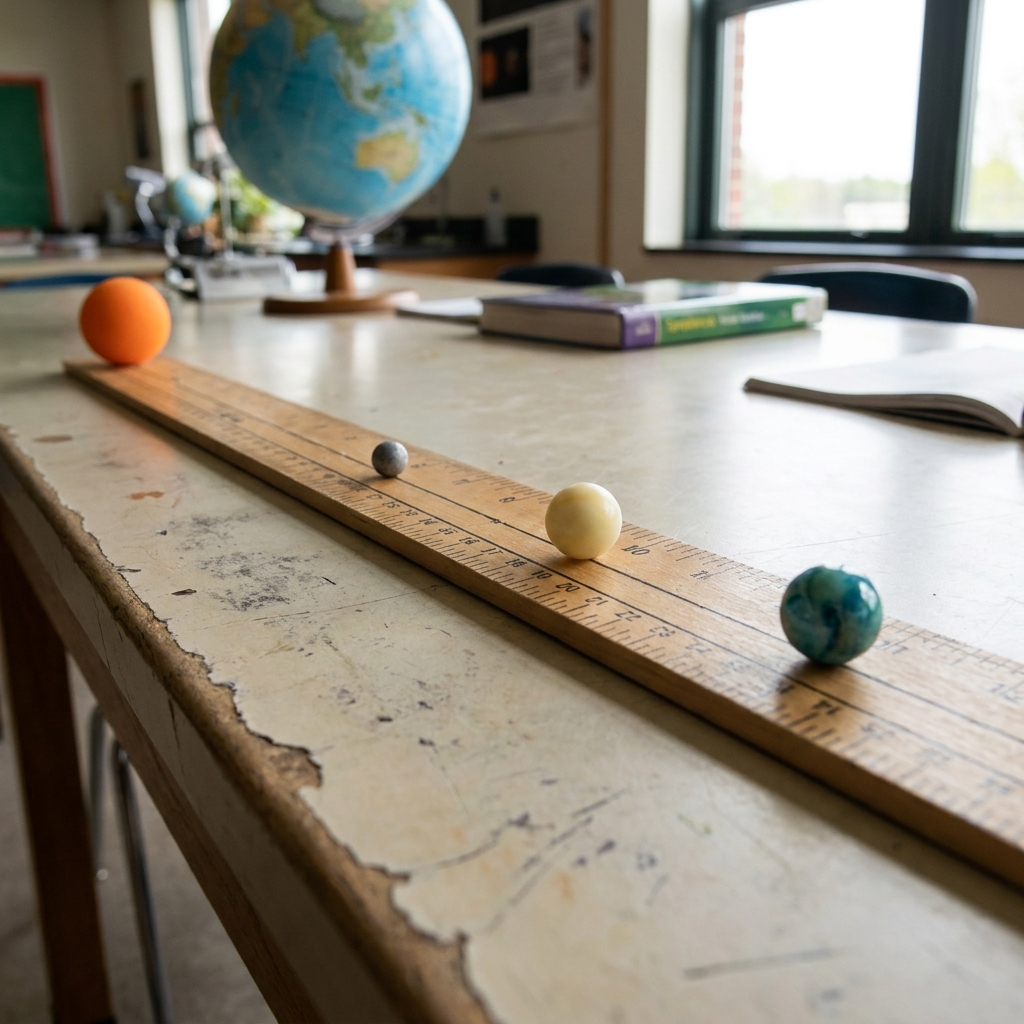
The core objective for this Mapping the Solar System lesson is for students to analyze and interpret data to determine scale properties of objects in the solar system. This is the exact language of the standard MS-ESS1-3, which serves as the anchor for middle school Earth and Space Sciences. When we ask students to analyze and interpret data, we are asking them to move beyond mere memorization of planetary diameters and actually grapple with the physical truth of space. In California, these concepts are part of an integrated science model that weaves together physical and Earth sciences. This approach to the standard is consistent whether you are teaching in Sacramento City Unified, Riverside Unified, Ukiah Unified, or Ceres Unified. The lesson also incorporates the specific California addition to the standard known as CA.MS-ESS1-3, which contextualizes these scientific concepts within the broader framework of California phenomena such as diverse ecosystems and water systems.
How students grasp planetary scale
Seventh grade science is a key time to introduce this, because students are finally comfortable enough with math ratios to apply them to abstract physical concepts. The lesson defines a scale model as a representation of an object that keeps the same proportions as the real thing, even if the size is much smaller or larger. This is exactly what scale modeling in science requires: the ability to shrink the impossible scale of the universe down to the size of a classroom desk or a hallway.

The mechanics of space modeling
The lesson begins with a conceptual hook that uses everyday objects to make sense of the massive differences in planetary size. By comparing the Earth to a small marble and Jupiter to a large basketball, students can visualize the size disparity instantly. This is the kind of practical, concrete thinking that helps a student who usually feels alienated by abstract astronomy. The lesson then pushes into guided practice, where students use a table of planetary diameters to rank them by relative size. You will see students realize that the gas giants are truly immense compared to our rocky inner neighbors.

The material introduces three essential vocabulary terms that you should reinforce throughout your unit: scale model, astronomical unit, and ratio. A ratio is a way to compare two different quantities by showing how many times one value contains or relates to another. Without this skill, the lesson falls apart. If your students cannot calculate a ratio, they will not be able to build a model that actually makes sense. I have found that students often try to guess the distances rather than doing the math. This lesson forces them to show their work because they must use the astronomical unit as their primary unit of measurement. An astronomical unit is a unit of measurement equal to the average distance between the Earth and the Sun. By centering the unit on this distance, the lesson creates a baseline that makes interplanetary distances manageable.
The why-it-matters section of the material notes that NASA engineers use these models to plan the paths of spacecraft. They calculate exactly where a planet will be when a spacecraft arrives. This is the hook for students who want to know why they have to bother with math in a science classroom. When a student sees that a tiny calculation error in a scale model could mean a multi-million dollar rover misses its destination, the motivation to get the ratios correct usually spikes. You can use this lesson as a whole-class assignment, a project for a student who missed the previous week of instruction, or as a productive, independent study module for those who need to catch up.
The biggest hurdle in this lesson is the shift in perspective. We spend so much time looking at textbook diagrams where planets are spaced evenly that we forget they are actually spread across a vast, mostly empty void. This lesson effectively breaks the myth of the tightly packed solar system. If students do not master this scaling skill now, they will struggle significantly when you later cover gravity, orbital mechanics, or the reasons for seasons. If they cannot visualize the empty space between objects, they will not understand why gravity functions the way it does at various distances. It is a foundational shift that creates the necessary mental space for more complex physics later in the year.
Use this for a substitute day if you are away, as it is self-contained enough that students can work through the definitions and the ranking table without much intervention. It is also an excellent option for attendance recovery because it requires active thinking rather than passive reading. The lesson is straightforward and fits well into the middle school curriculum, provided you have enough space to spread out if you choose to take the modeling beyond the desk-top level. It is a solid, focused piece of curriculum that does one thing well: it demands that students respect the sheer, intimidating scale of our solar system.
Related lessons
Earth's Moving Air and Water, Studies the movement of air and water in Earth systems
Reading Earth's History in Rock Strata, Explains how to interpret geologic history from rock layers
Human Impact on Earth's Systems, Examines how human activity alters natural Earth and space systems