

This lesson is for the sixth grader who missed equivalent expressions the first time, whether because of absences, a rough week, or a unit that moved faster than they did. If you are a counselor, an intervention teacher, or the person coordinating independent study, and you have a student whose math teacher flagged expressions as a gap, this is a reasonable thing to hand them. It is short, it is focused on one idea, and it does not assume the student remembers much beyond arithmetic.
The lesson is Understanding Equivalent Expressions, part of the Math 6 course in the Expressions and Equations strand. It runs about 45 minutes, which means a student can finish it in a single study block or one intervention period without it bleeding into the next day. That matters more than people admit. A lesson that takes three sittings often never gets finished.
What the lesson actually asks students to do
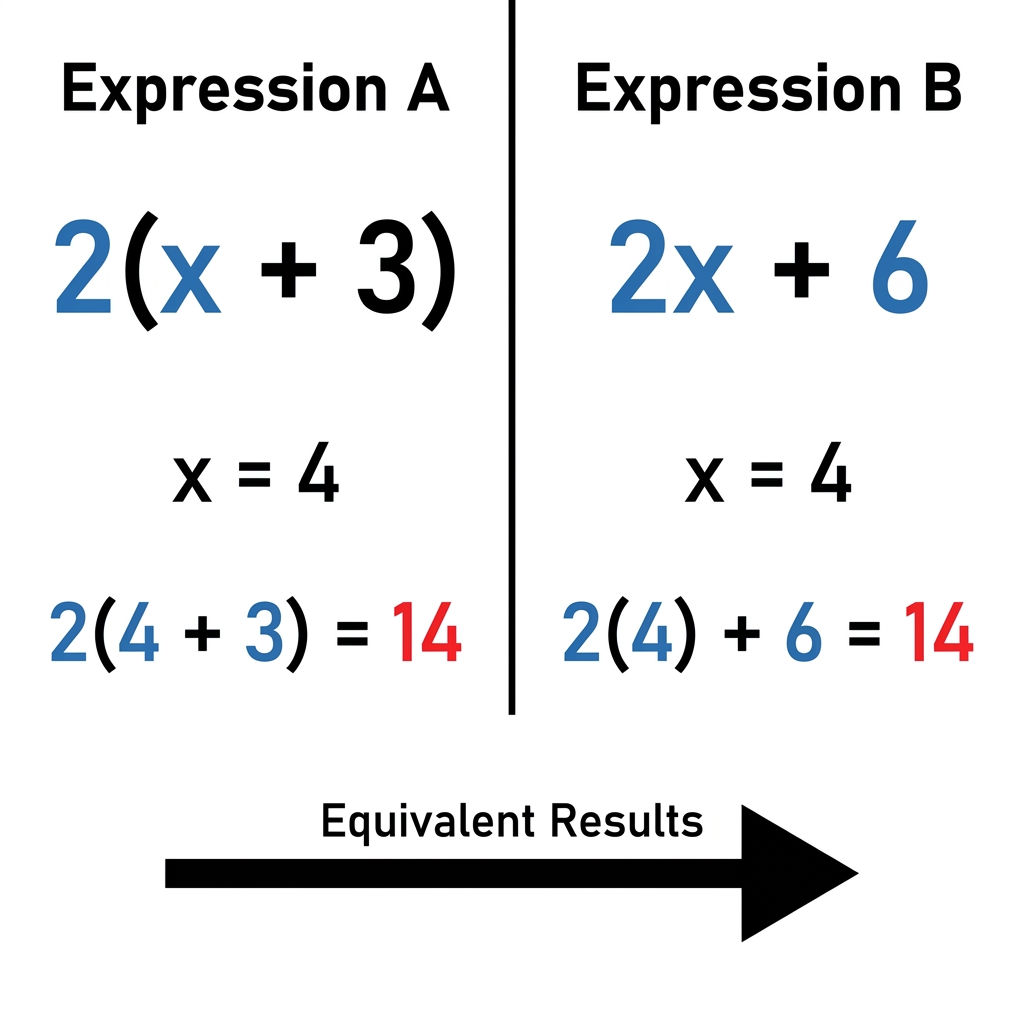
The whole lesson rests on one move: substitution. Students learn that two expressions are equivalent if they produce the same value no matter what number you put in for the variable, and the way they check is by plugging in numbers and comparing results.
It opens by reminding students of something they already know from arithmetic, that the same total can be written different ways. There is a brief scene set in a small farming village by a river, where a farmer is gathering bundles of wheat before the harvest. It is a light touch, and it gives the bundles-of-something idea a concrete picture before the letters show up.
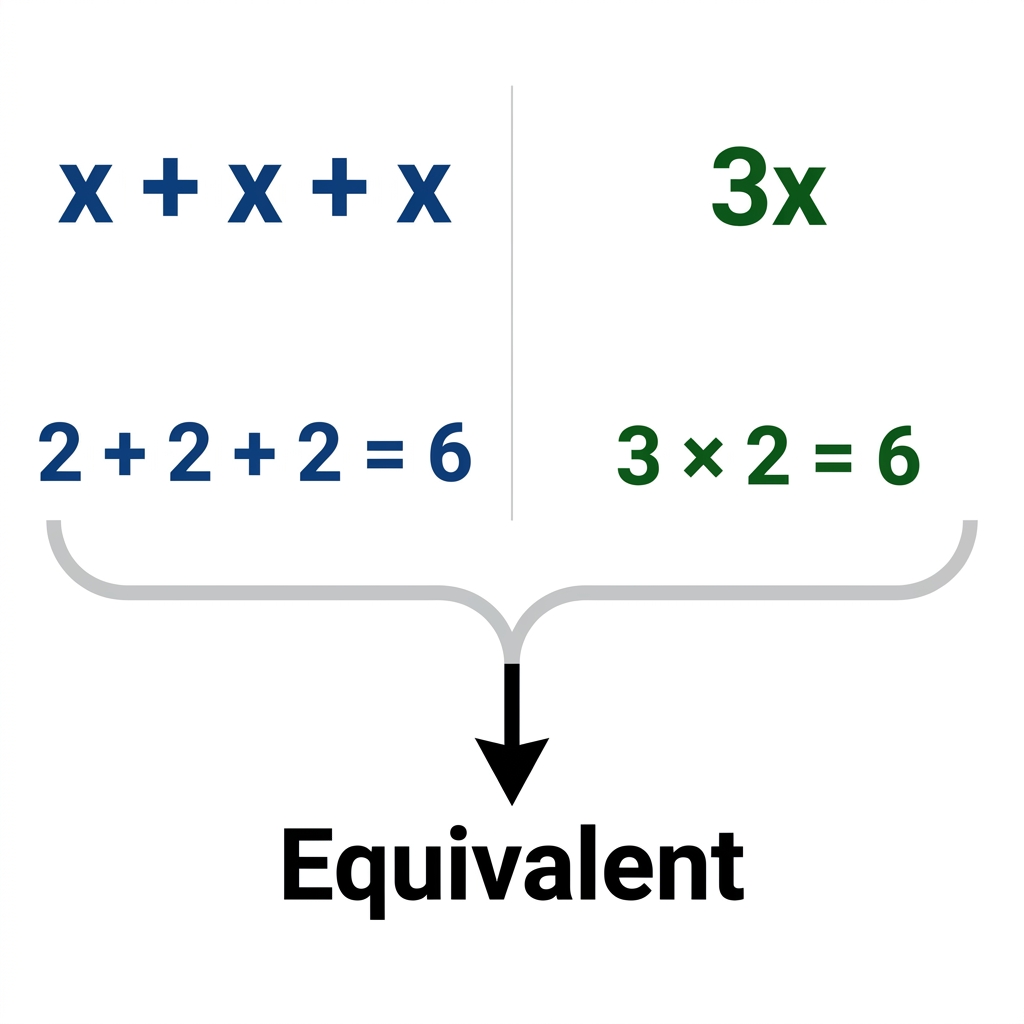
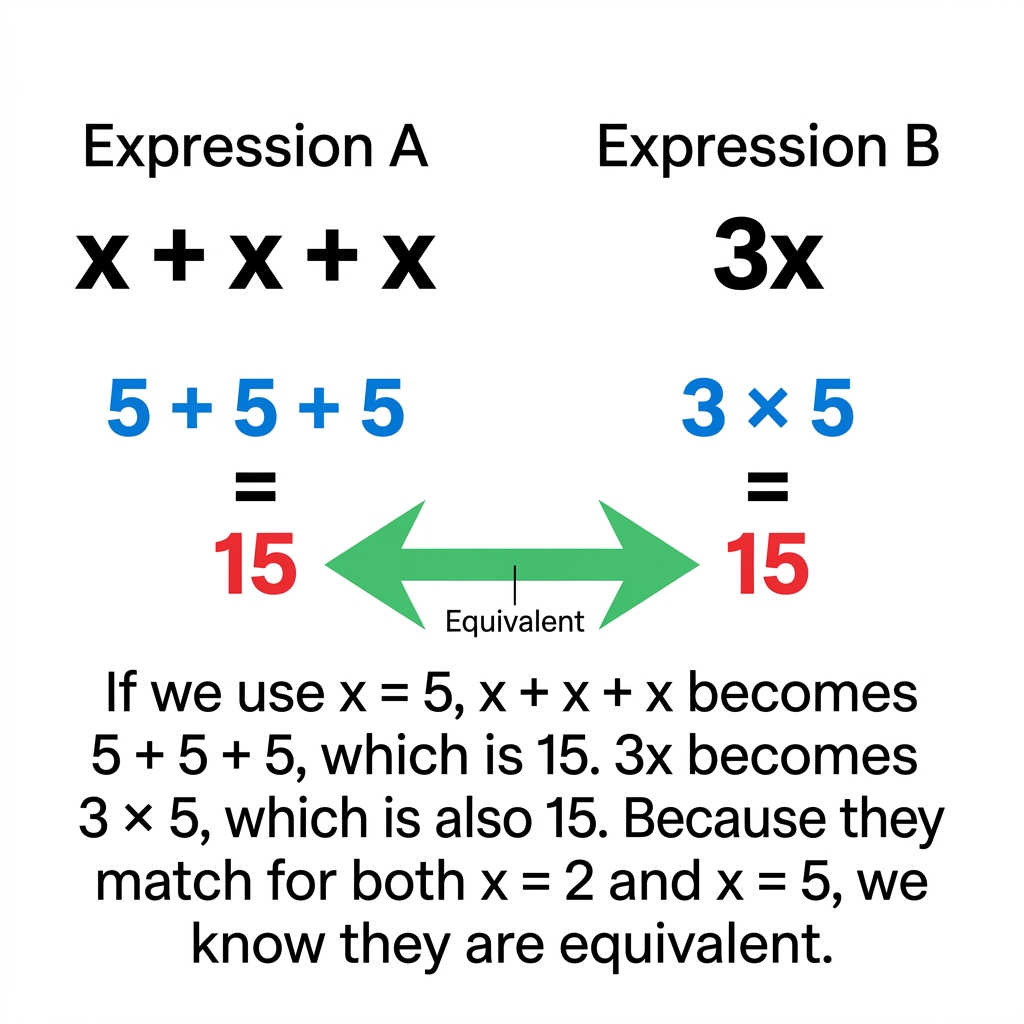
The worked example uses x + x + x and 3x. With x = 2, the first becomes 2 + 2 + 2, which is 6, and the second becomes 3 times 2, also 6. The student sees the two expressions land on the same number and draws the conclusion.
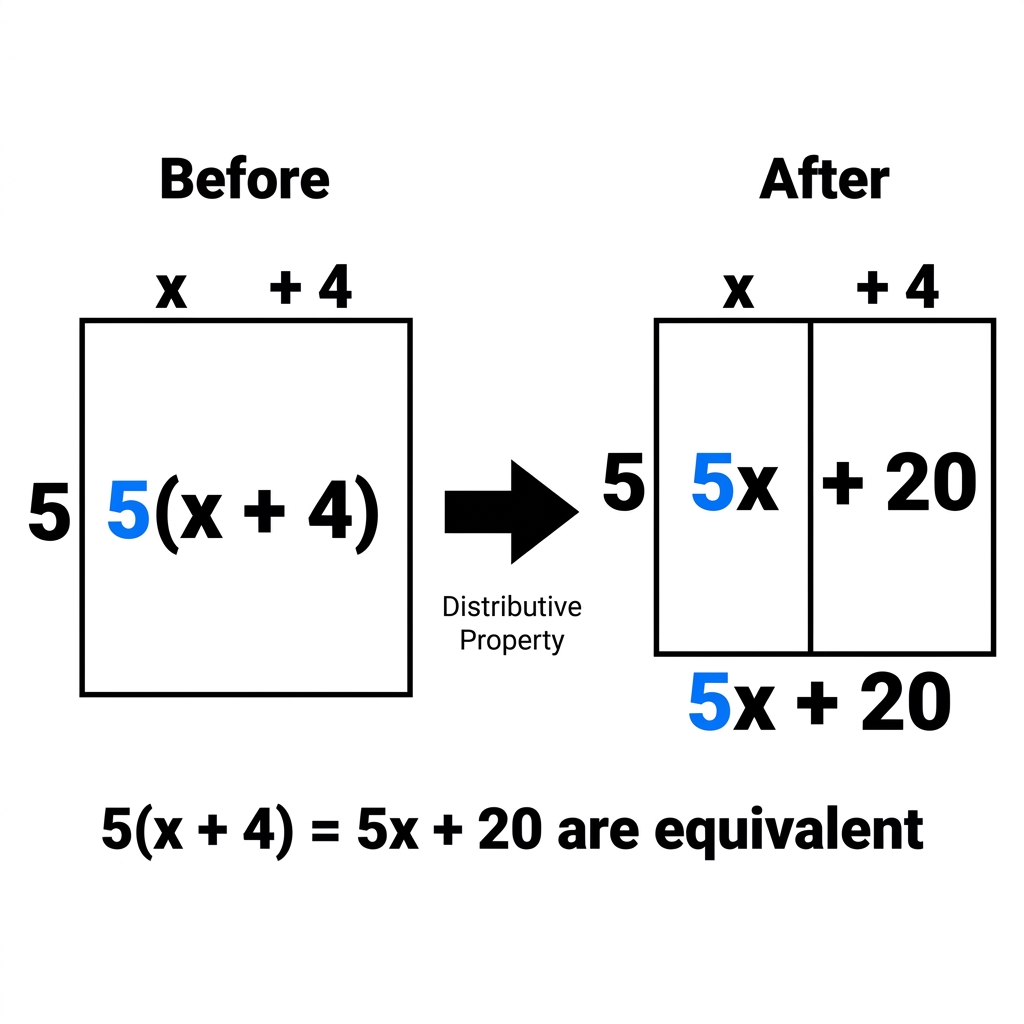
Then the guided practice turns it around. Students check whether 5(a + 1) is equivalent to 5a + 1. This is a good choice, and I suspect it was a deliberate one, because it is exactly the mistake sixth graders make when they first meet parentheses: they multiply the 5 by the a and forget the 1. Substituting a = 1 makes the problem obvious. The first expression gives 5 times 2, which is 10. The second gives 5 plus 1, which is 6. Different numbers, so not equivalent. A student who does that calculation honestly will feel the distributive property working, even before anyone names it.
The vocabulary is kept to three terms, all defined in plain language:
- equivalent expressions: expressions that name the same number regardless of which value is substituted into them
- variable: a letter or symbol that stands for a number
- substitution: replacing a variable with a specific number to find the value of an expression
The lesson closes with a short note on why this matters outside school, using the example of adding up party costs two different ways and getting the same total. It is a modest connection, and it does not oversell itself.
The standard behind it, and one thing to watch
The lesson is built on CA.MATH.6.EE.4, the California Common Core math standard for identifying when two expressions are equivalent. In plain terms, the standard wants students to understand that equivalence means the two expressions name the same number for every possible value of the variable, not just for one convenient choice. Its own example is y + y + y and 3y, nearly identical to what the lesson uses. The standard sits in the cluster about applying and extending arithmetic to algebraic expressions, which is a fair description of what is happening here: students are taking the rules they trust with numbers and using them with letters.
This is a statewide expectation. A sixth grader in Moreno Valley Unified, Mt. Diablo Unified, Glendale Unified, or Porterville Unified is working toward the same standard, so a student who transfers in or out mid-year is not stepping into a different set of goals.
Now the caveat, and it is a real one. The worked example checks a single value, x = 2, and concludes the expressions are equivalent. That is fine for x + x + x and 3x, which truly are equivalent, but one matching value does not prove equivalence in general. Consider 2x and x times x. At x = 2, both give 4. At x = 3, one gives 6 and the other gives 9. A student who only ever tests one number can be fooled.
Testing is great for proving two expressions are not equivalent, since a single mismatch settles it, as the 5(a + 1) problem shows. Proving they are equivalent takes more than a spot check. If you are supervising the student, ask them to try two or three different values, and ideally to explain why the expressions match, for instance that x + x + x is three x’s, which is what 3x means. That conversation takes two minutes and closes the gap the lesson leaves open.
Where it fits and how to use it
I would reach for this lesson in three situations. First, as an intervention piece for a student whose classroom teacher has already taught EE.4 and needs it reinforced before the class moves on to writing and solving equations. Second, for a student who missed the week entirely and needs the core idea without sitting through a full unit. Third, for independent study, where a single, clearly bounded 45-minute lesson is easier to assign and check than an open-ended packet.
It is less suited as a first introduction for a whole class, partly because of the single-value issue above. A classroom teacher introducing the idea would probably want more examples and more discussion than one worked problem and one practice problem.
For passing completion back to the student’s math teacher, the guided practice gives you something concrete to look at. Ask the student to show their substitution for 5(a + 1) and 5a + 1, the numbers they plugged in and the values they got. If they can show both, explain that the expressions are not equivalent, and tell you why the first one comes out bigger, that is solid evidence they have the standard. Send that work along with a note about whether they tried more than one value. It tells the classroom teacher far more than a checkmark would.
If you have a sixth grader who needs equivalent expressions again, open the sixth grade equivalent expressions lesson and work the 5(a + 1) problem yourself first. You will know in a minute whether it is the right fit for that student.
Related lessons
Understanding Equivalent Expressions, Testing whether two expressions name the same number
Writing and Evaluating Algebraic Expressions, Writing algebraic expressions and finding their values for given numbers
Understanding Inequalities, An introduction to inequalities and what they represent