

…which is why I keep coming back to the same point about second graders and story questions. The problem is almost never that they can’t answer. They answer fast. Ask a room of seven-year-olds who is in the story and every hand goes up, and a good share of those hands are attached to an answer that came from somewhere other than the page in front of them.
That is the wrong turn this second grade English language arts lesson is built around. Students answer from memory, from a cartoon version they saw once, or from what they figure usually happens in stories like this one. Or they grab the first detail that pops into their heads (the bear was brown, the rabbit had long ears) when the question was really asking about something that matters to the plot. The lesson is called Asking Questions About Stories, and its whole design pushes kids back to the text and the pictures for their evidence.
Why the wrong answer feels right to a seven-year-old
Think about what we ask second graders to do all day in reading. Retell. Share. Tell me about the story. For a lot of kids, knowing a story and having just read it feel like the same thing, and when the story is a famous one, they may have known it long before the book was opened.
Then there are the illustrations. Picture books at this level are vivid, and a child who glances at a page can come away with a dozen details. None of those details is wrong exactly. They just aren’t all equally important, and a second grader has no built-in filter for deciding which ones count.
The third piece is the question words themselves. Who and where are fairly concrete. Why and how invite guessing. A student asked why something happened will often supply a reason that sounds sensible to them rather than the reason the story gives. I don’t think that’s laziness. It’s a seven-year-old doing what seven-year-olds do, which is fill gaps with whatever makes sense.
How the lesson heads it off
The lesson opens by setting up the right mental posture before any question gets asked. Reading is framed as detective work: you are searching for clues. The opening image is a boy combing a park for his lost dog, holding a sign that says Missing. I like this choice a lot. A kid looking for a lost dog doesn’t care about every bench and tree in the park; he’s looking for the clues that will find the dog. That is exactly the filter we want students to bring to a story.
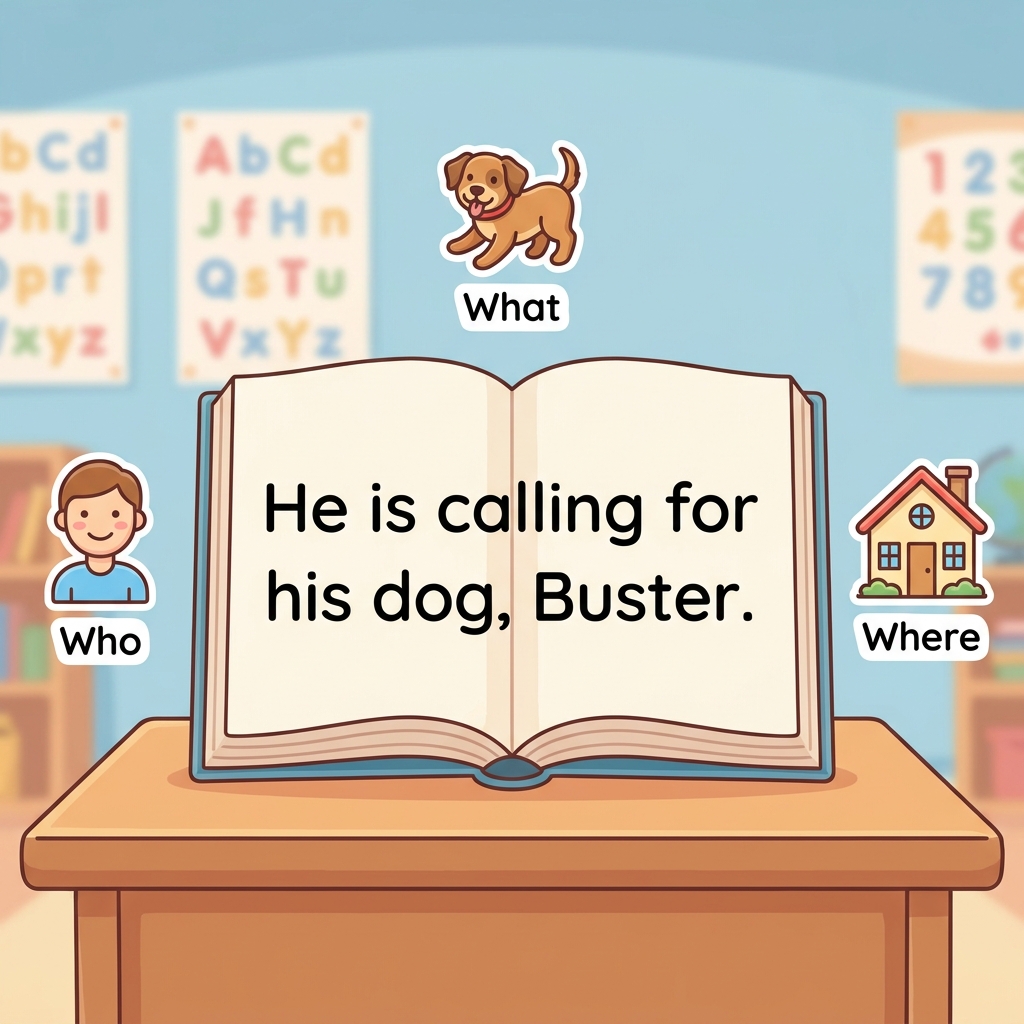
Then the lesson names what it’s looking for. Its core idea is stated plainly: “Key details in a story are the important facts that tell us who is in the story, where it happens, and what is happening.” Notice that the definition is tied to who, where and what. It gives students a short checklist for sorting a detail that matters from one that just happens to be on the page.
The worked example is where the anti-guessing work really shows. A bear finds honey in a forest, and the lesson points out that the tall trees and the beehive are what tell us the setting is a forest. That move, connecting an answer to the specific thing in the text or picture that proves it, is the habit the whole lesson is trying to build. The answer isn’t just forest. It’s forest, because of the trees and the hive.
Guided practice uses the famous fable about a turtle and a rabbit. This is a smart and slightly risky pick, and I mean that as a compliment. Plenty of your students will think they already know this one. That makes it the perfect place to practice the discipline of going back to the passage, because the temptation to answer from memory is right there. If a student can stick to the text on a story they think they know cold, they’ve learned the skill.
Two vocabulary terms carry the lesson:
- Key details: the most important pieces of information in a story, the ones that help us understand the plot
- Plot: the sequence of events that make up the story
The lesson closes the loop with a reason this matters outside reading class: a news reporter has to gather the facts to tell a complete story, and anyone reading news or messages has to find the key details to know what’s going on. Second graders like the reporter idea. It gives them a grown-up job to imagine while doing a kid-sized task.
One honest caveat. This is about a 45-minute lesson, and one fable is one fable. The why and how questions will still produce some creative guessing after a single session. Plan to keep asking “how do you know?” during read-alouds for weeks afterward. The lesson gives you the language and the routine; repetition does the rest.
The standard, and where this fits
The lesson is aligned to CA.ELA.RL.2.1, the California Common Core standard in Reading: Literature, under Key Ideas and Details. It asks second graders to ask and answer who, what, where, when, why and how questions to show they understand the key details in a text. California added a sentence that matters a great deal for this age: students should use information from both the illustrations and the words, in print or digital texts, to show they understand characters, setting and plot. The bear and beehive example is that California addition in action, since the picture does real work in answering the question.

The same lesson page also covers CCSS.ELA-LITERACY.RL.2.1, the national Common Core version of this standard. It’s the core question-asking expectation without the California sentence about illustrations, so you’re looking at one standard with two layers, and the lesson handles both together.
A second grade teacher in Chino Valley Unified, Poway Unified, Etiwanda Elementary School District or Kings Canyon Joint Unified is working from this exact standard, as is every second grade classroom across California.
As for how to use it: it works well for a student who missed the week and needs to catch up on the routine the rest of the class is already practicing, since the detective framing and the worked example stand on their own. It’s a natural fit for reading intervention, especially with kids whose comprehension answers drift away from the text. And because the lesson carries its own explanation, examples and practice passage, it’s a reasonable choice for a substitute day when you want real instruction to happen instead of a worksheet.
If you have students who answer story questions confidently and wrongly, this second grade asking and answering questions about stories lesson is where I’d start. Watch what happens when they hit the turtle and the rabbit and realize they have to prove it.
Related lessons

Using Descriptive Words to Tell a Story, Choosing descriptive words to make a story more vivid
Finding the Moral of a Story, Identifying the lesson or moral a story teaches
Understanding Stories with Words and Pictures, Using both text and illustrations to understand a story