

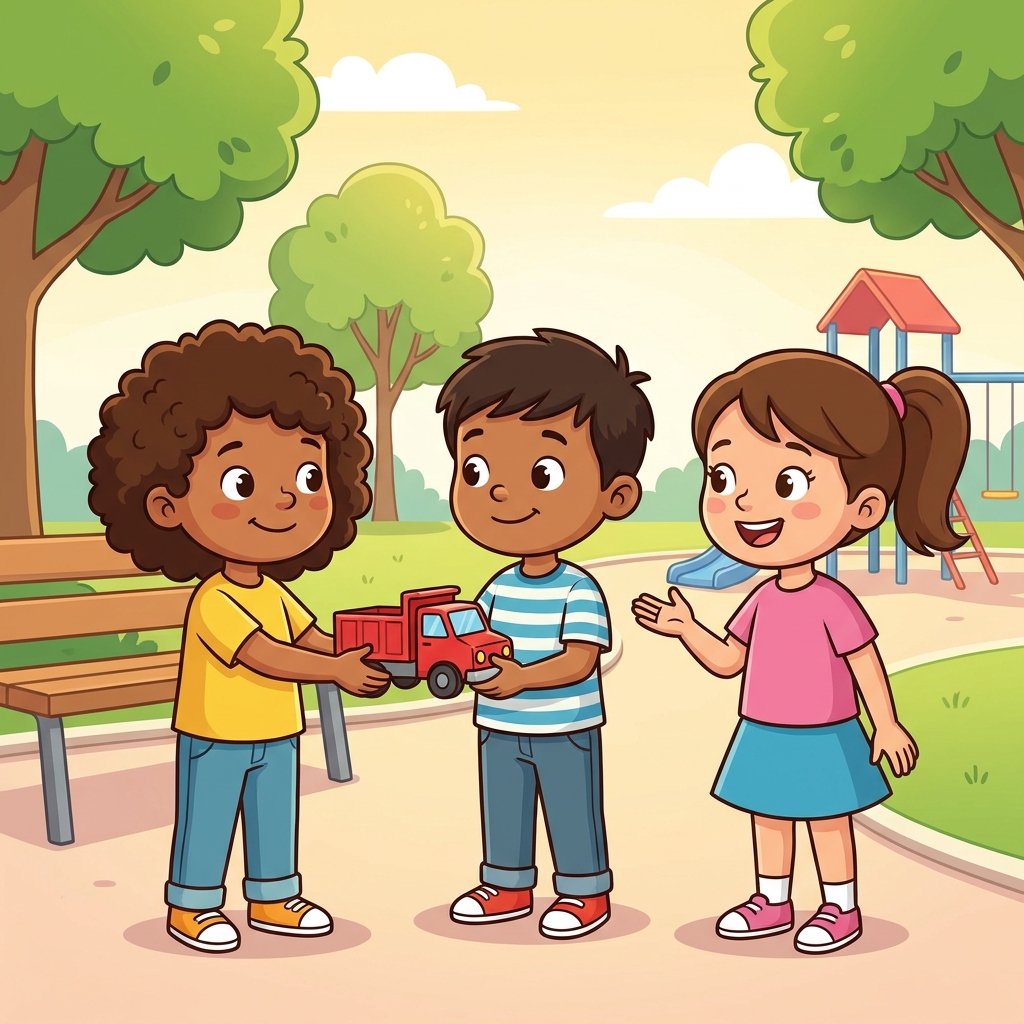
One toy. Two kindergartners who both want it. That is the whole setup behind the objective of this lesson, which reads, in kid language, “I can share toys to be a good citizen.” If you have taught five-year-olds for more than a week, you already know this scene, and you know the hard part is rarely the sharing itself. It is getting the child to say, out loud and in words, what they want and how they feel about it.
That is why Sharing is Caring sits in the Kindergarten English Language Arts course and not in a social studies unit. It looks like a citizenship lesson. It is really a speaking lesson in kindergarten ELA, and planning it that way changes how you run it.
What the lesson asks of students
The content is simple on purpose: sharing toys is something a good citizen does. Kindergartners can hold that idea without much effort. What the lesson is actually after is the language around it. Students are asked to express a thought (I want a turn), a feeling (I feel sad when I don’t get one), and an idea (we could take turns), and to say those things clearly enough that the other child, and the teacher, can hear them.
The standard here is CA.ELA.SL.K.6, which asks kindergartners to speak audibly and express thoughts, feelings, and ideas clearly. It is a California-only addition to the Speaking and Listening strand of the California Common Core standards for English language arts, meaning the state went beyond the national version and wrote speaking expectations into kindergarten explicitly. I like that it does. Audible speech is something we tend to assume rather than teach, and the quiet child in the back row gets passed over because of it.
The same expectation applies in every California kindergarten classroom, so a teacher in Elk Grove Unified, Clovis Unified, Mountain Empire Unified, or North Monterey County Unified is working toward the identical standard you are.
Where the fifteen minutes go
The lesson runs about 15 minutes, which is right for this age and tight for this skill. My advice: spend very little of that time explaining what sharing is. They know. Every one of them has been on both sides of a toy dispute.
Put the time into turns at talking. If a student only listens for fifteen minutes, they have done the citizenship part and skipped the standard. The point is that each child says something, in a full voice, about sharing. Even one sentence per student counts. With a large class, pair talk lets more mouths move at once, and you can circulate and listen.
Save a minute or two at the end for a couple of students to say their sentence to the whole group. That is where “audibly” gets real practice, because a voice that works with a partner often shrinks in front of twenty classmates.
What to watch for during guided practice
Three things tend to come up.
First, the mumble. Some students will give a perfectly good answer at a volume only their shoes can hear. Don’t repeat it for them. Ask them to say it again so their friend can hear. Modeling a “big voice” versus a “tiny voice” helps more than telling them to speak up.
Second, feelings words. Kindergartners often default to “good” or “bad.” If a student says sharing makes them feel good, that is fine, and it is also a chance to offer a sharper word like happy, proud, sad, or mad, then let them try it in their own sentence.
Third, the gesture answer. A student points at the toy or grabs it instead of asking. That is the exact moment the standard is about. Pause and give them the frame: “Can I have a turn?” Then have them say it themselves.
One honest caveat. The lesson does not do the speaking for you. If it is played while the class sits quietly, students will absorb a nice message about sharing and get very little speaking practice. The talking has to be built in by whoever is running it.
Who it fits besides the whole class
It works as a whole-class lesson early in the year, when routines around toys and centers are still forming and you want language to go with them. It is also a sensible pick for a substitute day: short, low-prep, and the topic is familiar enough that a sub does not need background to run it. Ask the sub to have every child say one sentence about sharing, and you have kept the standard alive.
It also fits a student who missed the week. Fifteen minutes with an aide or with you at a small table, plus a few spoken sentences, covers the same ground.
If you are planning your first weeks and want a short kindergarten speaking and listening lesson that connects classroom behavior to oral language, this is a good one to open, and a good reason to make sure every student hears their own voice at full volume before the fifteen minutes are up.
Related lessons
Action Words, Introduces verbs as words that name actions
Retelling Stories, Practicing retelling a story's events in order
Story Friends, Getting to know the characters who appear in stories