

We are well into the semester, and that means looking for ways to shore up understanding for students who missed the earlier, foundational units on the expansion of the United States. If you are an intervention coordinator or a counselor looking for a bridge back to the curriculum, Immigration and the Growth of American Cities is a solid choice for any 8th grade student who needs to catch up on the social and economic shifts of the mid-1800s. It fits right into the broader narrative of the era and keeps the focus strictly on the causal relationship between overseas events and our domestic infrastructure.
This lesson hits the requirements set out in the California-adopted standard CA.HSS-8.6.3. This standard asks for two main things: an identification of the reasons behind Northern European immigration and a descriptive analysis of how the resulting population influx altered the size and spatial arrangement of American cities. Whether students are in Capistrano Unified, Ontario-Montclair School District, Bassett Unified, or Sierra Sands Unified, the core historical requirements for this era remain the same. The lesson addresses the standard by walking students through the push factors, like the Great Irish Famine, and the pull factors that lured people to urban centers.
What the lesson actually asks students to do
The lesson starts with a simple concept to ground the abstract idea of migration: a small farming village losing its primary source of food. By using this, students identify the push factor as a negative condition that forces movement. It clarifies that a push factor is a negative condition at home, such as famine or lack of jobs, that forces people to leave their country. On the other hand, a pull factor is a positive condition in a new place, such as available land or factory work, that attracts people to move there. The clear contrast between these two terms is what makes the 8th grade immigration and urbanization lesson effective for students who may have struggled with this concept in a standard lecture format.

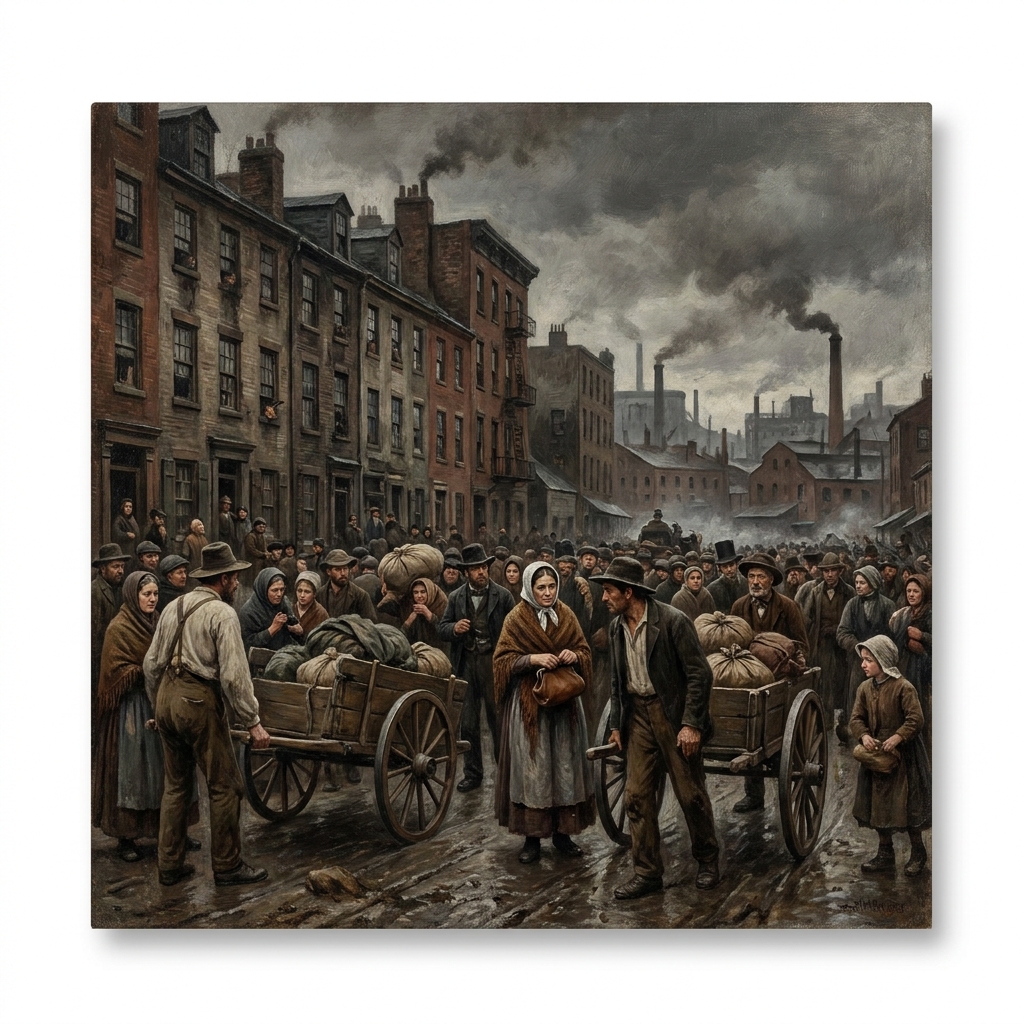
The worked example covers the Irish Famine of the 1840s, explicitly showing how the movement of millions of people into places like New York City necessitated rapid changes in housing. It introduces the term tenement, which is defined as a crowded, poorly maintained apartment building often used to house many immigrant families in a small space. The lesson explains that this rapid influx of people caused the city to expand quickly, which is a clear example of urbanization. Urbanization is defined as the rapid growth of cities as more people move into them to find work and housing. The student is not just reading a list of facts; they are tracking a sequence of cause and effect.
Where students slip
The trickiest part for many 8th graders is the spatial aspect of urbanization. It is easy to understand why people left, but harder to grasp how that affected the actual physical map of the city. During the guided practice, the lesson moves to the North End of Boston in the 1850s. Students must look at how the physical environment, the cramped, shared spaces, acted as a constraint on the growth of the city. I find that students often confuse the cause of migration with the result of urbanization. They might blame the tenement conditions for the migration itself rather than recognizing those conditions as an outcome of the sudden, massive arrival of people. Taking the time to tease apart that difference is where the real learning happens in this activity.
The lesson also includes a section on why this matters, focusing on how urbanization shapes the planning of cities. It connects historical housing and transportation issues to modern decision-making about community infrastructure. This is useful for intervention or independent study, as it provides a concrete reason for why they are studying these old urban layouts. It makes the history feel less like a closed chapter and more like a lesson in how cities function today.
Using this for intervention or independent study
This lesson is well-suited for a student who missed the week of instruction or for an independent study session because it provides all the necessary reading and context in one place. It takes about 45 minutes, making it a manageable task for an intervention block or as a make-up assignment for attendance recovery. The language is direct and keeps the student focused on the definition of terms like push factor, pull factor, and tenement. For an educator monitoring progress, this is a clean way to ensure the student understands the primary causes and effects of the mid-19th-century migration wave without needing a separate textbook or supplemental reading. You get a clear, concise view of their understanding of how urban environments evolved through that specific period of history.
Related lessons

Federal Authority and States' Rights: Webster and Calhoun, Discusses the debate over federal authority versus individual states rights

The Reconstruction Amendments: Redefining Citizenship, Explains the impact of the constitutional amendments on citizenship status
Moving Forward: Migration After the Civil War, Analyzes the patterns of population movement following the American Civil War