

I remember sitting with a student who was staring at a painting of a turbulent sea and asking why the artist chose those specific jagged brushstrokes instead of just writing out a description of the storm. It is a common moment in high school English 9 classes. We want our students to stop treating words and images as separate silos and start seeing them as different tools for the same job. The Comparing Visual and Textual Representations lesson is built specifically to bridge that gap.
This lesson starts by grounding students in what they already know. Most students are comfortable talking about how an author uses words, so the material pivots from that prior knowledge into how artists use colors or shapes to achieve similar emotional or narrative effects. Whether it is a painting or a poem describing a shipwreck, the lesson pushes students to consider that every creator makes a choice about what to keep in the frame and what to leave out.
What the lesson actually asks students to do
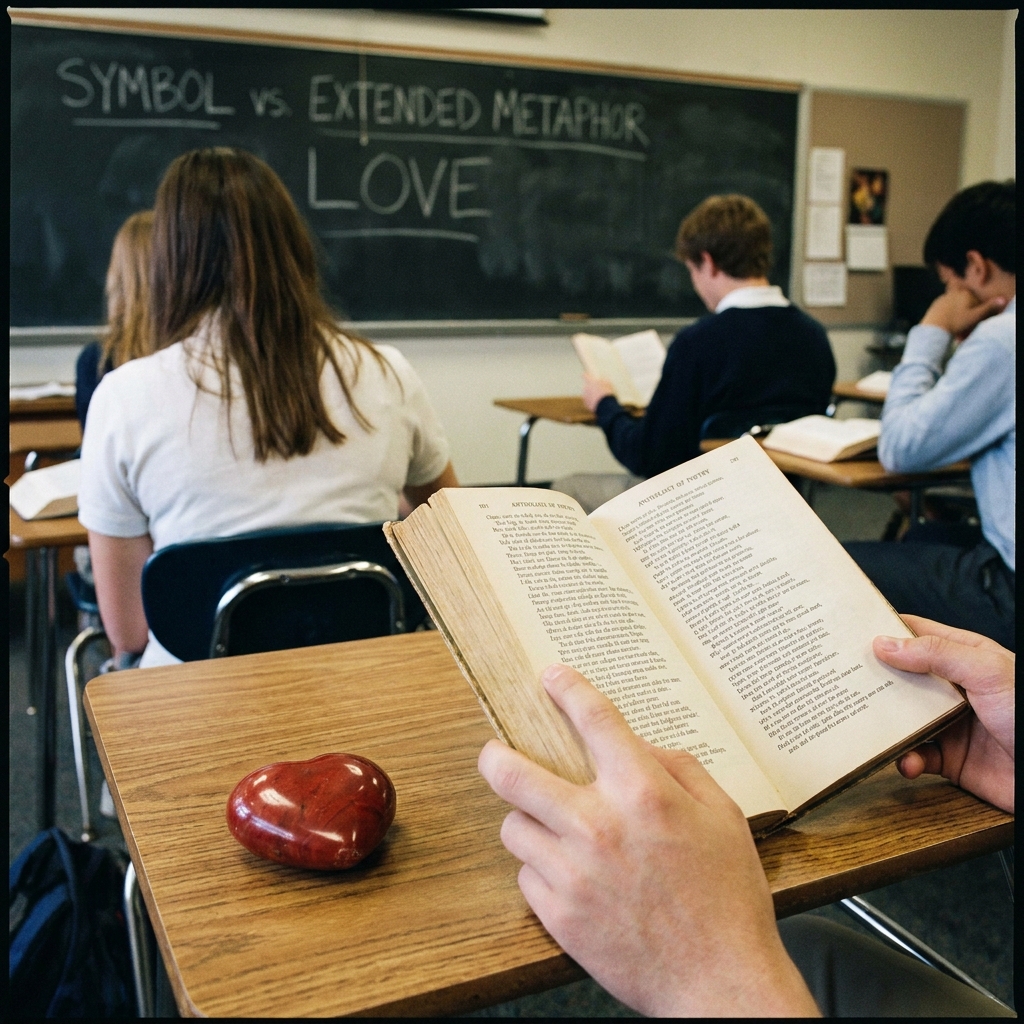
The core of this high school media analysis lesson is the concept of media analysis. It defines a medium as the specific material or channel used for communication, such as a painting or a written text. To move beyond surface observation, the lesson asks students to identify what a creator decides to emphasize, which is to give special importance or prominence to a specific part of a work. It also introduces the idea of diction as the choice and use of words and phrases in writing. Students examine a simple worked example: comparing a red heart symbol to a poem about love. The icon communicates quickly through a universal shape, while the poem uses detailed prose to unpack how love feels over time. It is a quick way to show that neither is inherently better, just different in their utility.
The standard at play here is CA.ELA.RL.9-10.7. This California-adopted standard asks students to analyze the representation of a subject or a key scene in two different artistic mediums and identify what is emphasized or absent in each treatment. It also aligns with CCSS.ELA-LITERACY.RL.9-10.7, which adds the requirement that students look at the specific tools each medium utilizes to convey its message. Teachers in Long Beach Unified, Sacramento City Unified, Fillmore Unified, and Sequoia Union High School District all use this same standard to help students sharpen their critical reading skills across different platforms.
Practical application and classroom fit
I appreciate that the lesson does not just stop at theory. During the guided practice, the class examines a battle site through different forms of historical documentation. It forces them to reconcile the visual evidence with the textual account. This is where you might notice a limitation: some students struggle when the media are too disparate in tone. You may need to provide a bit more scaffold for students who find it difficult to move between abstract visual symbols and concrete written text. However, the exercise is valuable for helping students understand that when they watch a movie, see a social media post, or read the news, they are receiving a curated version of an event.
This lesson works well as a whole-class assignment when you are starting a unit on comparative media or as a targeted intervention for a student who missed the week and needs to catch up on the fundamentals of literary analysis. It is also an effective independent study module for a student who needs to improve their ability to track how authors and artists make deliberate decisions. It is not an entire unit, but as a forty-five-minute intervention, it is exactly the right length to get them thinking about the mechanics of representation.
If you find your students leaning too hard on one interpretation of a text without considering the medium, this is a clean, direct way to reset their focus. It reminds them that everything they consume has been filtered through someone else’s choice of tool, whether that tool is a paintbrush or a pen. The goal is to make them stop and ask what is missing, which is a habit that serves them well beyond the English classroom.
Related lessons
Discovering Meaning in Stories, Teaches students how to interpret narrative themes and character motivations
Analyzing Complex Literature, Focuses on breaking down dense passages for deeper structural understanding
Supporting Ideas with Textual Evidence, Guides students in selecting relevant quotes to justify their interpretations