

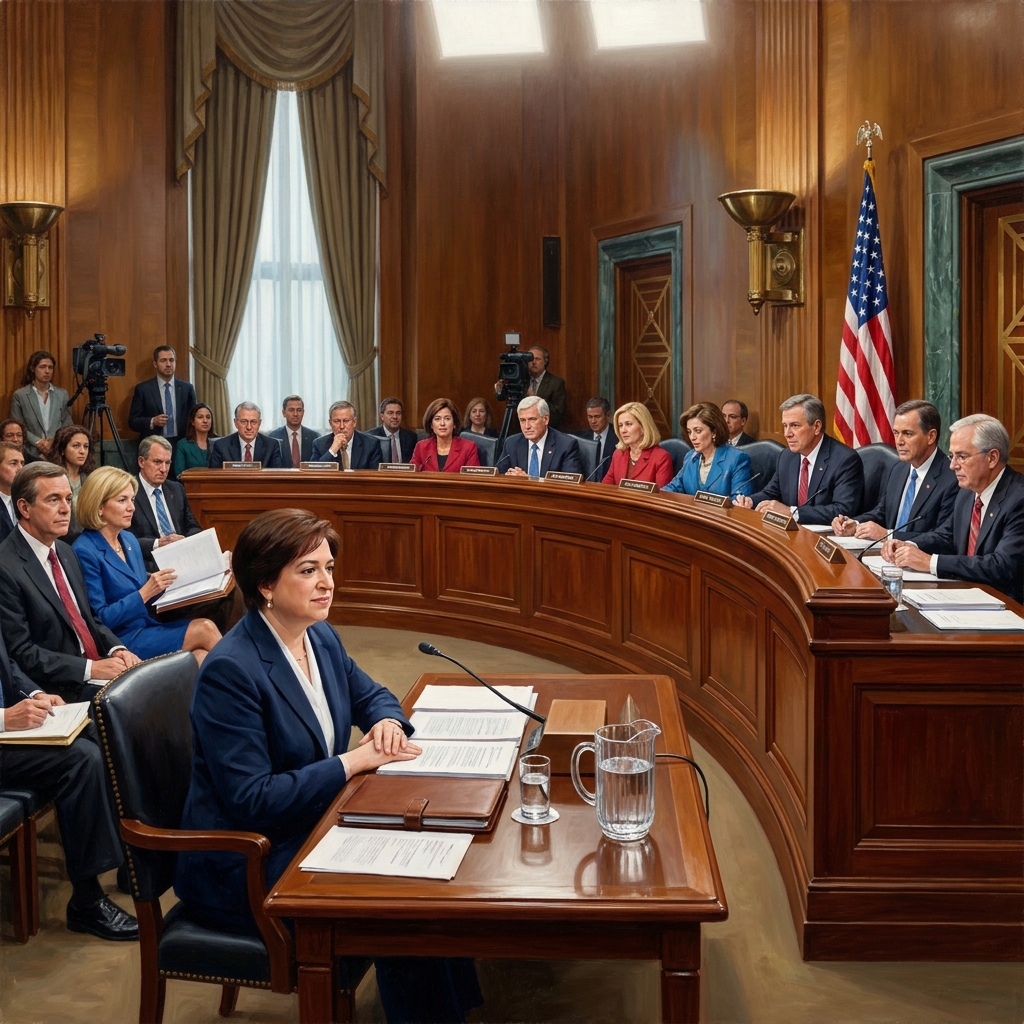
I remember sitting in a 12th-grade Government class years ago when a student asked why a President might choose one judge over another for the Supreme Court. It was not just about legal merit; it was about the power of the bench and the politics of the nomination. That is exactly the conversation Choosing the Court: Supreme Court Selection and Confirmation helps you facilitate. This lesson walks students through the formal mechanisms that translate a President’s pick into a lifetime appointment on the highest court in the land.
How the Supreme Court confirmation process fits into your 12th-grade Government course
The lesson does a clean job of organizing the process into digestible parts. It starts with the presidential nomination, where a candidate is selected, and moves quickly into the Senate’s constitutional role. Your students will examine the actual mechanics of the confirmation, specifically looking at how the President and Senate share power. You will find that it provides enough detail on the Senate Judiciary Committee to help students grasp why these hearings can become such intense public spectacles. When students work through a Supreme Court confirmation process lesson, they begin to see the difference between a nomination as a formal act and the rigorous advice and consent process that follows.

Understanding the constitutional standard
This lesson is built to meet the requirements of CA.HSS-PoAD.12.4.6, which is the California-adopted standard asking for an explanation of the processes of selection and confirmation of Supreme Court justices. This standard is central to the curriculum taught in West Contra Costa Unified, San Jose Unified, San Benito High School District, and Central Unified. It exists to ensure that every senior understands that the influence of a justice persists long after the administration that placed them there finishes its term. That is a heavy concept for seventeen and eighteen year olds to process, but it is necessary for understanding the long-term impact of judicial appointments on our national laws.
Vocabulary like nomination, advice and consent, and Senate Judiciary Committee provides the specific language students need to articulate these concepts. I have found that students often confuse the nomination with the confirmation itself, but the provided scenario featuring Elena Kagan helps clear that up. Seeing an example where a nominee faces questions about their legal philosophy from the committee helps students visualize the oversight the Senate is required to provide under Article II. It is an honest look at how these three branches of government overlap in ways that are often messy but vital to our system.
Putting the lesson to work in your classroom
Where this material really shines is in the guided practice, which asks students to think about what happens when a vacancy opens during an election year. This is the point where students usually stop treating the process as an abstract set of rules and start seeing it as a political reality. You might want to use this lesson as a whole-class assignment to anchor a unit on the judiciary, but it works just as well for a student who missed the week of instruction or for an independent study module. It is a straightforward, no-nonsense resource that does not try to over-explain the history but instead focuses on the structural process.

The primary caveat here is that the lesson is efficient. It covers the 45-minute mark perfectly, but you should expect to spend extra time if your students want to debate current examples or the history of filibusters or partisan shifts. If you have a class that likes to go down rabbit holes, keep an eye on your clock. Use this when you need a clear, reliable way to move students past the basics and into the mechanics of why these appointments are so guarded by both the executive and legislative branches. It is a solid tool for helping students understand that the people sitting on the Supreme Court are there because of a specific, defined, and highly political sequence of events.
Related lessons

The Legislative Branch: Structure and Power, Overview of legislative organization and federal lawmaking authority

Becoming a Citizen of the United States, Requirements and legal steps for attaining American citizenship
The Amendment Process: Changing the U.S. Constitution, Formal procedures required to modify the American Constitution