

A parent stopped me after back-to-school night years ago and asked why her sixth grader was spending class time on two Greek cities that stopped mattering a couple of thousand years ago. Fair question. I gave a weak answer that night. I have a better one now, and a good part of it lives inside a short lesson we built called Athens and Sparta: Comparing Ancient Greek Societies.
This is sixth grade social studies, part of our World History and Geography: Ancient Civilizations course, and it runs about 45 minutes. The objective is plain: students compare the different ways of life and political values in ancient Athens and Sparta. That phrase, political values, is the hinge of the whole lesson. I think the lesson is smart to make it the core concept instead of treating the two cities as a pile of fun facts that sixth graders memorize and then forget by winter break.
The lesson is built on CA.HSS-6.4.6 from the California History-Social Science standards. The standard asks students to compare and contrast life in Athens and Sparta, with emphasis on their roles in the Persian and Peloponnesian Wars. It sits inside cluster 6.4, where sixth graders analyze the geographic, political, economic, religious and social structures of early Greece. So knowing that Athens voted and Sparta trained soldiers is not enough. Students are supposed to connect how each city governed itself to how each city fought, and to whom it fought beside. That expectation is identical in Clovis Unified, Torrance Unified, Westminster School District and Napa Valley Unified, and in every other district in California, so a student who moves from Napa to Torrance in February picks up the same standard where they left off.
How the lesson moves, start to finish
It opens by reminding students what they should already carry in from earlier Greece work: ancient Greece was a collection of independent city-states, each with its own rules and traditions. Then it zooms in on Athens, where citizens gathered in an open-air meeting place to vote on laws, and names that practice as democracy, a system that gave many people a voice in government. The opener closes with a comparison to a town meeting, a place where citizens speak their minds and make decisions for everyone.
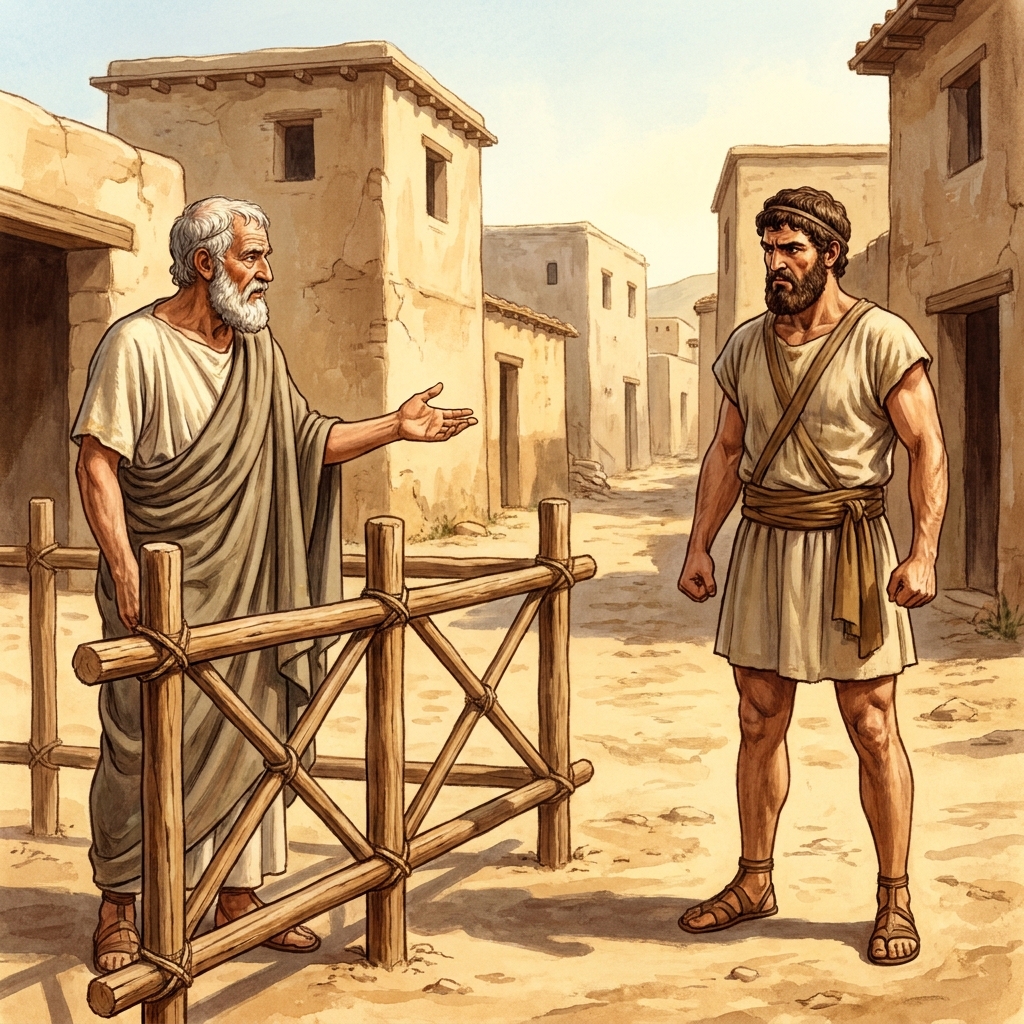
I like the town meeting comparison more than I expected to. Most sixth graders have sat through some version of a class meeting where everyone argues about the field trip, and that is close enough to the Athenian idea to make it stick. It also quietly sets up the contrast to come. If Athens is the town meeting, students start wondering what the other version looks like.
The concept portion hands them four words to work with:
- democracy: citizens take part directly in making laws and decisions
- oligarchy: a small group of powerful people holds all the authority
- alliance: an agreement between groups or nations to work together, often for protection
- hegemony: the leadership or dominance of one group or nation over others
Hegemony is the one that will trip them. It is also the word doing the most work for the Peloponnesian side of the standard, because the rivalry between the two cities is really a fight over who gets to lead the Greek world. I would say it aloud a few times and have students use it in a sentence about the two cities before moving on. Democracy and oligarchy, on the other hand, are a clean pair, and seeing them side by side gives students a vocabulary for the Athens and Sparta contrast that is sturdier than “one was nice and one was strict.”
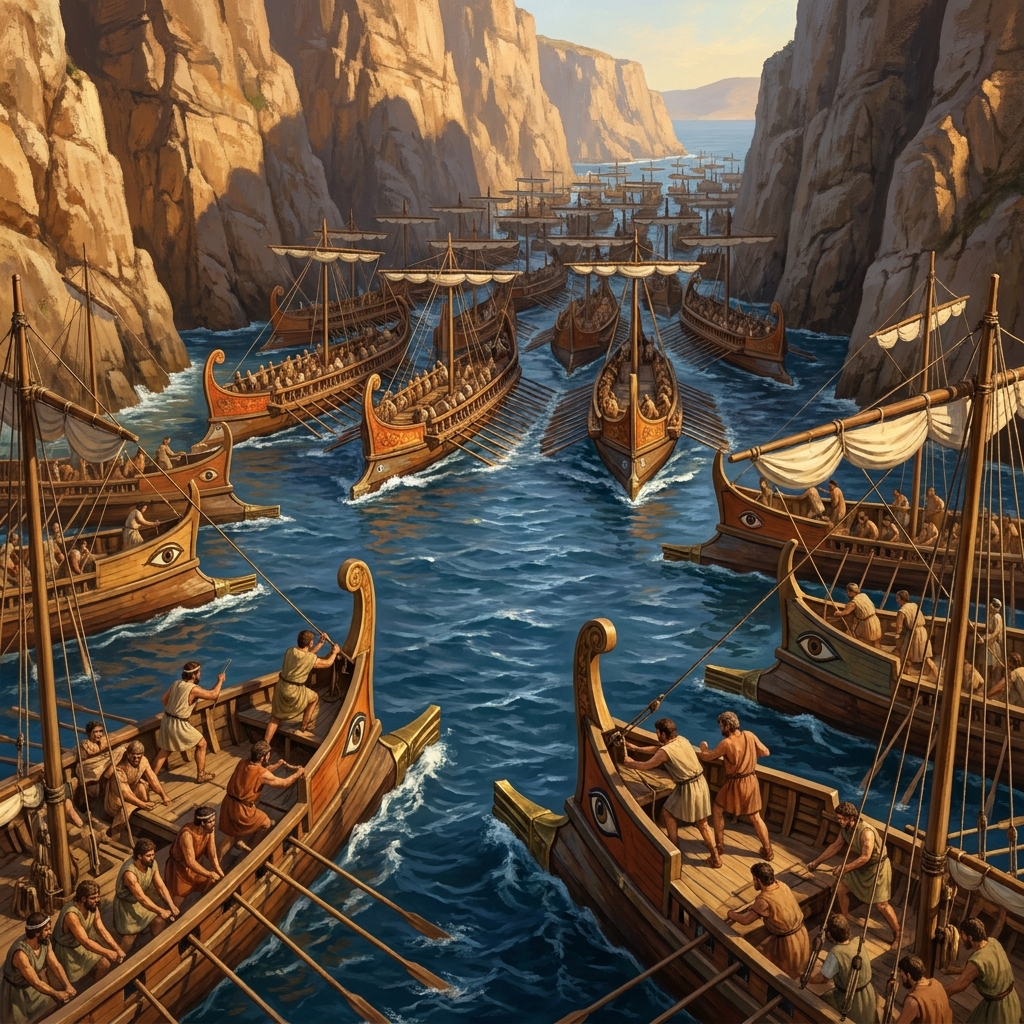
The worked example is the Battle of Salamis. Athens used its powerful navy to trap Persian ships in a narrow channel, and the lesson points out that the plan worked because the Athenians knew those waters well. The takeaway it names is using local knowledge to gain a military advantage. This is a good choice for a worked example because it has a shape you can draw. If you have a map handy, put it up; a narrow channel full of trapped ships is something a twelve-year-old can picture.
My one push on the worked example: it lands on local knowledge, which is true as far as it goes, but I would add a question before moving on. Why did Athens have a powerful navy to begin with? That question is the bridge to the next part, and students who ask it themselves will do better in guided practice.
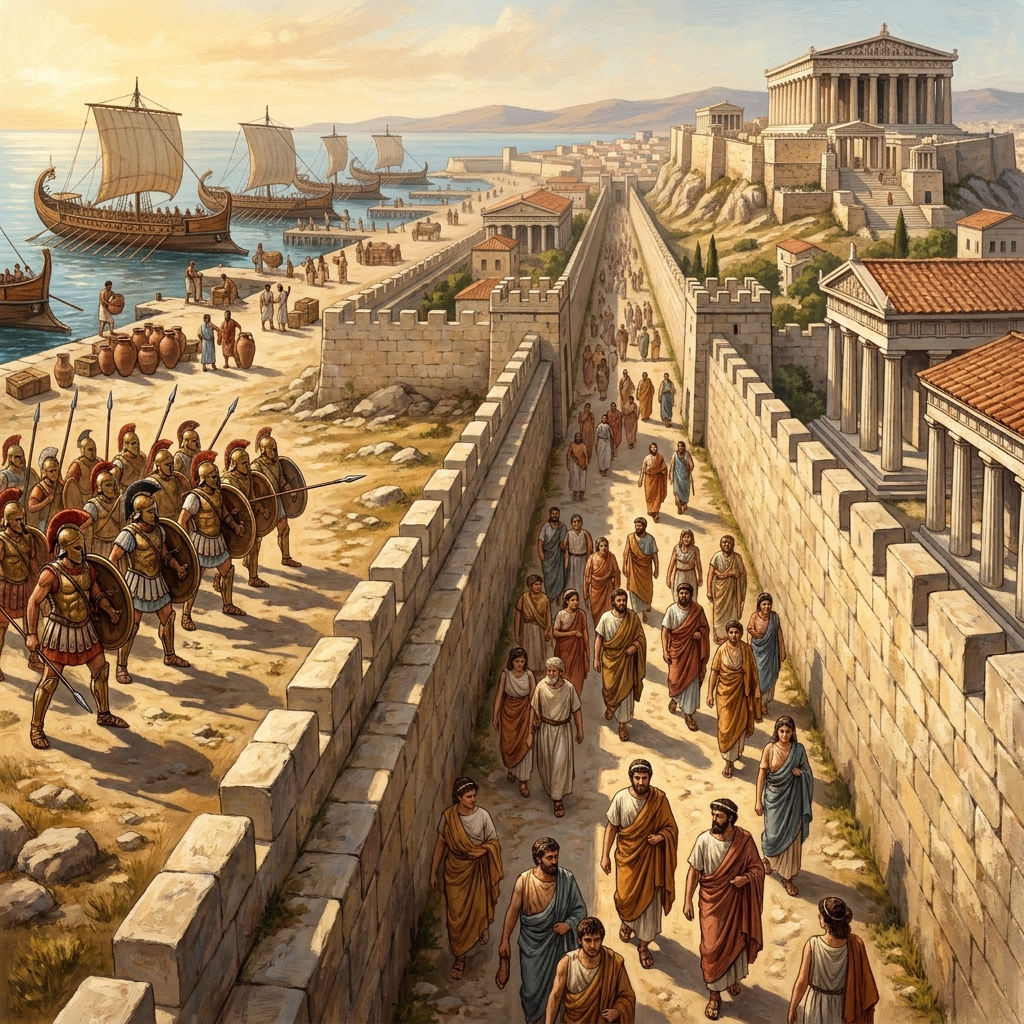
Guided practice turns the comparison over to the students. The setup is direct: Athens relied on its navy, Sparta relied on its infantry, and the lesson frames that difference as a direct result of their different political values. Students work through what each military choice says about the city behind it.
Here is the honest caveat. “Direct result” is a strong claim, and it is tidy in the way textbook claims often are. A sharp sixth grader might ask whether geography had something to do with Athens building ships. That is a great question, and it is fair game; cluster 6.4 lists geographic structures first. I would welcome that pushback rather than steer around it, because a student weighing two causes is doing exactly the comparing and contrasting the standard is after.
The closure comes back to the present. The lesson argues that understanding these historical alliances and rivalries helps students see how countries work together today, and that watching Athens and Sparta struggle to balance their power makes it easier to understand why modern nations form alliances or slide into conflict. That, more or less, is the answer I wish I had given that parent. The two cities still matter because the problem they could not solve, how rival powers share a neighborhood, has never gone away.
Where it fits and what to plan around
Forty-five minutes is tight for a standard this big. The worked example lives in the Persian War, and the Peloponnesian side comes through mostly in the vocabulary of alliance and hegemony and in the closing discussion. If you want students writing about the Peloponnesian War with any depth, plan a follow-up day. Treat this as the frame, not the whole house.
That tight structure is also what makes it useful outside a normal class period. For a student who missed the week of Greece, it is a clean way to catch the central comparison without rebuilding the whole unit, and the four vocabulary words give you something concrete to check afterward. It works well in independent study for the same reason: the arc goes in order, from what students already know to a worked example to their own comparison, so a student working alone is not left guessing what comes next. And on a substitute day, it holds together without needing the regular teacher to fill gaps, since the examples carry the explanation.
If you are scanning for a sixth grade Athens and Sparta lesson that keeps political values at the center and gives you Salamis as a concrete anchor, this one is worth assigning. I would pair it with a quick written prompt the next day: pick one city, explain its military choice, and use either democracy or oligarchy in the answer. You will learn fast who got it.
The full lesson, with the opener, vocabulary, Salamis example and guided practice, is on the page for CA.HSS-6.4.6.
Related lessons
Farming and the Rise of Cities, How early farming connects to the growth of the first cities
The Teachings and Spread of Buddhism, The core teachings of Buddhism and how the religion spread
Trade Networks of Ancient Egypt, The trade routes and networks that linked ancient Egypt to others