

Second graders can do real research, as long as somebody hands them a piece of it that fits in their hands.
That is my short pitch to the team for Working Together to Research and Write, a second grade English language arts lesson from the writing course. It runs about 45 minutes, and its objective is plain: students work with others to read books and write down facts for a project. No report at the end, no poster. Just the habit of reading something, finding what is true in it, and recording it so someone else can use it. I think that habit is the whole point at this age, and I would rather they get it right than rush toward a finished product.
What the lesson asks students to do
It opens by defining research in kid terms: reading books or looking at information to learn new facts about a topic. Then it shows a teacher modeling the process with three books about honeybees, pulling facts into a list for the class. That modeling piece matters. Most of our students have never watched an adult read across more than one source on purpose.
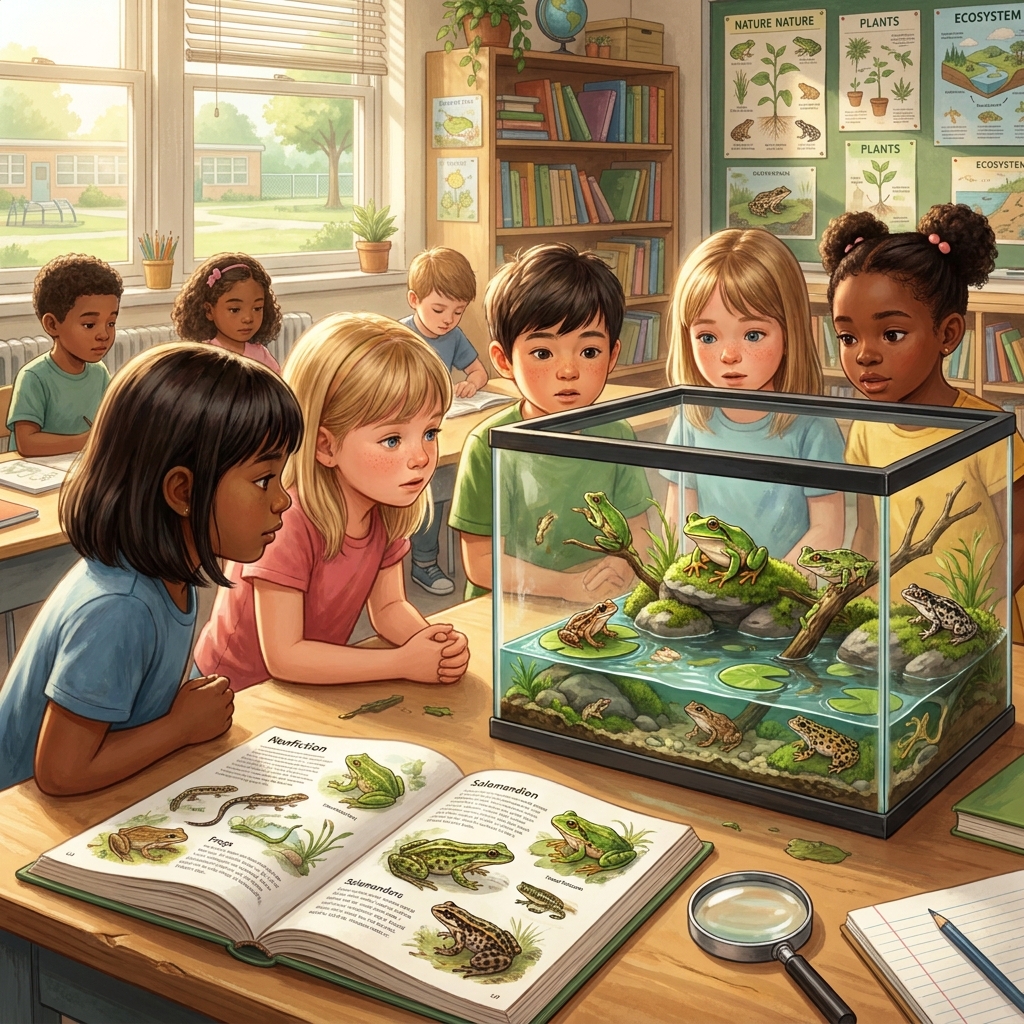
The worked example moves to frogs. Students read, then write down true facts like “frogs lay eggs in water” and “frogs have strong back legs,” with the stated reason that other people can learn from the work. Then it is their turn: two fact sheets on polar bear habitat, with details about the cold Arctic and the thick fur that keeps the bears warm. The lesson closes by connecting research to how scientists share information about animals and the environment so they can protect nature.
Two vocabulary words carry the lesson:
- research: reading books or looking at information to learn new facts about a topic
- fact: a piece of information that is true and can be proven
The standard behind it is CA.ELA.W.2.7, from the California Common Core State Standards for English language arts, in the Writing domain under Research to Build and Present Knowledge. It asks second graders to take part in shared research and writing projects, such as reading several books on one topic to produce a report or recording science observations. The word I keep circling is “shared.” The standard does not expect a seven-year-old to research alone, and neither should we. Students in Poway Unified, Los Angeles Unified, Burton Elementary School District and Alhambra Unified are working toward this exact standard, since it reads the same in every California district.
What to listen for while they work
The polar bear practice is where you will hear what students actually understand. Walk the room and listen to partner talk more than you read their papers.
First, listen for the difference between a fact and a feeling. Someone will write that polar bears are cute or that the Arctic is scary. That is a teachable moment, not an error to erase. Ask: can we prove that? The lesson’s definition of a fact gives you that exact language.
Second, listen for copying. Some students will try to write down the entire fact sheet. Pulling out one true idea and putting it in their own short words is harder than it looks, and it is the skill we want.
Third, listen for where. When a partner offers a fact, does the other one ask which sheet it came from? That question is the seed of citing sources, years before anyone says the word.
One honest caveat. Two fact sheets is a small pool, and the lesson models the process rather than producing anything close to a report. If you want students to meet the full reach of the standard, you will need to extend it with a class topic and real books from the library.
Folding it into the week
My suggestion: run it early in the week as a whole-class lesson, then spend the next few writing blocks on a shared topic of your own, with each table reading a different book and adding facts to a class chart. The frog and polar bear examples give everyone the same starting language before the books come out.
It also works well as a catch-up for a student who missed the week, since the modeling and worked example are built in. And it is a solid substitute day plan, because the structure carries itself and the practice produces something you can check when you return.
If anyone on the team was hunting for a second grade shared research writing lesson to anchor the unit, this is the one I would start with. Bring the class chart from your extension to our next meeting. I want to see which facts the kids decided were worth keeping.
Related lessons
Choosing How to Write, Deciding which kind of writing fits a purpose
Making Your Writing Better, Revising and improving a draft to strengthen the writing
Writing Great Stories, Building strong stories with clear events and details