

Twelve graders in your government class are at a point where they need more than just definitions when they study how power moves in a country.
As you prepare for your next unit, Political Systems and the Quest for Democracy offers a structured way to handle these big ideas in a single forty-five-minute period. It is built for the high school Principles of American Democracy course, specifically keeping twelfth graders focused on how governance actually functions rather than just theory. Whether you are using this as a whole-class assignment to start the week or as an independent study module for a student who missed the earlier introductory lectures, the flow remains steady and clear.
What the lesson asks students to do
The lesson starts by asking students to think about how power is acquired and used. It centers on the idea that every society relies on a set of rules and institutions to distribute power. The material defines a political system as the established set of rules and institutions that a society uses to govern itself, make laws, and distribute power among its members. Students are encouraged to use this definition to categorize different ways societies have organized themselves over time.

The content relies on a few key terms to keep the conversation grounded. Students will work with the concept of democracy, defined here as a form of government where power is vested in the people and exercised by them directly or through freely elected representatives. They also look at sovereignty, which is the supreme authority or power of a state to govern itself, and suffrage, the right to vote in political elections. These terms are essential for students as they transition into looking at the history of democratic ideals.
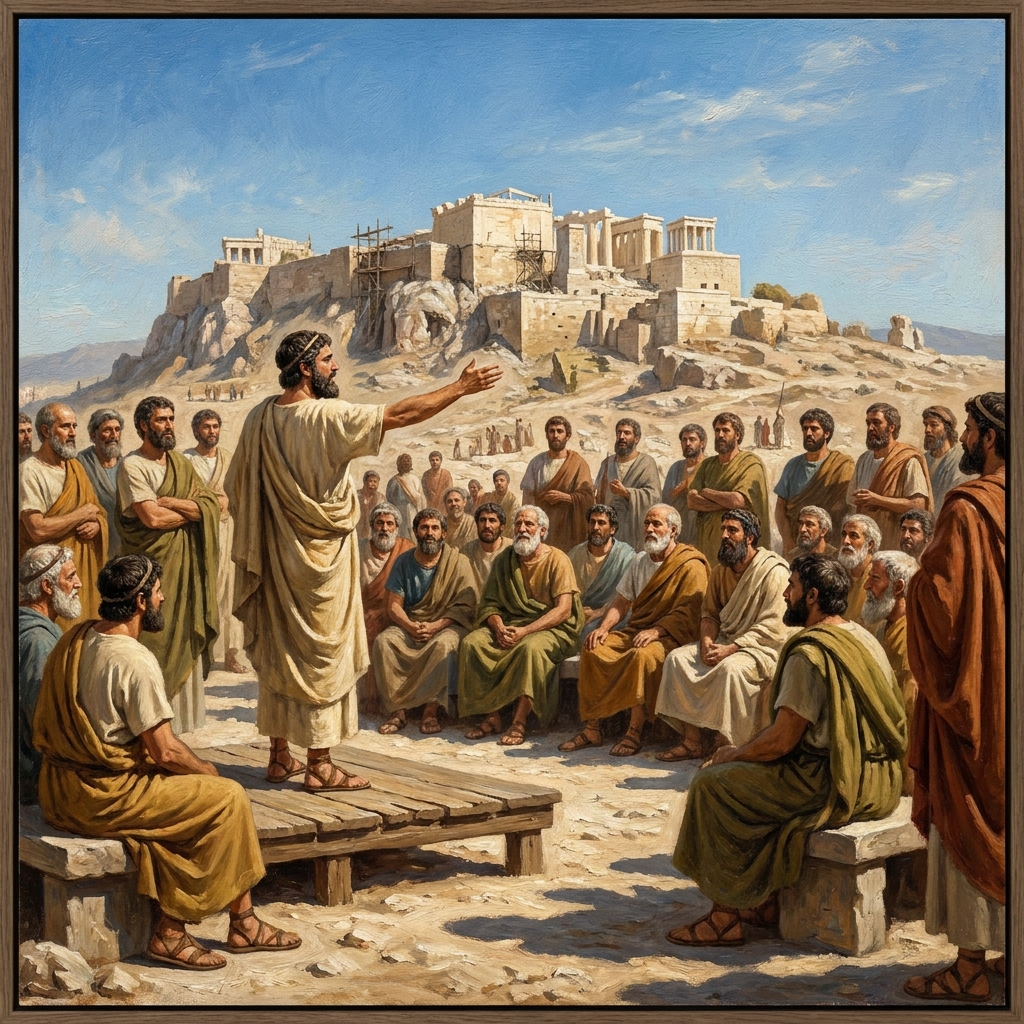
A unique feature of this lesson is a simulation that attempts to model ancient Athenian civic participation. It frames the Ecclesia as a central governing body, although it limits the assembly to six participants for the sake of the activity. It is a bit of an odd constraint, but it does force students to see how a small, manageable group might debate and vote on laws before moving toward the more complex representative systems we use today. You will see students testing out the high school government political systems lesson and comparing those ancient practices to modern structures.
Where students slip
The biggest hurdle in this material is not the vocabulary, but the jump between contexts. The lesson moves from the ancient world directly into a worked example involving the United States Bill of Rights. In the United States, the Bill of Rights serves as a crucial example of a political system protecting individual liberties. By guaranteeing rights like freedom of speech, it limits what the government can do to the people.
Students often struggle to see how those abstract limits on government power link back to the ancient examples they just reviewed. When they move into guided practice, they are asked to look at the 1990s in Eastern Europe. The lesson asks them to analyze how these nations moved away from single-party rule to establish new institutions for democratic norms. This part of the lesson requires them to think critically about how one system falls while another rises. Teachers in Anaheim Union High School District, Long Beach Unified, Calexico Unified, and Newark Unified all use this same standard to show students how political transitions are rarely smooth, even when the goal is a more democratic society.
Managing the forty-five-minute flow
To keep students on track, I suggest watching how much time they spend on the Athenian simulation. Because the group size is fixed at six, it can either be a quick exercise or a distraction if students spend too long arguing over their simulated roles. Keep them focused on the core objective, which is identifying the characteristics of these systems. The why-it-matters section of the lesson reminds them that democracy only works when people use their voices to hold officials accountable, which is a great hook for getting them through the more technical parts of the instruction.

This lesson is quite effective for a substitute day because the logic is linear and self-contained. You do not need to provide a deep back-story for them to grasp why sovereignty matters in the modern era. Just remind them that understanding these systems helps them interpret the news and prepare for their upcoming role as voters.
Connecting to the state standards
The lesson is designed to meet CA.HSS-PoAD.12.9. This California-adopted standard asks students to analyze the origins, characteristics, and development of different political systems across time, with an emphasis on the quest for political democracy, its advances, and its obstacles. It is a dense standard, but this lesson breaks it down into manageable segments by focusing on the transition between systems rather than just memorizing dates or names.
You are demonstrating to them that democracy is not a static state but a process. It requires constant engagement with the institutions that define our lives. When your students finish this, they should be able to explain why a political system needs both rules and the active participation of the governed to function effectively. It is a good, solid reminder for them that their voice in a local election is just the modern version of the debate that started in much older systems.
Related lessons

Interpreting the Bill of Rights, Analyzing foundational documents that protect individual rights within our government

Locating Your Federal Representatives, Identifying current elected officials to understand the structure of representation

Media and Politics in American Democracy, Evaluating how news sources shape public perception of political processes