

Second grade math often hinges on whether students can connect their basic arithmetic skills to the physical objects they see in their daily lives.
When you have a student who is struggling to translate word problems into equations, this Measuring and Solving Length Problems lesson is a straightforward way to offer them some extra time with the material. It takes about 45 minutes to work through, making it a solid choice for a substitute teacher’s day, an intervention block, or even for a student who missed the week of instruction and needs to catch up before moving on to more complex geometry topics. It acts as a bridge between the simple act of measuring with a ruler and the more abstract logic required to solve problems involving lengths.
How the lesson builds measurement skills
The lesson starts by acknowledging what students already know about rulers. It defines length as the measurement of how long an object is from one end to the other, using a ribbon as a simple visual example to ground the idea in a physical object. From there, it moves into using addition and subtraction within 100, which aligns with CA.MATH.2.MD.5. This California-adopted standard specifically asks that students be able to use equations with a symbol for the unknown number to solve word problems involving lengths given in the same units, and these students are doing exactly that in classrooms across Fresno Unified, Fontana Unified, San Rafael City Elementary School District, and Madera Unified.

The lesson includes vocabulary terms that are essential for any second grade mathematics intervention. It defines total as the amount you get when you add two or more numbers together, and difference as the amount left over when you subtract one length from another to see how much bigger or smaller one is. I like that it anchors these definitions in real-world logic. For example, it explains that carpenters are people who build things with wood and use this kind of math to ensure every piece fits perfectly. This context helps students understand that math is not just a bunch of numbers on a page but a tool used to solve practical problems.
Because the material focuses on these specific standards, it allows educators to isolate whether a student is having trouble with the arithmetic itself or the conceptual leap of representing physical space with numbers. By focusing on length, the lesson ensures that students are not overwhelmed by converting units or using complex measuring tools, allowing them to focus entirely on the arithmetic operations and the word problem structure.
The logic behind the word problems
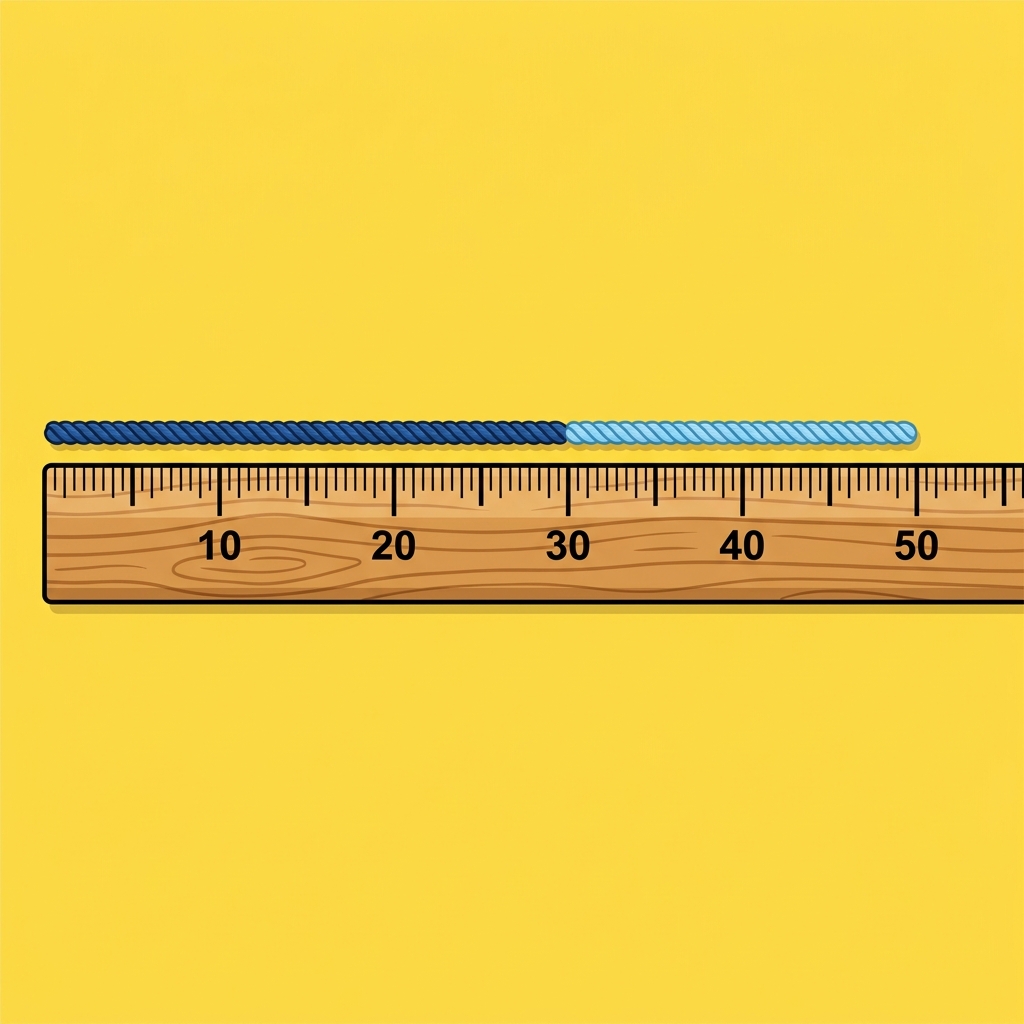
The core of this second grade length word problems lesson is found in how it guides students through the math. Instead of just giving a list of equations to solve, it presents a scenario where a string is 40 centimeters long. When the student cuts 10 centimeters off, they are effectively subtracting the length, shown as 40 – 10 = 30 centimeters. It is a simple, clean way to show how subtraction works when applied to a physical measurement.

The guided practice moves to two wooden boards of different sizes, one 42 centimeters long and the other 38 centimeters long. Asking students to calculate the difference between these two boards requires them to actively apply the vocabulary they just reviewed. One of the best parts of this material is how it handles the unknown. The lesson uses drawings of rulers and various equation formats to represent the unknown number, which helps visual learners who might get tripped up by text-heavy problems. While the lesson is designed for a general second grade math course, it is particularly effective for those students who need a slow, paced introduction to these concepts rather than a quick lecture.
I have found that students sometimes struggle to differentiate between when to add and when to subtract when dealing with length. This lesson does a good job of keeping the units consistent so the focus remains on the operation itself. By focusing solely on length in one measurement unit, the cognitive load is reduced, allowing the student to really get comfortable with the underlying algebraic thinking. It is a relief to find a resource that does not overcomplicate the process with too many distractions. For an independent study coordinator, this provides a clear, verifiable output for the student to show they understand the math involved in standardizing measurements.
This structured approach to length word problems ensures that students are not just guessing operations, but are instead reading the problem to identify the relationship between the quantities. When students visualize the ribbon or the wooden boards mentioned in the lesson, they gain a stronger grasp of why subtraction might be necessary for finding the difference or why addition helps when finding the total. This methodical practice is exactly what is needed for students who find abstract word problems difficult to parse without visual context.
Related lessons

Measuring and Finding Length Differences, Calculating the numerical gap between two measured object lengths
Measuring Length with Tools, Using standard rulers to determine the length of objects

Learning About Money, Identifying coin values and counting currency for basic math