

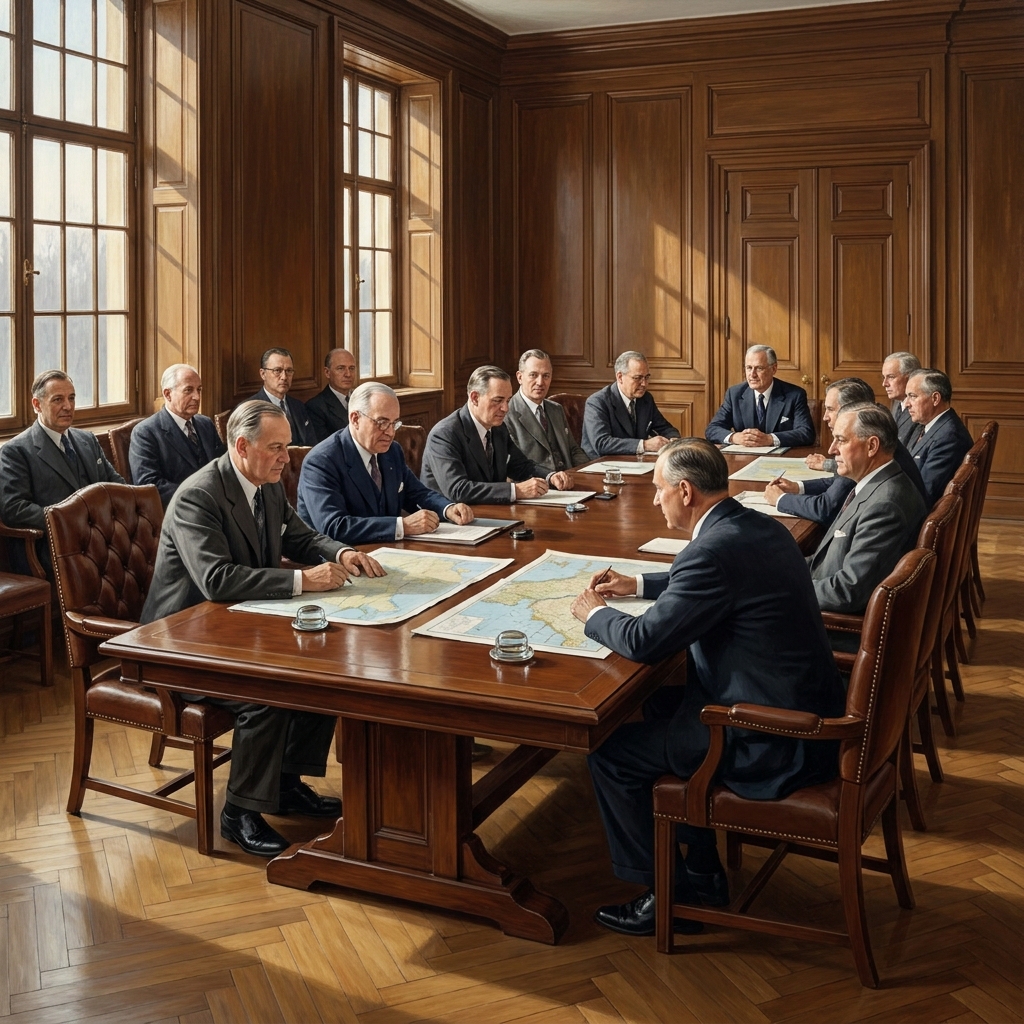
A student recently asked me why we still hear about NATO on the nightly news. It is a fair question, as the alphabet soup of 1950s alliances can feel like distant history to a teenager. If you teach 10th grade World History, you know that connecting those Cold War tensions to modern diplomacy is the real challenge of the curriculum. The lesson Global Alliances and the Modern World makes that connection manageable by stripping away the filler and focusing on the mechanics of collective defense.
This material fits well for a whole-class lecture, an intervention session for students who struggled to grasp the shift from the League of Nations to the United Nations, or as a stand-alone lesson for a substitute day. It covers the core concept of collective defense, which is the idea that a group of nations agrees that an attack on one member is an attack on all of them. The lesson uses concrete examples like the North Atlantic Treaty Organization (NATO) to show why countries form these blocs. Students also examine the Warsaw Pact, the United Nations, SEATO, and the Organization of American States. These entities are the same across the state in classrooms from Fremont Unified and Visalia Unified to Whittier Union High School District and Fallbrook Union High School District.
Analyzing the standard through classroom practice
The lesson is built around the requirements of CA.HSS-10.9.8. This California-adopted standard asks for two main things. First, it requires that students discuss the establishment and work of the United Nations. Second, it demands that they examine the purposes and functions of the Warsaw Pact, SEATO, NATO, and the Organization of American States. To meet this, the lesson starts with the failure of the League of Nations, which failed to stop aggression in the 1930s, to set the stage for why leaders needed something stronger after 1945.

When you use a 10th grade world history alliance lesson, you are moving beyond simple definitions. The vocabulary is concise: United Nations, NATO, Warsaw Pact, and Collective Defense. The lesson asks students to identify these purposes and then jump into guided practice. Students are tasked with looking at the strategic goals of NATO and SEATO during the 1950s, forcing them to compare why different regions needed different types of security. My favorite part is the why-it-matters section. It connects the 1950s directly to today, helping students see that when they see news reports about current peacekeeping forces, they are seeing the legacy of these very alliances in action.
Where students slip and how to support them
The biggest hurdle for high schoolers here is distinguishing between the ideological motivations of the Soviet bloc and the Western alliances. The lesson handles this well by keeping the focus on the strategic goals of each treaty. One potential pitfall is that students might view these alliances as static entities. Remind your class that these organizations were responses to immediate threats. The lesson serves as a solid reminder that history is not just about what happened, but why countries chose to bind their futures together.

I find this useful because it does not overcomplicate the diplomacy. You get forty-five minutes of focused work that leads directly to the standard’s goals. If you have a student who missed the week on Cold War history, this provides the necessary vocabulary and historical context to get back on track without needing to read through a massive textbook chapter. It is direct, it is historical, and it keeps the focus on the power dynamics that defined the latter half of the twentieth century.
Related lessons
The Road to World War I, Traces the escalating tensions leading up to the Great War

The Road to Israel: Nationalism, Trauma, and Diplomacy, Examines the complex origins and establishment of the Israeli state

The Rise of Industrial Cities, Details the rapid urbanization and economic shifts during industrialization