

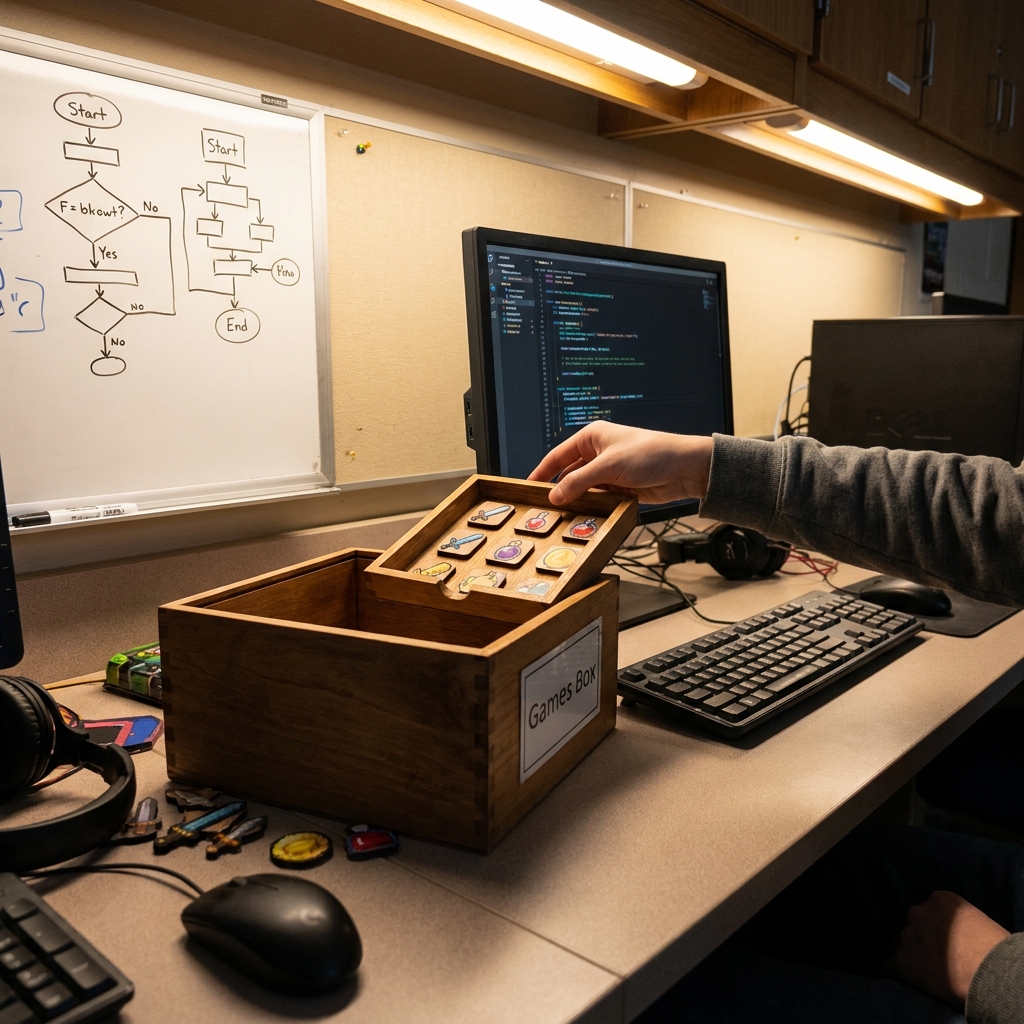
Breaking a complex task into manageable pieces is the single most important habit a young programmer can form.
In this Building Modular Programs lesson, your high school students move beyond writing long, messy scripts and start thinking like software engineers. The core of this material focuses on how to take a big, intimidating program and partition it into smaller, reusable bits. It is the natural next step after students have mastered basic control flow, and it is the necessary precursor to any project that involves multiple developers or complex state management. If a student skips this step, they usually hit a wall in the second half of the term where their code becomes too knotted to debug, and they lose the ability to add new features without breaking existing ones.
The logic of modular design
The lesson explains modularity through the lens of efficiency and maintainability. When developers need to perform math calculations repeatedly, they do not rewrite the same logic twenty times. They write it once as a procedure. This is the first concept students encounter. You see the lightbulb go on when they realize that they can define a procedure once and call it whenever that action is required. The vocabulary in the lesson is precise: a Module is a self-contained section of code that performs a specific, focused task. This is supported by the concept of a Procedure, which is a named sequence of instructions that can be reused, and Encapsulation, which is the practice of hiding the internal details of how a component works from the rest of the program. This high school computer science modular programming lesson provides a solid framework for these terms, ensuring students have the technical language they need to describe their own architecture.

Meeting the California standard
The lesson is mapped directly to CA.CS.9-12S.AP.17. This California-adopted standard asks that students construct solutions to problems using student-created components like procedures, modules, or objects. It is the same requirement taught across the state, from the Victor Valley Union High School District and Lodi Unified to the Santa Rosa High School District and Tulelake Basin Joint Unified. The standard demands that students show they can abstract logic rather than just copy-paste blocks of code. When students follow this requirement, they shift from being users of code to architects of it. It takes patience to get them to stop viewing their code as one long, linear story and start seeing it as a collection of interacting parts, but it is a necessary shift for meeting CA.CS.9-12S.AP.17 in a way that actually results in clean, working software.
Classroom application and debugging
For the guided practice, the material provides a library management system scenario. Students are tasked with designing a Search module to handle title and author queries. I have found this to be a great way to test whether they understand how modules interact with a larger system. They have to decide what inputs the module needs and what data it returns. If they do it well, the rest of the program does not need to know how the searching happens; it just needs to know how to trigger the search. The worked example about game development is particularly effective here. It explains that in an inventory system, if you need to change how items are sorted, you only edit that one module. Because the module is separate, updates to the inventory list do not crash the movement engine or the combat logic. This shows students that modularity is not just a stylistic choice but a safety mechanism. When they inevitably break their code later, they will thank you for teaching them to isolate variables in this way.

Planning for this lesson
This lesson fits well as a whole-class assignment when you transition from basic algorithms to structural design. It is also quite effective for a student who missed the week, as the logic of modularity is self-contained enough that they can catch up by building the library search tool in a single session. I would caution you that some students find the concept of encapsulation frustrating at first because they want to access everything from everywhere. Remind them that the goal is not to limit their power but to prevent their code from becoming a tangled mess that they cannot fix by themselves. Once they see their code working in pieces, the frustration usually turns into pride.
Related lessons
Understanding Recursive Execution, Covers how functions call themselves to solve repeating logic problems

Mastering Problem Decomposition, Breaks down complex coding tasks into smaller actionable technical steps

Collaborative Software Development: Version Control and IDEs, Explains team-based coding workflows using shared code repositories and tools