

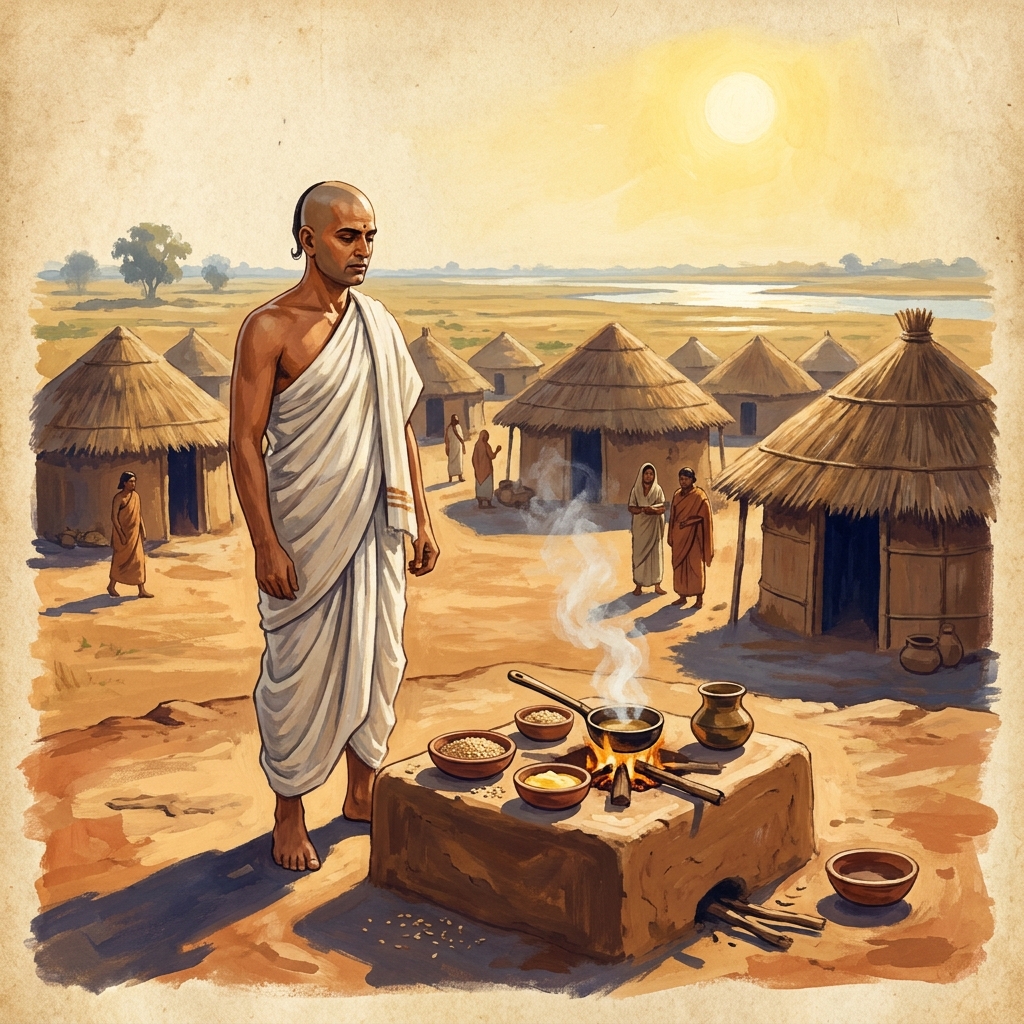
Understanding the social structures of early civilizations can be a difficult task for young students who are used to modern ideas of choice and change. This lesson on the caste system of ancient India provides the necessary context to help students compare ancient social rankings with contemporary concepts of social mobility.
What the lesson asks of students
I remember standing at the whiteboard, chalk in hand, trying to explain to a group of 6th graders why someone in ancient India could not simply choose a new profession. A student asked me if they could just decide to be a priest instead of following their parents into the fields. That moment of realization is exactly where The Caste System of Ancient India starts to do its work. This 6th grade social studies lesson focuses on the objective of identifying the four levels of the Indian caste system and explaining how these roles were passed down through families.

The material covers the core concept of a hierarchy, which it defines as a system where groups are ranked one above the other. The lesson uses a pyramid to represent the social order, placing priests at the top and laborers at the bottom. The primary standard for this work is CA.HSS-6.5.4, which specifically asks students to outline the social structure of the caste system. This is a California-adopted standard, and it is taught consistently across the state in districts such as Moreno Valley Unified, San Juan Unified, Scott Valley Unified, and Tehachapi Unified. The standard is part of a larger cluster focused on analyzing the geographic, political, economic, religious, and social structures of the early civilizations of India.
The content and vocabulary
When you sit down with this 6th grade social studies caste system lesson, you will find four key vocabulary terms that build the foundation for the discussion. These terms are essential for your students to master:
Hierarchy: A system in which members of a society are ranked according to relative status or authority.
Varna: A Varna is one of the four main social classes in the ancient Indian caste system.
Hereditary: This means something is passed down from parents to their children, like a family job or social position.
Social Mobility: This refers to the ability to move from one social class to another; in the ancient Indian caste system, there was very little of this.
The lesson uses the example of a Brahmin performing a ritual at a temple to illustrate these concepts. The narrative explains that the Brahmin leads religious ceremonies because he was born into that specific Varna to perform those duties. It is a concrete way to show that a person’s life was determined from birth, rather than by personal ambition or individual choice.
Where students often slip
The trickiest part for my students was usually the concept of social mobility. They want to believe that hard work is the only factor in success, so they find it difficult to grasp that in this system, the merchant family trading spices had to stay in the merchant class regardless of their skill or desire. During the guided practice, you will ask them to imagine that merchant family and describe how they determine their future. Watch your students during this part of the lesson. They might try to suggest that the merchant child could study to become a priest, which gives you the perfect opening to refer back to the meaning of hereditary roles. Remind them that the lesson argues that understanding this system helps us appreciate why we value the freedom to choose our own paths today. It turns the study of the past into a conversation about fairness in a modern society.
How to use this in your classroom
This lesson is designed to take about 45 minutes, which makes it a very useful tool for a substitute day or for a student who missed the week and needs a quick way to catch up on the content. Because it requires students to synthesize information from the hierarchy and apply it to a specific scenario, it also works well as a small-group intervention for those who struggle with the social studies content. You could also assign this as an independent study task if you need a reliable resource that follows the state framework closely. Just keep an eye on the clock during the guided practice, as that is where the best discussions happen. I find that if I give them an extra five minutes to talk through the merchant scenario with a partner, they leave the room with a much clearer understanding of why social mobility is such a significant aspect of our own history.
Related lessons
Leaders of Ancient Egypt: Hatshepsut and Ramses the Great, Students examine the lives and reigns of ancient Egyptian leaders
Ancient Civilizations: How Geography and Society Connect, This lesson analyzes how physical geography shapes human social structures
Keeping Traditions Alive: Judaism After the Temple, Students explore how cultural traditions persist during historical societal changes