

Explaining how the universe builds matter is one of the most rewarding parts of high school science.
When you teach a high school science course like Biology or Earth and Space Sciences, you are often looking for ways to make the abstract concepts of cosmology feel tangible. The Cosmic Forge: How Stars Create Elements offers a way to do just that. The lesson does not just dump facts about space on students. Instead, it starts with a simple, familiar analogy: a campfire. Just as a fire releases energy while wood changes form through chemical reactions, the lesson asks students to view stars as massive cosmic engines that transform matter through intense heat and pressure.
How students master the process of element creation
The core objective here is to help students explain how stars create new chemical elements throughout their life cycles. To get there, the material introduces three essential vocabulary terms: nuclear fusion, where the nuclei of small atoms join to form a larger, heavier nucleus; stellar nucleosynthesis, which is the process by which stars produce new elements during their life cycle; and a supernova, the powerful explosion of a high-mass star that scatters those heavy elements into space. A great example used in the material is the Sun, where hydrogen atoms fuse to produce helium. Students see this as a perfect example of stellar nucleosynthesis because the star is actively building a heavier element from a lighter one to generate energy.

This lesson addresses HS-ESS1-3, the standard that asks for students to communicate scientific ideas about the way stars produce elements over their life cycles. The material also incorporates the California-specific version, CA.HS-ESS1-3, which contextualizes these scientific concepts within our own state. Educators in Santa Ana Unified, Fresno Unified, Death Valley Unified, and Fillmore Unified all teach this same standard, ensuring that students across California receive a consistent foundation in how our universe functions. I find that when students see that the atoms in their own backyard were once inside a distant star, the science stops feeling like a textbook abstraction and starts feeling like their own history.
Connecting cosmic events to California geology
One of the strongest parts of this stellar nucleosynthesis science lesson is the guided practice. It moves from general stellar modeling to the specific application of trace element analysis right here in California geology. The lesson explains that the materials forming our crust were originally part of a solar nebula, a massive rotating cloud of gas and dust enriched by those previous supernova explosions. Gravity pulled this material together through accretion to form our planet, and then planetary differentiation caused dense elements to sink to the core while lighter ones stayed in the mantle and crust.
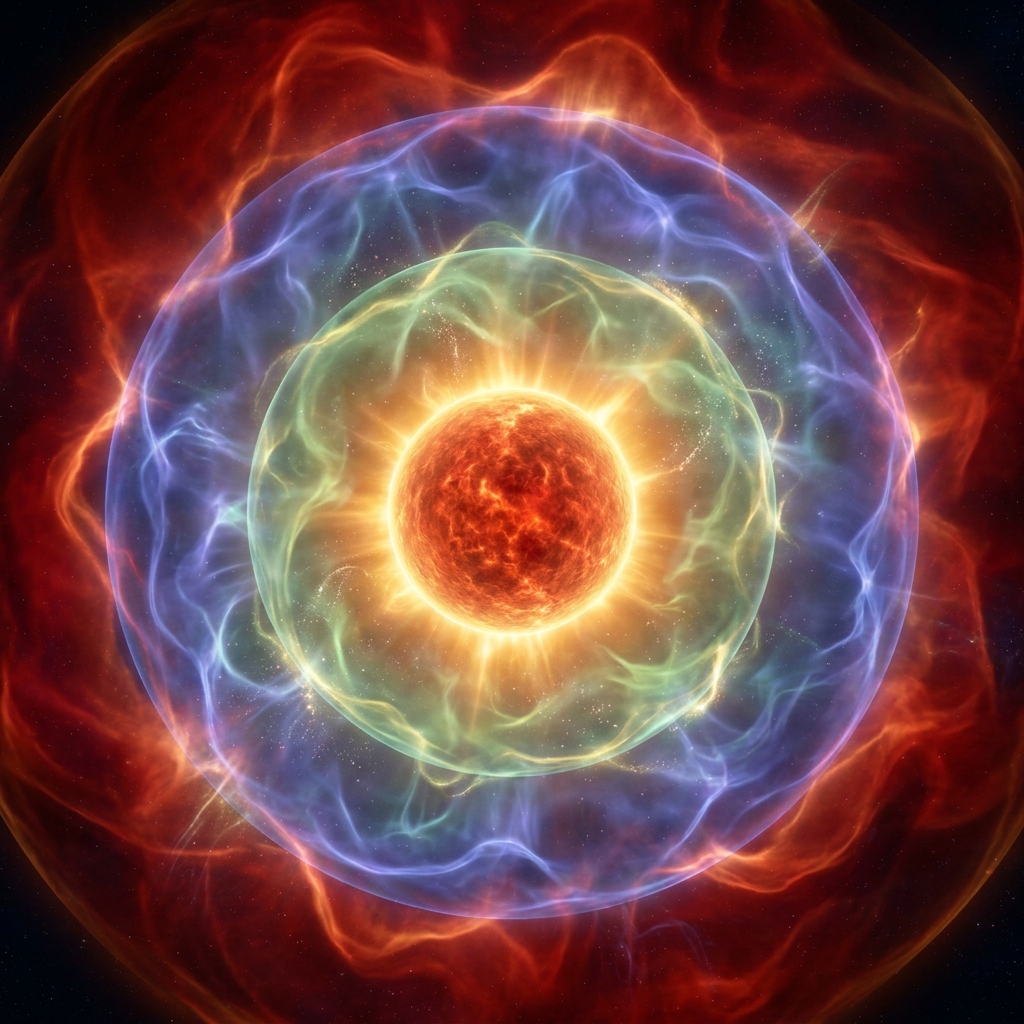
These stellar-forged atoms were eventually uplifted and concentrated into California crustal plates through tectonic processes. This is where the lesson shines because it grounds the physics of space in the geography of the state. Researchers use isotopic markers, which act as atomic fingerprints, to track how that ancient stellar material moves through our current ecosystems. A climate zone, defined as a region with distinct precipitation and temperature patterns, dictates the chemical weathering of rocks in California. This weathering releases minerals into the soil to support biodiversity hotspots. Essential elements like magnesium or iron serve as micronutrients that determine the unique plant life in these hotspots. As a global hub for environmental science, California leads the world in using this isotopic analysis to inform preservation strategies.
I have used this material as a whole-class assignment to jumpstart a unit on geology, but it also functions well as an intervention activity for students who need to grasp how chemical properties relate to physical space. If you have a student who missed the week on nuclear processes, this provides a clear, sequential path for them to catch up. The lesson takes about 45 minutes, which is enough time for students to grapple with the concepts without feeling rushed. My one caveat is that the jump from fusion in stars to tectonic plates in California is a big leap for some students, so be prepared to pause during the guided practice to let them process that transition. It is worth the time to see that connection click for them.
Related lessons

Modeling Orbits in the Solar System, Simulating gravitational interactions within a planetary system
Understanding Earth's Feedback Loops, Analyzing how systems respond to environmental changes
Earth Systems and Human Impact, Evaluating how anthropogenic actions affect geological processes