

Sixth grade science presents the moment where students move from observing phenomena to measuring them. When your class begins the unit on thermodynamics, they are at a point where they need to bridge the gap between intuition and formal measurement.
You can find this Energy and Temperature lesson useful for grounding that transition. The material focuses on the core concept of thermal energy transfer, teaching students that the heat of an object is tied directly to the movement of its particles. Students learn that kinetic energy is the energy of motion that particles have, and when these particles move faster, the temperature of the object rises. They also define thermal energy transfer as the movement of energy from a warmer object to a cooler one, causing particles in the cooler object to speed up. A final key term is specific heat, which is a property of matter that describes how much energy is needed to change the temperature of a specific amount of that material.
How this lesson connects to California standards
The lesson serves the CA.MS-PS3-4 standard. This requirement asks that students plan an investigation to determine the relationships among the energy transferred, the type of matter, the mass, and the change in the average kinetic energy of the particles as measured by the temperature of the sample. Because California teaches middle school science using an integrated model, this lesson is part of a larger curriculum where standards are contextualized with state phenomena, including seismic activity and energy policy, as taught in Elk Grove Unified, Fontana Unified, Castaic Union School District, and Corning Union Elementary School District. Teachers in these districts follow the same standard, ensuring that the expectations for analyzing how matter reacts to energy inputs remain consistent across the state.

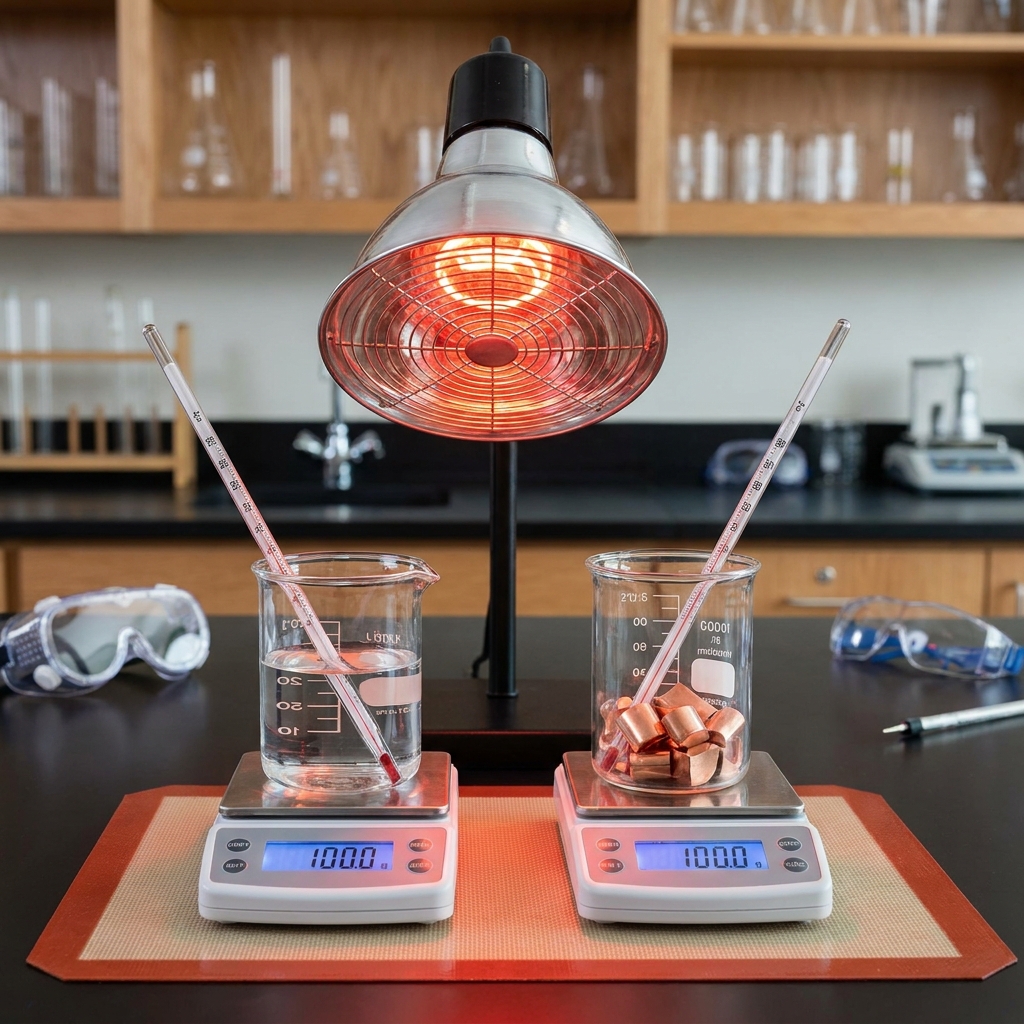
When you use sixth grade physical science lesson materials, you are not just teaching definitions. You are asking students to see why copper behaves differently than water under a heat lamp. The lesson explains that copper heats up faster because it has a lower specific heat than water. This specific, concrete difference helps students grasp why mass and material type are the primary variables in their calculations. The material is designed to prepare students for later units where they analyze the conservation of energy, which becomes difficult if they cannot first distinguish between thermal energy transfer and temperature.
Practical application and why it matters
I find that students get stuck when they assume that all substances react to heat in the exact same way. They see a small cup of water and a large pot of water on a stove and might ignore the role of mass. This lesson addresses that by pointing out that while we know adding energy to an object makes its particles move faster, the quantity of the matter matters just as much as the temperature reading. You can use this for a whole-class assignment or for a student who missed the week and needs to catch up on the fundamentals of the physical science course. It also works as a high-quality substitute day plan, as the concepts are clear and provide enough structure to keep a room of sixth graders productive without constant oversight.

The lesson provides a nice shift from abstract kinetic theory to local geology and engineering. It describes seismic activity where underground rocks heat up due to pressure. This is a crucial area of study in California, where geologists monitor this internal heat as part of geothermal energy research. Engineers also apply this when following Title 24 building standards, which mandate specific insulation materials that resist rapid temperature changes to reduce the load on HVAC systems. By connecting the laboratory behavior of copper to the climate control of a home, you show students that these physics laws are part of their daily environment. If you notice a student struggling to grasp specific heat, have them revisit the scenario comparing copper and water before moving on to the geothermal activity investigation.
Related lessons

Gravity: The Invisible Pull, Explores the fundamental forces that dictate gravitational attraction between objects

The Law of Conservation of Mass, Covers mass maintenance during physical and chemical changes in matter
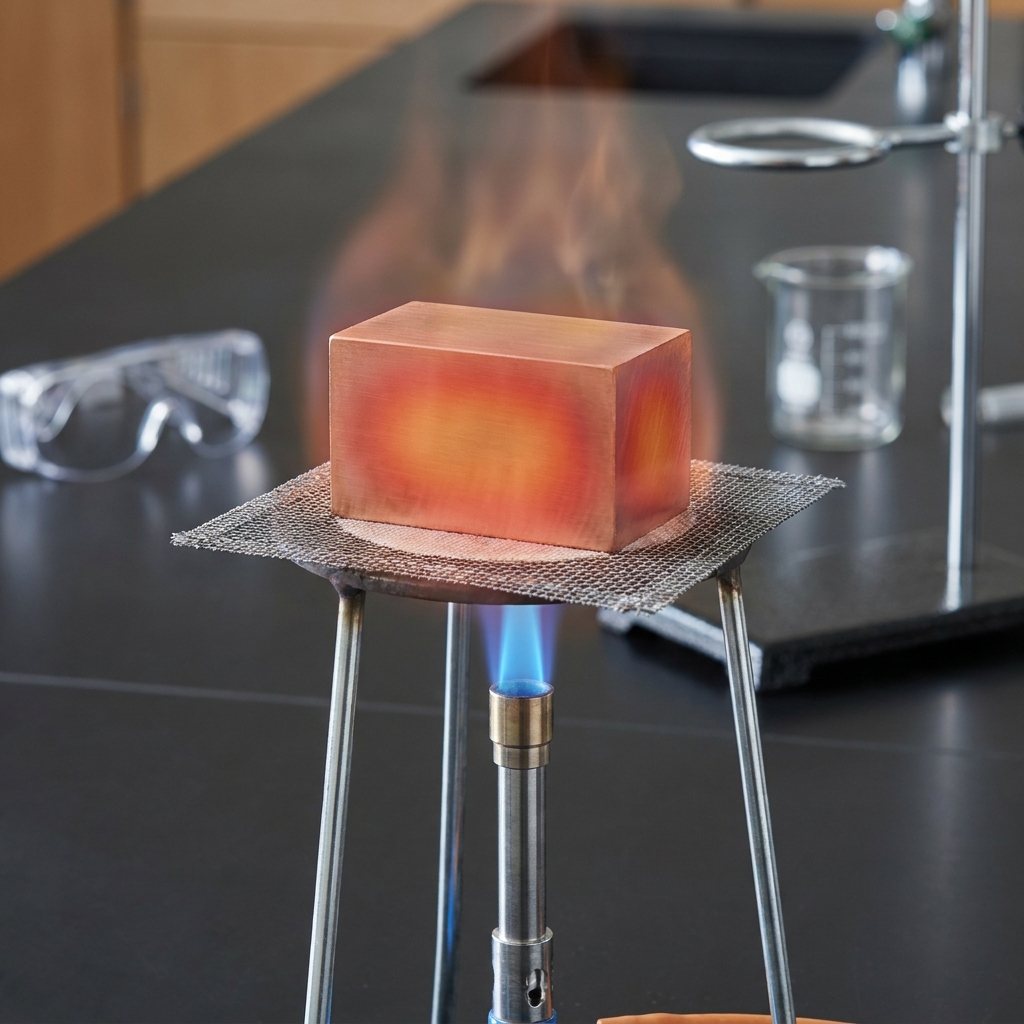
Thermal Energy and Particle Motion, Examines how microscopic particle speed correlates with macroscopic temperature changes