

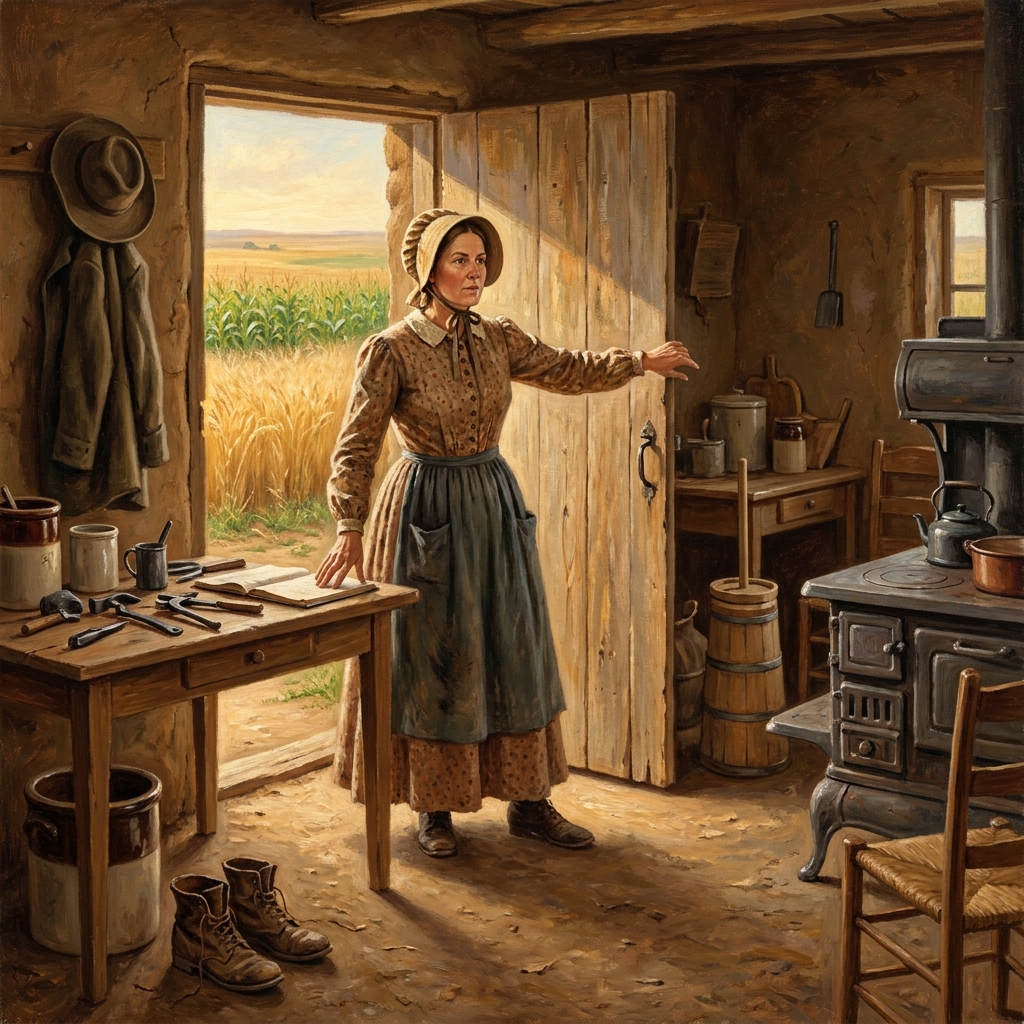
I was just looking over our US History pacing, and I think Women on the Western Frontier is exactly what you need for that block on westward expansion. It is a tight, 45-minute lesson that sticks to the point without too much fluff. Since our students sometimes view history as just a list of names and dates, they tend to glaze over when we talk about legal and social changes. This lesson brings it back to the daily, tangible labor that defined life for women on the prairie.
What students actually do
The lesson starts by anchoring the concept of status in the everyday work of survival. It points out that pioneer women performed essential labor to keep a household running, from cooking and cleaning to gardening on the harsh prairie. It uses the example of Laura Ingalls Wilder to make that abstract concept of status concrete. Then, it pushes students to think about agency through a scenario where a woman manages a homestead entirely on her own because her husband is away. In this exercise, students have to identify how making decisions about land and crops shifted a woman’s standing in her community.

Aligning with the California standard
This 8th grade social studies lesson is built specifically to address CA.HSS-8.8.3. This California-adopted standard asks students to describe the role of pioneer women and the new status they achieved in the West, such as through the work of figures like Annie Bidwell or the fact that Wyoming granted suffrage to women in 1869. The standard also looks at how slave women gained freedom during this period. Teachers in Twin Rivers Unified, Sweetwater Union High School District, South Whittier Elementary School District, and Tehachapi Unified are all working toward this same standard, which asks students to analyze the specific, evolving roles that moved these women into positions of greater power.
Where to use this in your week
I found that this works best as a whole-class assignment or for a student who missed the week and needs to catch up on the social history side of the unit. It is also a perfect fit for a substitute day because the instructions are clear and the guided practice is straightforward. Just watch for students who struggle to define status as a form of power. Some will just list chores, so you might need to lean on the provided why-it-matters section. It explains that when they learn how laws and personal contributions changed the status of women in the West, they can better understand their own role in government today. That connection to the present is a great hook. Just keep an eye on the guided practice section where they imagine managing that homestead alone. It requires a bit of empathy that some of my eighth graders are still working on, but it is worth the effort.

Related lessons

Abraham Lincoln and the Declaration of Independence, Discusses presidential interpretation of the nation's founding American political document

Building the Nation: Federal Economic Policy in the 19th Century, Covers federal financial legislation and nineteenth century economic growth trends

Reconstruction: Rights, Bureaucracy, and Jim Crow, Explains post-civil war political shifts and the new legal landscape