

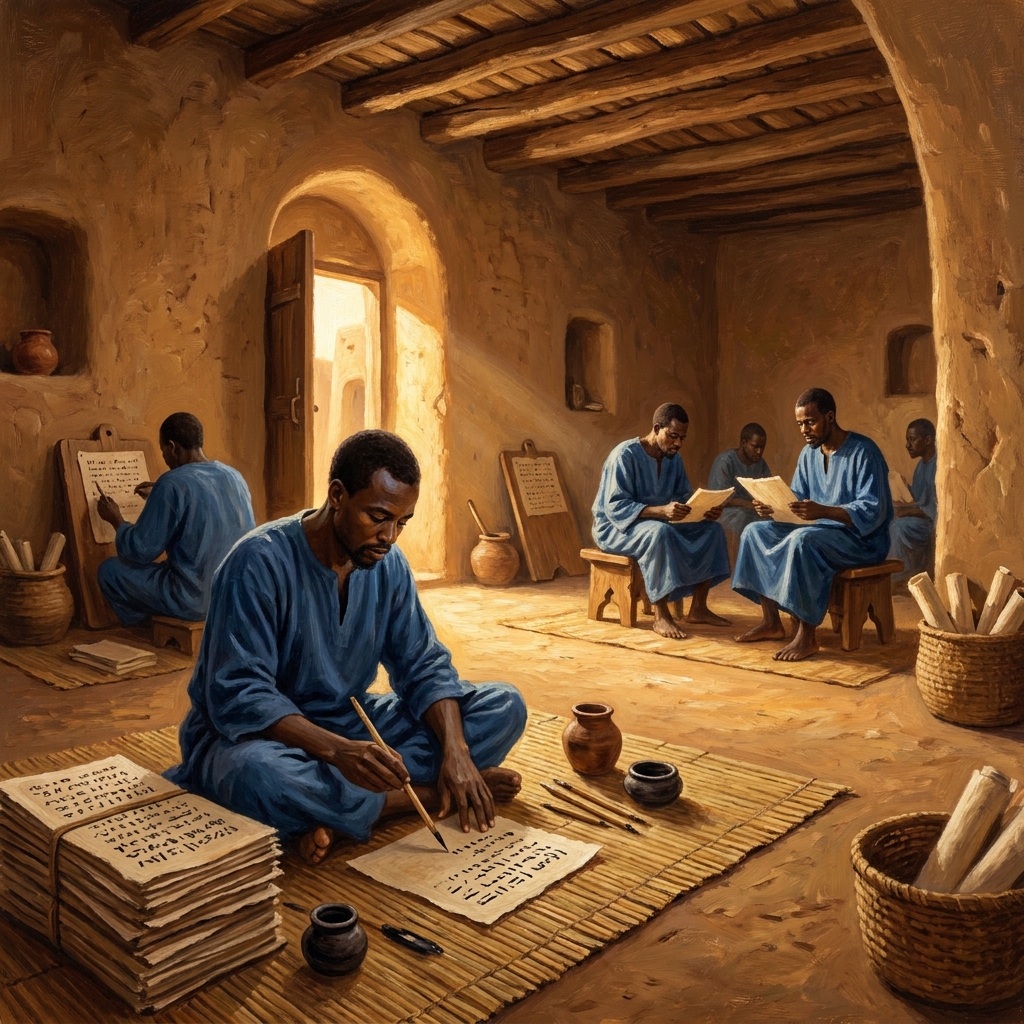
Students often arrive in my 7th grade social studies classroom assuming that history only exists if it is trapped behind glass or printed on a page. When we start talking about the history of Medieval Africa, they struggle to categorize a story told under a tree as legitimate historical evidence. This mistake is common because we spend so much time emphasizing textbooks and artifacts. Voices and Ink: Preserving African History does a good job of correcting that bias by showing how oral and written records functioned together to maintain complex civilizations.
This lesson is designed for a standard 45-minute period. It starts by grounding students in a familiar scene: a village elder sitting on a wooden stool while children gather on the ground to hear the story of their ancestors. By starting here, the lesson immediately forces students to view the storyteller as an official source of information rather than just a narrator of myths. It is a necessary shift in perspective for seventh graders, who are just beginning to evaluate the credibility of different historical accounts.
The mechanism of historical preservation
The core concept here is that African societies in places like Ghana and Mali relied on a dual-track system. The lesson explains this through the specific example of Timbuktu, where scholars documented trade records using ink on paper. These manuscripts are concrete evidence, showing exactly what goods moved through the city in the 14th century. When you use a 7th grade oral tradition lesson like this one, you can show your students that written records provide permanence, while oral traditions provide the community framework that holds everything together.

The vocabulary provided is quite specific. The lesson defines a Griot as a West African historian, storyteller, and musician who preserves the history of a people through oral tradition. It also defines transmission as the process of passing information from one generation to another, and oral tradition as the practice of speaking these histories aloud. These terms are not just academic definitions. They represent the official, sanctioned roles that kept society stable over centuries. The lesson emphasizes that transmission was a deliberate social responsibility rather than a casual activity.
Meeting the California social studies standards
The primary standard being served here is CA.HSS-7.4.5. This California-adopted standard asks students to describe the importance of both written and oral traditions in the transmission of African history and culture. Across the state, teachers in Mt. Diablo Unified, San Jose Unified, Rescue Union Elementary School District, and Atascadero Unified use this same standard to help students understand how sub-Saharan civilizations organized their societies. The standard recognizes that without both tracks of information, we would lose the context for why these societies valued specific social norms and governance structures.
I appreciate that the lesson does not try to over-simplify the history. It presents proverbs as social glue, noting that these short sayings provided a common framework for behavior. When students work through the guided practice, they are asked to imagine a community gathering to hear a proverb. This helps them understand that these traditions were how values were reinforced, not just how names and dates were recited. It brings the history into the present, showing students that they use similar skills whenever they talk about what is important in their own communities today.
Classroom application and observations
I find this lesson works best when you give students space to debate which form of history is more reliable. You might notice your class hesitating to call an oral story a record, but once they see how the Griot served a professional, sanctioned role, they change their tune. It is a productive bit of friction. If you have a student who missed the week or needs an independent study assignment, this is a solid choice because it requires them to synthesize information rather than just memorize facts. It is also excellent for a substitute day because the narrative arc is self-contained and easy for a student to walk through independently.

One limitation worth noting is that it does not cover every aspect of the sub-Saharan civilizations in great detail, as the focus is tightly centered on the transmission of knowledge. You will likely want to supplement it with more information on the geography or specific political structures if that is your current unit focus. However, as a standalone look at historical methodology, it hits the mark. It treats seventh graders like historians who are capable of understanding why societies needed permanent, reliable ways to hand down their truth to the next generation.
Related lessons
Innovations of Medieval China, Scientific and technological advancements during the medieval Chinese period
Protestant Self-Governance and Democratic Ideas, Historical connections between Protestant values and early democratic systems
Islamic Civilizations in the Middle Ages, Social and cultural structures of Islamic civilizations during medieval times