

This 4th grade English Language Arts lesson is an ideal tool for an intervention teacher, an independent-study coordinator, or a counselor who needs a straightforward way to revisit core reading concepts with a student. If a student in your class missed the week we spent on informational text structure or simply needs a refresher on how to approach different types of historical and factual writing, this resource provides a clean path to mastery. It runs about 45 minutes, making it a manageable assignment for a student working through attendance recovery or for a substitute teacher who needs a focused, self-contained lesson for the day.
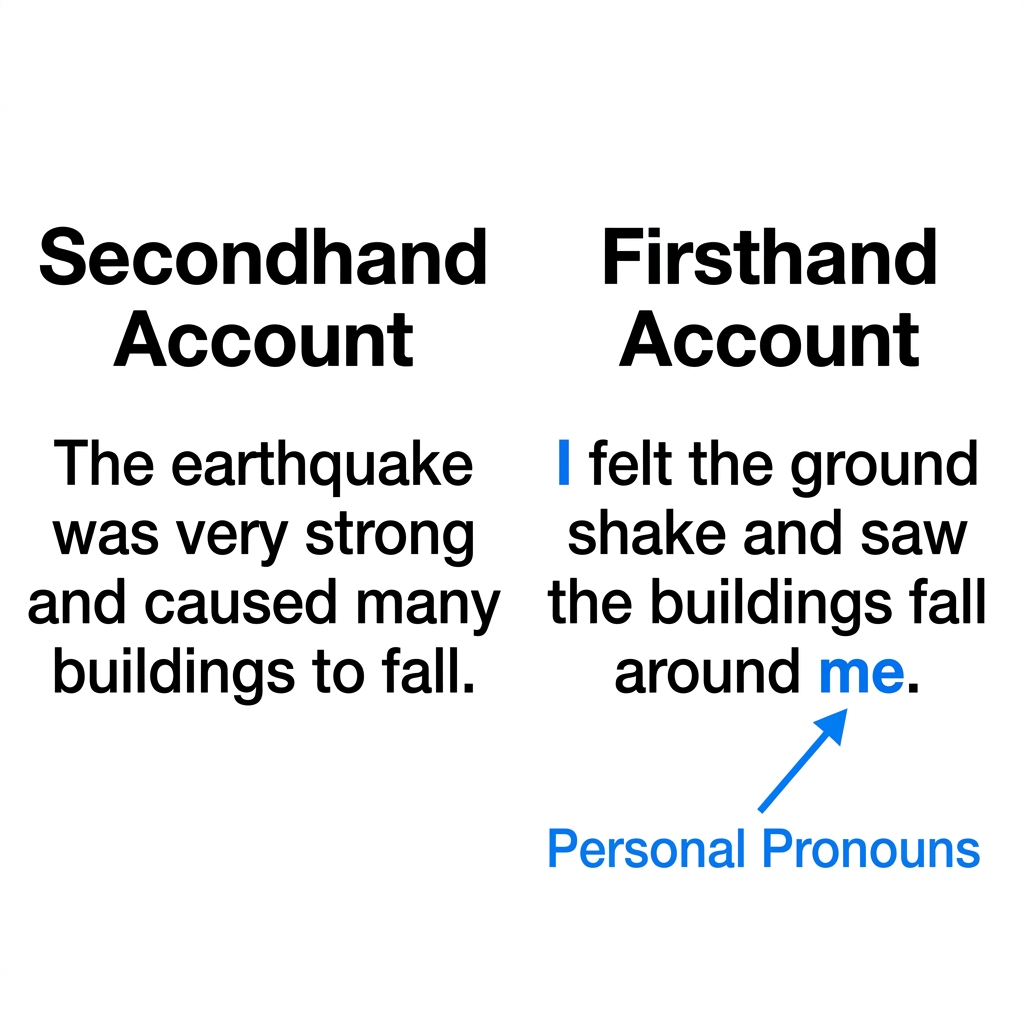
The material focuses on Understanding Firsthand and Secondhand Accounts, which is a foundational skill in the 4th grade reading curriculum. Students begin by establishing basic vocabulary. A firsthand account is a record of an event written by a person who experienced it directly, while a secondhand account is a record written by a person who did not experience the event but learned about it from others or research. The lesson uses a soldier’s letter from the Revolutionary War as a primary example. When the soldier writes about feeling cold and hungry while fighting for freedom, students clearly see the personal perspective that defines a firsthand record. It is a solid, concrete example that avoids unnecessary abstraction.
What the lesson actually asks students to do
This assignment directly addresses CA.ELA.RI.4.6, the California-adopted standard that asks students to compare and contrast a firsthand and secondhand account of the same event or topic and describe the differences in focus and the information provided. The standard requires more than just identifying the type of text. It asks the student to analyze why the focus shifts depending on who is writing. Whether you are teaching in Riverside Unified, Los Angeles Unified, Oak Grove Elementary School District, or Las Virgenes Unified, the expectation remains that students can look at two accounts and explain how the writer’s personal involvement changes the information. The lesson uses guided practice that prompts the student to apply this logic to a description of a volcanic eruption, which is a perfect way to test if they can identify the difference in focus without getting lost in the details of the event itself.

When a student completes the work, they should understand why this distinction matters in the real world. As the lesson correctly points out, this is a matter of knowing who to trust. If you want to know how a specific game felt during play, you ask the athlete; if you want to know the rulebook requirements, you read the official guide. This is the exact logic a journalist uses, and it is a helpful bridge for 4th graders who are starting to move beyond simple narrative reading.
Where students slip
The trickiest part for most students is often the bias inherent in firsthand accounts. They tend to assume that because a firsthand account is personal, it must be the full truth, or conversely, that because it is personal, it cannot be factual. This lesson does a good job of steering them toward the middle ground. It teaches them to look for the focus rather than just hunting for facts. In my experience, students who struggle with firsthand and secondhand accounts often rush to summarize the topic instead of comparing the accounts as requested. If you are assigning this for intervention or independent study, remind the student that their job is to compare the writers’ perspectives, not just to list what happened during the volcanic eruption or the war. Focus is everything here. By the time they hit the final practice section, they should be able to articulate why a scientist writing about a volcano provides different information than a local resident who watched the lava flow. If they can make that distinction, they have met the standard.

Related lessons

Understanding How Informational Texts Are Organized, Teaches students to identify structures in informational reading materials

Finding the Main Idea and Summarizing, Focuses on pulling key ideas from complex informational text

Using Visuals to Understand Informational Text, Explains how charts and diagrams enhance informational reading comprehension