


Students often treat dictatorships like villains in a movie who appear out of thin air, fully formed and already powerful. They frequently miss the messy, desperate transition points that actually allowed these movements to take hold. When we teach The Rise of Totalitarianism after World War I, the challenge lies in shifting their perspective from personal blame to historical causation. This tenth grade social studies lesson forces that shift by grounding the rise of power in specific economic and social realities.
You can use this material for a whole-class assignment, a substitute day, or for a student who missed the week and needs to catch up on the narrative of the 1920s and 1930s. The lesson covers the specific mechanics of totalitarianism, a term defined here as a form of government in which the ruler or party has absolute power and seeks to control every aspect of public and private life. It uses the history of post-WWI Germany to illustrate how hyperinflation and the sudden drop in the value of money created a vacuum that radical groups were quick to exploit. Students examine how Mussolini utilized mass mobilization to force the King of Italy into appointing him, moving beyond simple biography to look at tactical, organized pressure.
The lesson focuses on the transition points that created a vacuum for power. By identifying the specific economic and social realities, students see that the rise of power was not inevitable. It was a reaction to the sudden drop in the value of money and the desperation of the post-WWI environment. When you look at the mechanics of totalitarianism, you see how these groups exploited the vacuum created by economic collapse. This tenth grade social studies lesson provides the tools to trace these shifts. Students start to see the difference between a government that manages crisis and a government that uses crisis to consolidate absolute power. This distinction is the core of understanding these regimes.
Moving past the dictator-as-villain myth
The lesson serves the state-mandated goal of CA.HSS-10.7, which asks students to analyze the rise of totalitarian governments after World War I. This tenth grade history totalitarianism lesson is the same requirement taught in Chaffey Joint Union High School District, Anaheim Union High School District, Cabrillo Unified, and San Lorenzo Unified. It asks students to evaluate how economic instability, like the hyperinflation that made a loaf of bread cost millions of marks, left citizens searching for stability at any cost. The guided practice asks students to step into the role of a historian analyzing the Great Depression, prompting them to connect the Treaty of Versailles and national humiliation to the subsequent political shifts. This postwar landscape is presented as a breeding ground for extremism, rather than just a historical backdrop.

By forcing students to look at the Treaty of Versailles, the lesson encourages them to analyze national humiliation. This is not just a historical event but a tool that radical groups used to gain support. Students analyze how this humiliation, combined with economic instability, created a specific environment where extremism could thrive. This approach shifts the focus from simple biography to the tactical, organized pressure that defined the era. The guided practice asks students to trace the path from the end of the war to the rise of authoritarian control, connecting the pieces in a way that makes the timeline logical and easier to grasp.
Why the mechanics of power matter
One aspect I appreciate is how the lesson handles the role of media. It makes the connection between historical propaganda and the information environment today. When the material says identifying propaganda is crucial today, it is reminding students that the tools used to consolidate power are not just relics of the past. It provides a frame for why this specific CA.HSS-10.7 content remains relevant. By understanding mass mobilization, students begin to see how public support is manufactured. The lesson defines opposition as those who challenge these government goals, helping students recognize how totalitarian regimes work to silence dissent by framing it as a threat to national stability. This approach works well because it forces students to think about how governments manipulate information. The biggest limitation is that the lesson is brief, so it works best when you are ready to facilitate a follow-up discussion on how these patterns appear in other contexts. It does not try to solve everything, but it provides a clean, logical framework for the shift from democratic processes to total control.

The lesson is designed for a tenth grade social studies classroom where time is limited. It provides the specific mechanics of totalitarianism, allowing you to use it for a whole-class assignment or for a student who missed the week and needs to catch up. The lesson does not try to solve everything, but it provides a clean, logical framework. By grounding the history of post-WWI Germany in specific economic and social realities, it helps students understand how the sudden drop in the value of money created a vacuum that radical groups were quick to exploit. This lesson effectively connects the history of mass mobilization to the broader study of political shifts. When you look at the mechanics of power, you see how these governments moved beyond simple biography to look at tactical, organized pressure. Students see how the history of the 1920s and 1930s is more than just a narrative of villains, but a study of power and influence.
Related lessons

Industrial Change: Machines and Society, Discusses how new technology transformed daily life and industrial production
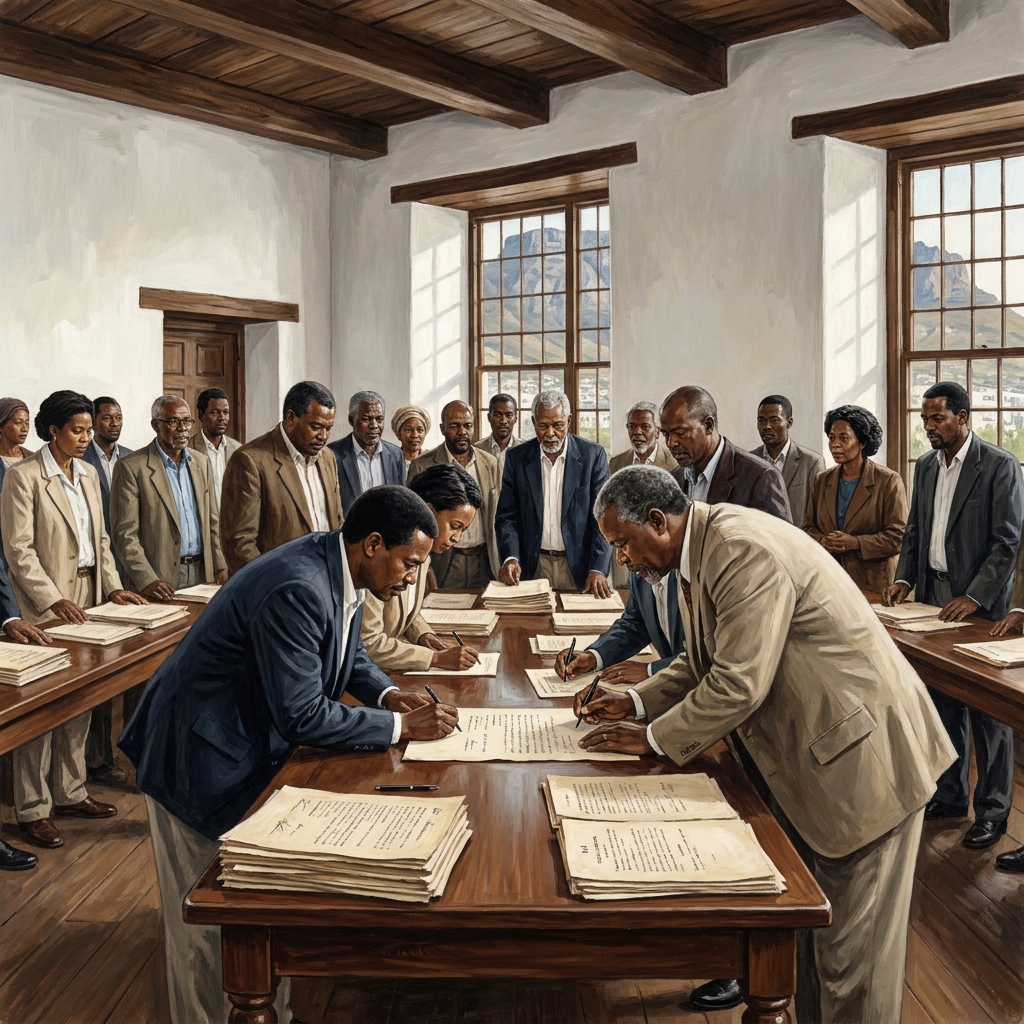
Democracy and Individual Freedom in the Modern World, Examines the development of democratic ideals against rising authoritarian pressures
Capitalism and Its Critics, Covers economic theories and debates regarding early twentieth century markets