


By the time third grade math rolls around to division, students have usually spent a good amount of time building a foundation in multiplication. Moving from the idea of combining groups to splitting a total into equal parts is a significant shift in thinking. This transition usually happens mid-year, and getting it right sets the stage for everything that follows in elementary arithmetic.
I recommend starting with Sharing and Grouping: Understanding Division because it keeps the focus on the concrete action of partitioning objects. Whether you are using this as a whole-class introduction, a review for a student who missed the week, or an independent study module, it grounds the abstract concept of division in manageable, real-world scenarios. This lesson is built around the primary standard CA.MATH.3.OA.2, which requires students to interpret whole-number quotients of whole numbers. When you apply this standard, you are asking students to visualize 56 divided by 8 as a way to partition 56 objects into 8 equal shares. The lesson also incorporates CCSS.MATH.3.OA.A.2, which helps students interpret quotients by viewing them as the number of shares or as the size of each share when partitioning occurs. Educators from Twin Rivers Unified, Los Angeles Unified, Newhall School District, and Eureka City Schools School District all rely on these same principles to ensure students understand that division is simply the inverse of their multiplication facts.
What the standard really asks
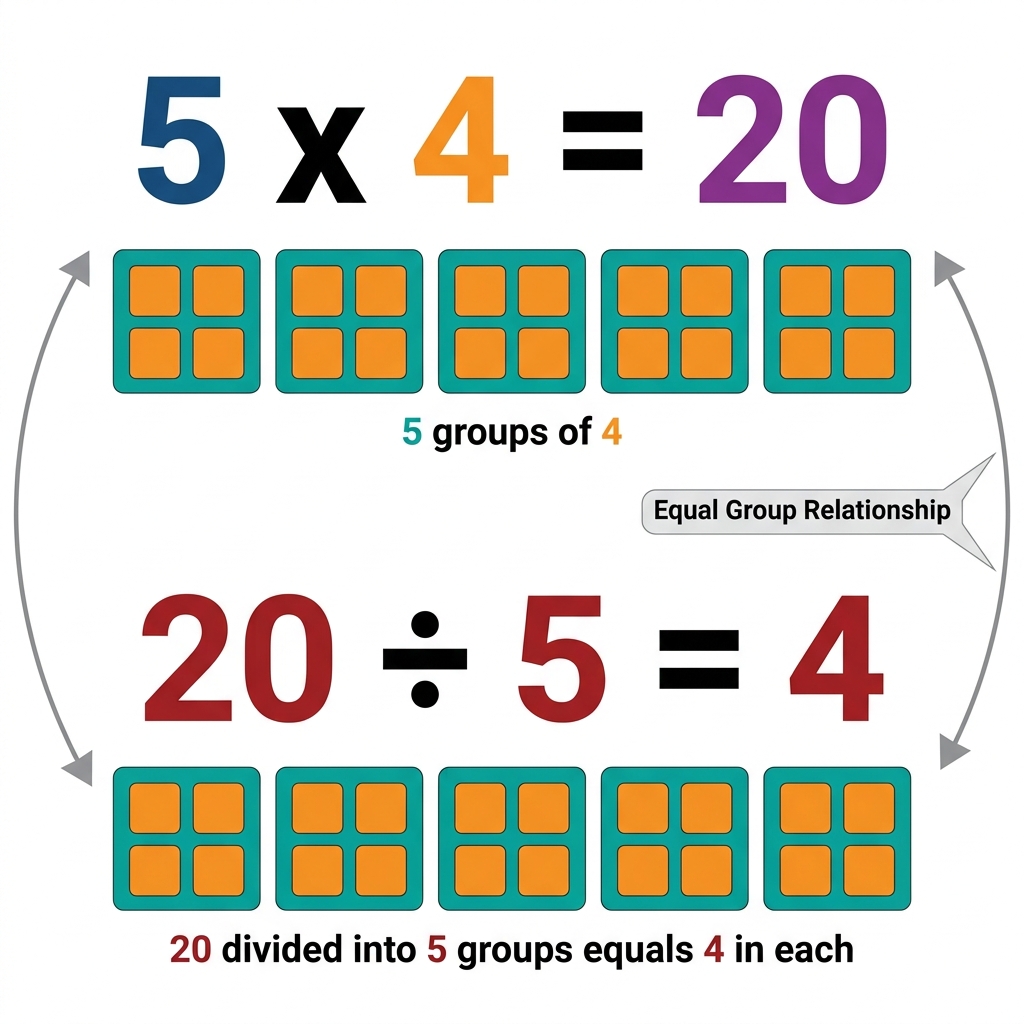
The standard asks for more than just mechanical calculation. It demands that a student can describe a context where a total number of items, a number of groups, and the size of each group relate to one another. For instance, if a student has 20 cookies to share among 5 friends, they should be able to write the equation 20 / 5 = 4. They must recognize that 20 is the total, 5 is the number of groups, and 4 is the size of each share. It is a common mistake for students to confuse the number of groups with the number of items per group, so I appreciate that this lesson forces them to articulate the difference.
How the lesson builds the concept
The lesson uses a practical opener that moves students from the comfort of multiplication into division: if a student knows how to use multiplication to find a total, they now need to learn to go the other way by splitting a total into equal parts. It uses simple scenarios, such as 12 cookies shared among 3 friends or 24 blocks shared among 4 people, to illustrate that each person gets exactly 6 blocks. By the time students reach the guided practice where they have 28 stickers to put into 7 bags, they have a clear understanding of the following terms:
- division: a way to split a total number of objects into equal parts, where each part has the same number of items
- quotient: the number of objects in each share or the number of groups created after dividing
If you are looking for a reliable third grade division lesson, this one hits the mark by keeping the examples grounded. It shows students that a division equation is just a mathematical sentence showing the relationship between a total and its parts, much like how a baker divides muffins into equal boxes for customers. It is a straightforward approach that avoids overcomplicating a skill that many students find intimidating at first.
Related lessons

Understanding Multiplication, Building foundational skills for multiplication using groups and arrays
Solving Math Problems with Groups and Arrays, Representing multiplication and division through arrays and groups

Solving Two-Step Word Problems, Applying multiplication and division to multi-step word problems