

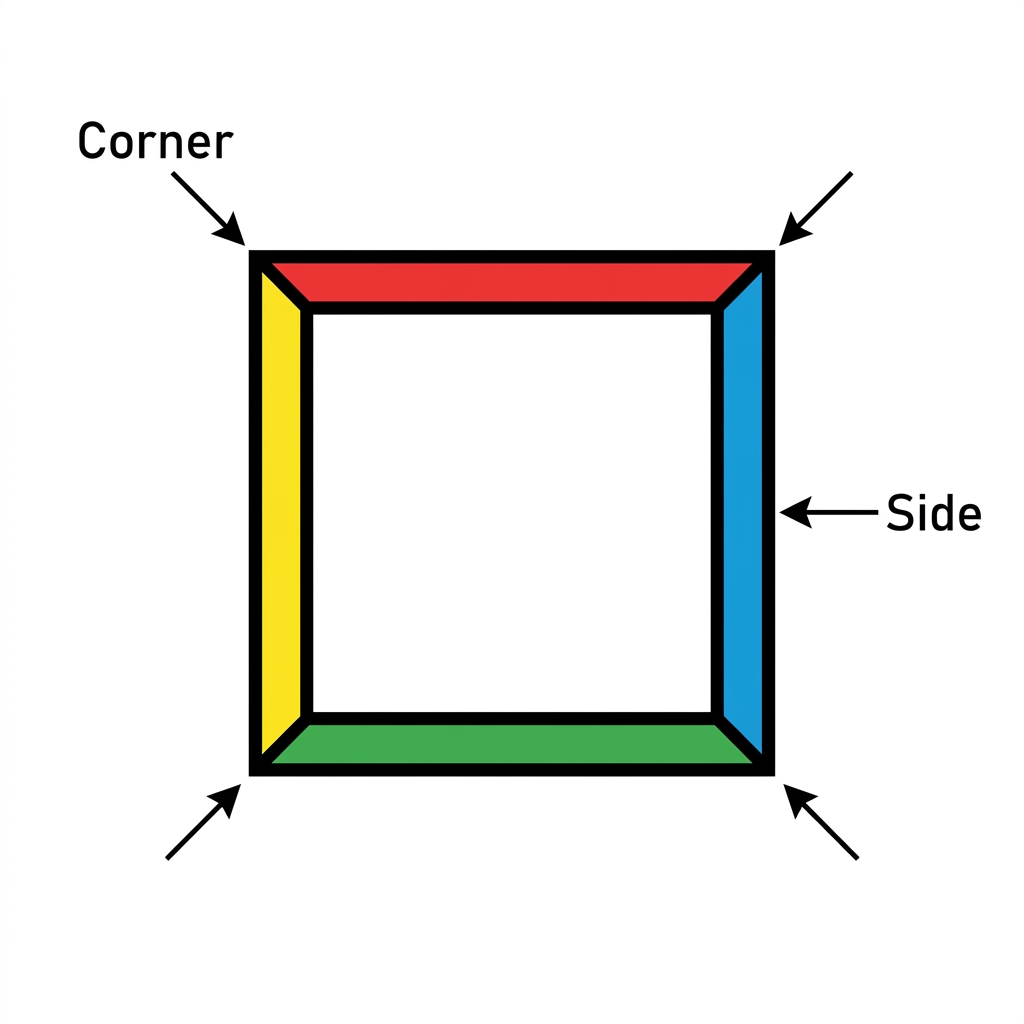
When we get to mid-year, kindergarten students often hit a wall with geometry. They can easily name a square if it sits flat on its base, but if you tilt that same square to look like a diamond, they suddenly start calling it something else entirely. It is a common hurdle because early learners tend to look at the whole shape rather than breaking it down into its actual properties. This is exactly where the lesson Shapes All Around Us proves its worth by shifting their focus from the overall orientation to the specific components that define a shape.
This kindergarten mathematics resource is designed to help students stop guessing and start analyzing. The objective is simple: I can name and compare shapes by their sides. Students work through identifying shapes by looking at the number of sides and vertices. The lesson material explicitly asks them to use informal language to talk about similarities and differences, teaching them to look past how a shape is rotated to identify what it really is based on its parts.
Analyzing shapes through specific attributes
The lesson moves students toward meeting CA.MATH.K.G.4. In California, this standard asks students to analyze and compare two- and three-dimensional shapes in various sizes and orientations. It requires using informal descriptions to point out parts like sides and corners. Whether you are teaching in Oakland Unified, Newport-Mesa Unified, Westminster School District, or Placentia-Yorba Linda Unified, you are working toward the same goal of getting students to recognize these essential geometric attributes. When you use a kindergarten geometry lesson like this, you are giving them the vocabulary to defend their answers instead of just making a guess based on how a shape is positioned on the page.

The material focuses on a few key terms to build this understanding. Students will be expected to talk about:
- Sides
- Vertices (which they learn as corners)
- Attributes
- Similarities
- Differences
The beauty of this approach is that it forces them to count. Once they realize that a triangle always has three sides regardless of how it is turned, the orientation problem starts to disappear. It is a relief for the teacher, because you no longer have to explain the same concept every time a worksheet changes the rotation of an object.
Where students slip in geometry
The biggest struggle I see with this standard is that students want to ignore the properties if the shape is complex or stretched. They see a rectangle and call it a square because it has four sides. This lesson helps head that off by encouraging them to compare the lengths of the sides. By discussing which sides are equal and which are not, they start to develop a deeper sense of what makes a shape unique. I find that when I pair this with some physical blocks, the kids really start to see why the sides matter more than the orientation.

If you have a student who missed the week or needs a bit of extra help during intervention, this 15-minute activity is perfect. It is concise, hits the standard directly, and does not waste time with fluff. It also works quite well as a quick task for a substitute day if you need something that is low-prep but high-value. You can trust that the students will walk away with a firmer grasp of how to define a shape, which is a foundational skill they will rely on throughout their elementary school years.
Related lessons

Shapes All Around, Practicing the identification of various shapes in everyday settings

Making New Shapes, Building complex shapes by combining smaller simple shapes
Making Numbers Together, Developing early number sense through counting and grouping