

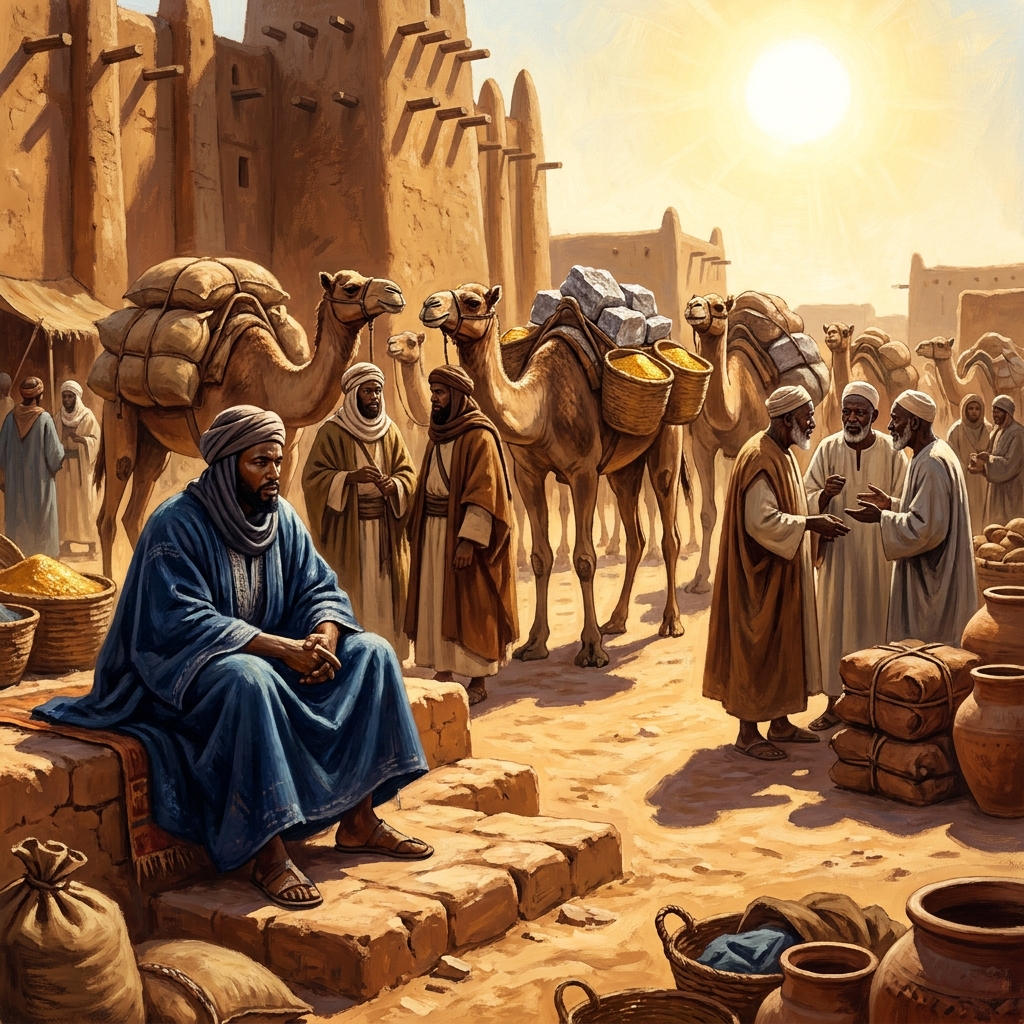
The unit on Medieval West Africa offers 7th grade students a chance to look beyond the typical focus on European history. When you assign Power and Stability in Medieval West Africa, you ask students to reconsider what makes a civilization thrive beyond just castles and cathedrals. It centers on the Niger River, which the material correctly identifies as a vital highway. It was not just a source of water for farming but the actual lifeblood that allowed the Ghana Empire to control resources and expand its influence. If students miss this connection, the entire narrative of why these empires rose and fell stays abstract. They need to see that geography dictates the possibility of surplus food, which in turn fuels the complex societies they are studying.
Geography as the foundation for state power
By the time your students reach the unit on Medieval West Africa in their 7th grade history course, they have usually spent weeks looking at maps of Europe and the Mediterranean. This shift in focus is significant. You will find that students often breeze over the concept of geography until they have to map out trade routes. This lesson asks them to think about the Niger River as a strategic asset. When a student understands that boats carrying goods meant the difference between a regional village and a vast empire, they begin to see history as a series of deliberate choices rather than inevitable outcomes. The lesson is built to ensure they can explain how geography, trade, and leadership shaped the empires of Ghana and Mali, moving them from simple identification toward real analysis.

Understanding the mechanics of trade and leadership
The core of this 7th grade social studies lesson is how these empires managed their own internal and external stability. It introduces a set of specific vocabulary terms to help students organize their thoughts: Empire, Trans-Saharan trade, Mansa, Social hierarchy, Surplus, and Bartering. Using these terms is essential because the students need a common language to discuss how the Trans-Saharan trade network connected West Africa to the Mediterranean world. If they cannot explain what bartering is or how a surplus of resources shifted power, they struggle to grasp the economic nuances of the Mali Empire.
I find the worked example scenario particularly helpful for classroom discussion. It places the students in the shoes of a merchant who must pay a tax on goods before selling them in the market. This turns a dry economic concept into a concrete, human experience. The lesson also highlights the role of the Mansa. By describing the Mansa as an emperor or king who ensured merchant safety and promoted religious tolerance to maintain peace, the lesson provides a clear look at how central leadership functions in practice. If you have students who are typically disengaged during lecture-heavy days, this tax-scenario approach usually sparks a few questions about why and how these taxes were collected, which is exactly the kind of inquiry we want to promote.
Connecting to the state standard
This lesson is designed to meet the requirements of CA.HSS-7.4, which is the California-adopted standard for this unit. This standard asks students to analyze the geographic, political, economic, religious, and social structures of the sub-Saharan civilizations of Ghana and Mali. Whether your students are at Clovis Unified, Sacramento City Unified, Hawthorne School District, or Pasadena Unified, they are learning the same essential components of African history because this is a core expectation across the state. The standard is asking for a structural analysis, not just a list of kings or battle dates. It wants students to see how the religious environment and social hierarchy interacted with economic necessity to sustain the empire over generations.

One caveat: the material covers a lot of ground in forty-five minutes. You might find that some students need extra time to process the difference between a social hierarchy and a simple division of labor. I suggest treating the why-it-matters section, which compares ancient trade routes to our modern reliance on international law and global economy, as a bridge. Connecting their own lives to these ancient structures is the best way to make the standard feel less like a hurdle and more like a tool for understanding their current world. When they see the past as a logical system of trade and governance, they are much better prepared for the unit on the Renaissance and the Age of Exploration that usually follows later in the spring.
Practical application for the classroom
I view this lesson as highly versatile for different classroom needs. It works well as a whole-class assignment because the narrative flow keeps everyone on the same page. However, it is also a fantastic tool for a student who missed the week or is working through an independent study program. Since the text is clear and the objectives are defined by the vocabulary and the guided practice, a student can work through the module independently without needing to jump between five different textbooks or digital resources. If you have a substitute teacher for the day, this is a very safe bet because it provides the structure they need without requiring them to be experts in the specific nuances of Mali or Ghana.
If you find that your students are still struggling with the concept of the social hierarchy after the first run-through, consider having them map out the merchant’s path again, but this time asking them to label where the various levels of society, from the ruling class down to the merchants and farmers, would interact. It is a simple way to reinforce the vocabulary. The goal is to move them past the idea that these were isolated or primitive societies. They were, instead, highly organized states that utilized their resources to project power across a vast geographic area. Keeping the lesson focused on that structure ensures the students are actually hitting the mark for the state curriculum.
Related lessons
Knowledge Across Borders: The Islamic Golden Age, Studies intellectual advancements during the Islamic Golden Age period

The Roots of the Scientific Revolution, Covers origins and key contributors to the Scientific Revolution

Enlightenment Ideas and Modern Democracy, Explores how Enlightenment philosophy shaped modern democratic systems