


Introducing geometric concepts requires bridging the gap between measuring individual lines and understanding the total boundary of a shape. This transition is essential for students as they begin to explore how measurement applies to the real world. By focusing on the total distance around a polygon, educators can help their students solidify their understanding of addition within a geometric context.
How to introduce perimeter to your third graders
I remember walking past a student working on a worksheet last week who was staring intently at a square garden plot. He had already mastered using his ruler to measure a single line, but he was stuck on how to combine those lengths to account for the entire boundary. That moment of hesitation is exactly where Measuring the Distance Around Shapes steps in to provide clarity. This lesson focuses on the transition from measuring individual segments to understanding the total distance around a polygon.

In this 3rd grade mathematics lesson, students move from simple line measurement to the core concept of perimeter. The lesson defines perimeter as the total distance around the outside edge of a shape. It also clarifies that students are working with polygons, which are simply flat, closed shapes made of straight sides. Seeing these definitions alongside the practical examples makes the math feel less abstract for the class.
Educators in Santa Ana Unified, Lodi Unified, Mendota Unified, and King City Union School District all teach this same core concept as part of their standard curriculum. When you assign finding the perimeter of polygons, you are giving your students a structured path to apply their existing knowledge of addition to geometry.
Connecting the math to the real world
The lesson uses a concrete, relatable approach. For example, it explains a rectangular picture frame with sides of 2 meters and 4 meters, showing that the perimeter is 2 plus 4 plus 2 plus 4, which equals 12 meters. This step-by-step breakdown is vital. It avoids the shortcut of just multiplying dimensions, which can confuse students before they truly understand what perimeter represents. By adding each side individually, students visualize the physical edge they are measuring.
The lesson ties this to the standard CA.MATH.3.MD.8, which asks students to solve real world and mathematical problems involving the perimeters of polygons. This standard is fundamental because it requires students to identify the sides of a closed figure and calculate the sum of those lengths. It is a critical bridge toward more complex geometric measurement tasks.
I find that students get the most out of this when we talk about the “why.” The lesson mentions how construction workers use perimeter to determine the amount of fencing needed for a yard or the wood required for a frame. It frames the error clearly: if they calculate the perimeter incorrectly, they simply won’t have enough materials to finish the job. This gives the math a tangible consequence that resonates with kids.
Managing the lesson in your classroom
I suggest using this lesson for a whole-class introduction, though it works just as well for a student who missed the week or needs a bit of independent study time. It takes about 45 minutes to complete, which is perfect for a focused math block. Keep an eye on students during the guided practice, which asks them to imagine a rectangular swimming pool deck and place a safety rope around it. Watch for those who forget to add all four sides of the rectangle.

One common trap is when students focus only on length and width, forgetting that a rectangle has four sides to measure. If you see them struggling, have them trace the boundary with a finger before they start adding the numbers. It seems simple, but it stops many common mistakes. This lesson is a solid resource that fits cleanly into your third grade mathematics unit on measurement and data. It is direct, easy to follow, and keeps the focus strictly on the math rather than wrapping it in unnecessary fluff.
Related lessons

Measuring Mass and Volume, Covers identifying and measuring mass and liquid volume units
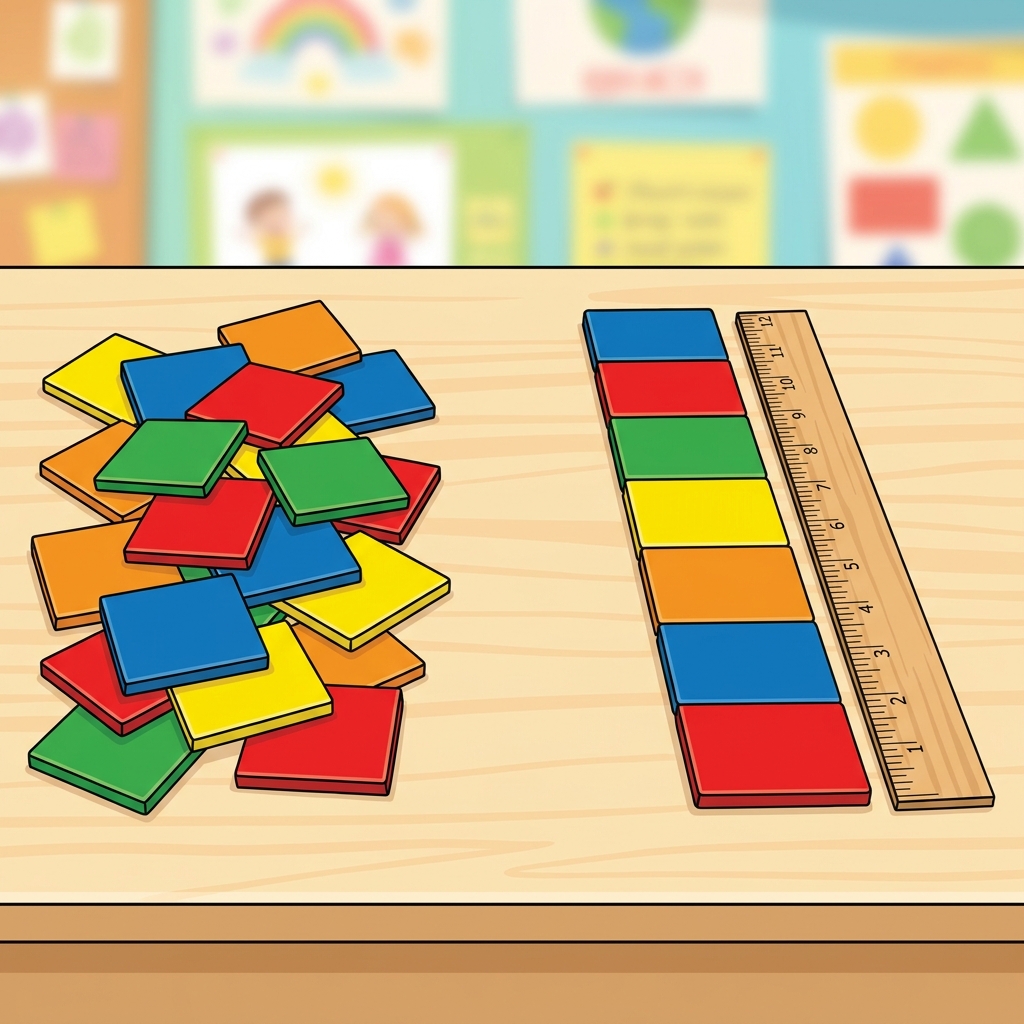
Measuring Space with Squares, Explains how to determine area using square unit tiles

Finding Total Area, Guides students through calculating total area using multiplication