

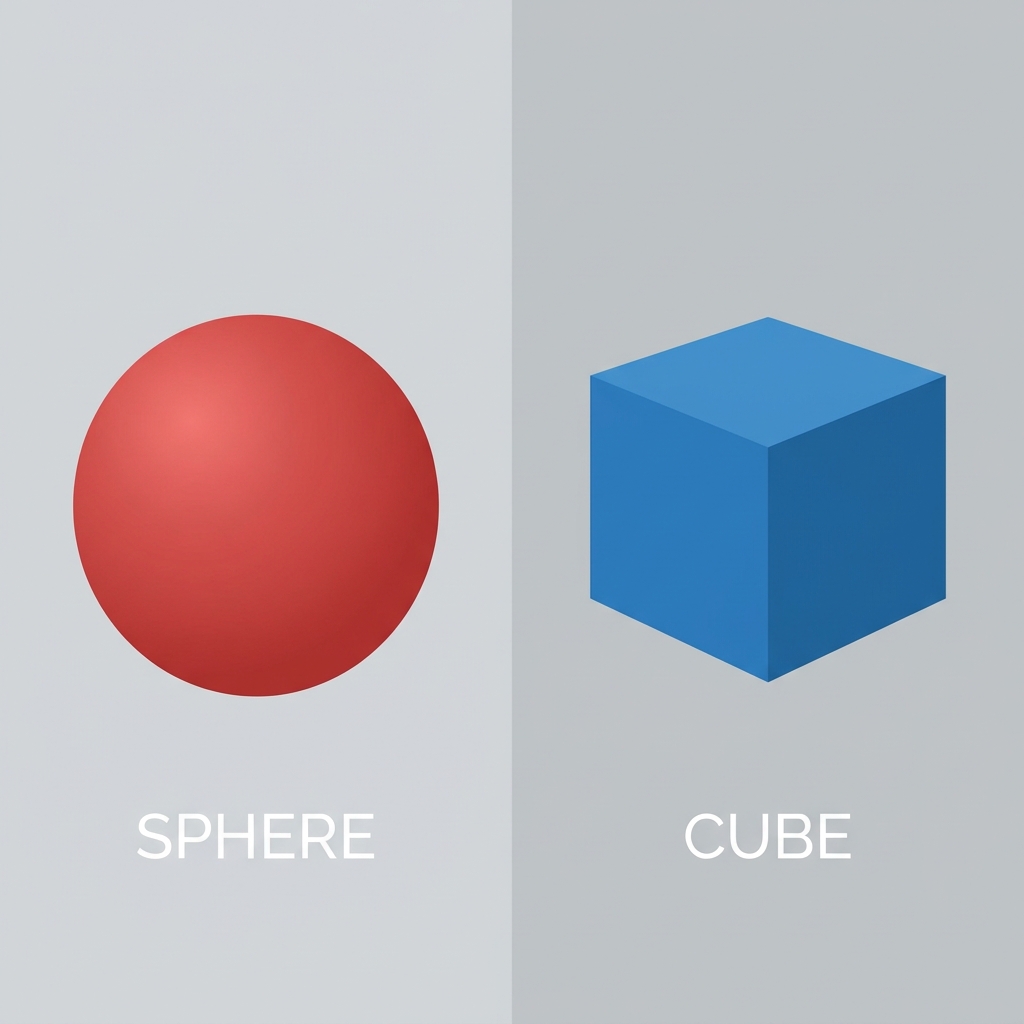
Geometry instruction in the second grade requires students to shift from visual recognition to analytical thinking. When students learn to count corners and identify faces, they build the spatial reasoning necessary for more complex mathematical concepts later in their education. This post outlines how specific geometry lessons help students meet these foundational requirements.
Breaking down the geometry standard
“Recognize and draw shapes having specified attributes, such as a given number of angles or a given number of equal faces.” That is the core requirement of CA.MATH.2.G.1, the California-adopted standard for CA.MATH.2.G.1. In plain language, this standard expects your students to move past just naming a shape because it looks familiar. Instead, they need to verify a shape by analyzing its actual construction, specifically by counting the corners where sides meet and the flat surfaces that make up a solid object. It is a logic test disguised as a drawing activity.

This is a foundational shift in how children perceive the physical world. Instead of just identifying a triangle as a pointed shape, they identify it because it has three distinct corners. This approach is standard practice across Elk Grove Unified, Visalia Unified, Carmel Unified, and Oceanside Unified as they implement the curriculum. Whether you are working with a student who missed the unit in class or a student in an intervention block, the clarity of the criteria helps remove the guesswork from their work.
What the lesson actually asks students to do
In Exploring Shapes and Their Parts, students engage in a 45-minute lesson designed to solidify these geometric rules. The lesson starts with a clear definition: “An angle is the corner where two straight sides of a shape meet.” It anchors this knowledge by defining a triangle as a shape with three such angles, then moves into worked examples like a hexagon, which the lesson describes as a shape that has 6 sides and 6 angles. It effectively connects the concept of flat surfaces, which the lesson calls faces, to the two-dimensional aspects of angles.
After the introductory concepts, students move into a guided practice section. This part of the lesson sets up a puzzle that asks for a shape with exactly 5 angles. This is where you see if your student is truly grasping the definition or just guessing based on the look of the drawing. The lesson does not hide behind fluff; it asks them to prove they understand the relationship between the sides, angles, and faces of a shape before they move on. It is specific, directed, and provides immediate feedback on their spatial reasoning.
Why this lesson fits your classroom
If you are an intervention teacher or an independent-study coordinator, you know that geometry can often feel abstract to a second grader. This lesson works because it grounds the math in real-world application. The lesson highlights that shapes are everywhere: architects rely on specific shapes to construct sturdy buildings, and artists use them to compose images. By understanding how many angles or faces a shape possesses, students see that math is a tool used to make things fit together properly. It gives them a reason to pay attention to the count.
You can use this lesson as a quick whole-class review if you notice the group is struggling with classification, or assign it to a student who needs to recover attendance hours. It is also a solid choice for a substitute day because the instructions are self-contained. The language is direct enough that a student can walk through it without needing a lecture from you, which is a major benefit when you are trying to balance multiple student needs simultaneously.
Where students slip
The most common point of confusion I see when teaching this is the transition from counting sides to identifying angles. Students frequently count the sides correctly but double-count the corners or skip one entirely. Because this 2nd grade shared research writing lesson is focused, it gives you a way to see exactly where they trip up. If a student consistently struggles with the puzzle involving 5 angles, you know exactly which definition to revisit. It saves you from reteaching the entire chapter when the issue is just one specific vocabulary point. Keep an eye on how they identify the faces, as some students confuse a 2D drawing of a 3D shape with the 2D polygon itself. The lesson handles this by reinforcing the definition of a face as a flat surface on a solid shape, but keep that distinction in mind if you have to conference with the student after they submit their work.
Related lessons
Counting Squares in Rectangles, Counting individual squares to find the total area of rectangles
Sharing Fairly: Parts of a Whole, Dividing shapes into equal parts to represent simple fractions