


We have all seen that mid-semester slump where the abstract nature of geometry starts to overwhelm even our most capable eighth grade students. If you are managing an intervention group or an independent study caseload, you know the exact moment when the light bulb flickers. When that happens, you need a precise, focused resource that cuts through the noise and gets back to the mechanics of the subject. Exploring Parallel Lines and Rigid Transformations is built for exactly that kind of student work.
This lesson is designed to be completed in about 45 minutes. It works well as a catch-up assignment for a student who missed the week of classroom instruction, or as a targeted review for someone struggling to visualize geometric changes on a coordinate plane. The layout is clean and the progression of the material is logical, which is a relief when you are balancing multiple student needs in a single session.
What the lesson asks students to do
The core objective is to help students identify how parallel lines remain parallel after being translated, rotated, or reflected. The lesson starts with the basics, defining parallel lines as two lines in the same plane that never intersect because they maintain the same distance from each other at every point. This is the foundation upon which everything else is built. If a student cannot hold that definition, the rest of the unit will remain out of reach.

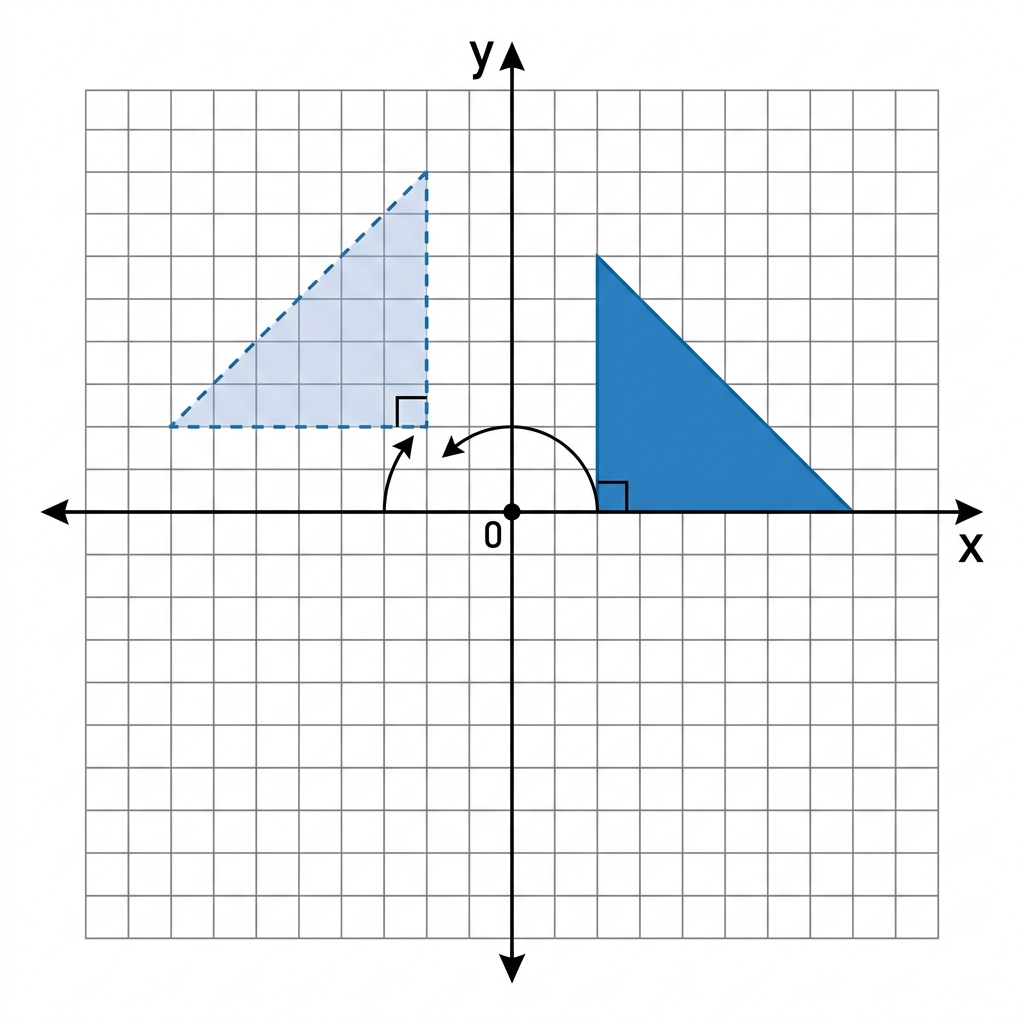
The lesson then introduces a framework centered on the idea of rigid transformations. A rigid transformation is defined here as a movement of a geometric figure that does not change its size or shape, such as a translation, rotation, or reflection. When we slide a figure to a new position on a grid without turning or flipping it, we are performing a translation. The lesson demonstrates that this is a rigid transformation, meaning the shape and size of the figure stay exactly the same.
The material moves into specific worked examples. For instance, a rotation is another type of rigid transformation. The lesson shows that if you take two parallel lines and rotate them 90 degrees around the origin, they will still be parallel to each other in their new position. To check their progress, students move to guided practice where they imagine a tiled floor with a pattern of two parallel lines and must reflect this pattern across a diagonal axis. It is a straightforward way to test if they have truly internalized the geometric property rather than just guessing.
Why this lesson fits your intervention or independent study goals
The lesson serves the California-adopted CA.MATH.8.G.1c standard. This specific standard asks students to verify experimentally the properties of rotations, reflections, and translations, specifically that parallel lines are taken to parallel lines. It belongs to the broader California Common Core geometry cluster focused on understanding congruence and similarity using physical models, transparencies, or geometry software.

You will find that teachers in districts like San Ramon Valley Unified, Desert Sands Unified, Millbrae Elementary School District, and Adelanto Elementary School District are using this same material to ensure their students meet these state requirements. The beauty of this approach is that it connects the math to reality. For example, the lesson explains that engineers use parallel lines in bridge design. The supports must be parallel to distribute weight evenly, and if the supports were not parallel, the bridge might not be stable. That little bridge analogy often makes the difference between a student staring at a coordinate grid and a student who finally understands why the math matters.
When you assign this for attendance recovery or independent study, the feedback loop is simple. Because the lesson provides such specific scenarios, you can easily glance at the student work to see where they broke down. Did they forget the definition of parallel lines? Or are they struggling to perform the reflection on the coordinate plane? Being able to pin down the error quickly is the best tool an intervention teacher has. It keeps the student from spinning their wheels, and it keeps your schedule from falling apart.
The lesson is not meant to be a week-long project. It is a concentrated dose of practice. If you have an eighth grader who feels behind, direct them to this content. It is enough to refresh their memory without adding to the sense of being overwhelmed that many struggling math students report.
Related lessons

Geometric Angle Relationships, Covers how angles relate within geometric figures and lines

Understanding Volumes of 3D Shapes, Explains calculating volume for various three dimensional objects
Understanding Rigid Transformations, Discusses movements that preserve shape and size