

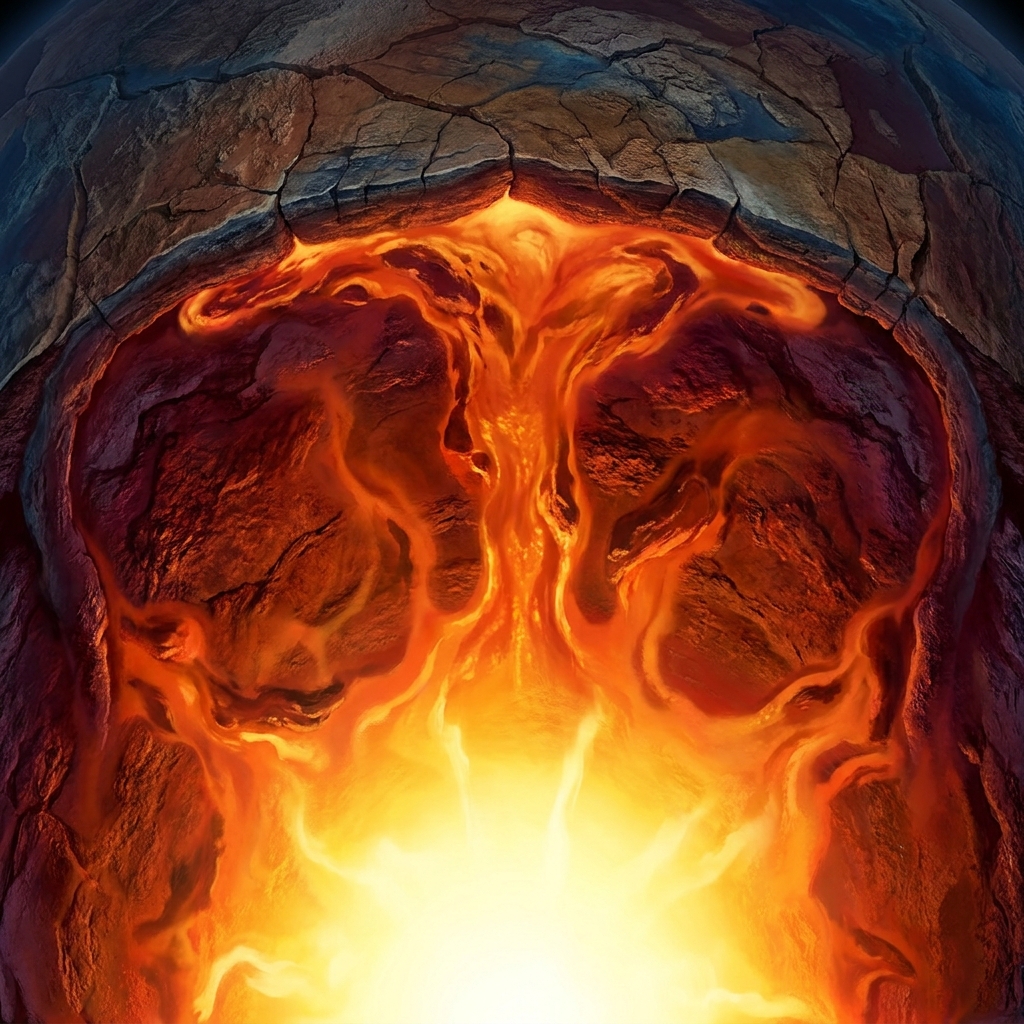
Finding a solid, straightforward lesson for a student struggling with Earth science can be a headache, but Earth’s Moving Interior makes it manageable.
This lesson is designed for high school biology or earth science students who need a focused review of how thermal energy dictates planetary movement. It takes roughly 45 minutes to complete, which makes it a practical option for an independent study module, an attendance recovery session, or a substitute teacher day. It is direct and avoids the fluff that often weighs down digital curriculum.
What the lesson covers
The core objective is to explain how internal heat generates moving currents that shift the outer layers of the planet. It opens with the basic physics of thermal transfer: heat moves from hotter to cooler areas. The materials walk students through the example of a metal pot on a stove, helping them visualize how temperature gradients create motion. From there, it transitions to the mantle, which contains hot, semi-solid rock. This rock functions like a thick fluid, rising when heated by the core and sinking as it cools near the crust.

Students work with three primary vocabulary terms to explain these geological phenomena: thermal convection, mantle, and buoyancy. These terms provide the framework for understanding how buoyancy forces allow warmer, less dense material to move upward. The instruction requires students to apply this knowledge to the San Andreas Fault, explicitly connecting the concept of deep convective forces to the surface-level tectonic movement that shapes our own state. Whether you are teaching in Fremont Unified, Perris Union High School District, Petaluma Joint Union High School District, or El Monte Union High School District, the expectation for mastering these concepts remains consistent across California schools.
Connecting to the standard
The lesson is built around HS-ESS2-3, the California-adopted standard that asks students to develop a model based on evidence of Earth’s interior to describe the cycling of matter by thermal convection. This standard is not just about memorizing the layers of the planet. It is about understanding the mechanics of how energy drives geological change. The lesson provides a clear path for students to meet this requirement by linking the abstract movement of rock in the mantle to the tangible reality of crustal shifting. It brings in the California context by noting that this process creates our unique landscape, where plate interactions support the biodiversity we see in our state today.
Using this for intervention
If you have a student who missed the week on plate tectonics or needs a refresher to prepare for a performance task, this high school science convection lesson is a reliable resource. I find that the pacing is helpful because it starts with a familiar analogy before moving to the complex mantle mechanics. It prevents the student from feeling overwhelmed by technical jargon early on.

One limitation to keep in mind is that the lesson relies on the student having a basic grasp of density. If a student is stuck on why the rock rises, you may need to spend five minutes drawing a diagram of a lava lamp before they start the lesson. Aside from that, the digital sequence is self-contained. It is a clean tool for a counselor or an independent study teacher who needs to assign work that can be completed, graded, and documented without a massive amount of overhead.
Observations on the material
I appreciate that the text focuses on the “why” behind the science. Understanding convection matters because it helps us predict earthquakes and volcanic eruptions. By monitoring crustal movement, scientists can see where pressure is building up. The lesson does not hide behind generic statements about science. It stays locked on the relationship between thermal energy and the physical reality of the Earth’s crust. It is a rare example of a digital assignment that treats the student like someone capable of thinking through mechanical causality rather than just checking boxes.
Related lessons

The Cosmic Forge: How Stars Create Elements, Describes how stars synthesize elements throughout their life cycles

Evaluating California Resource Sustainability, Examines sustainable management of natural resources in California
Understanding Earth's Feedback Loops, Explains how negative and positive feedback loops affect climate