

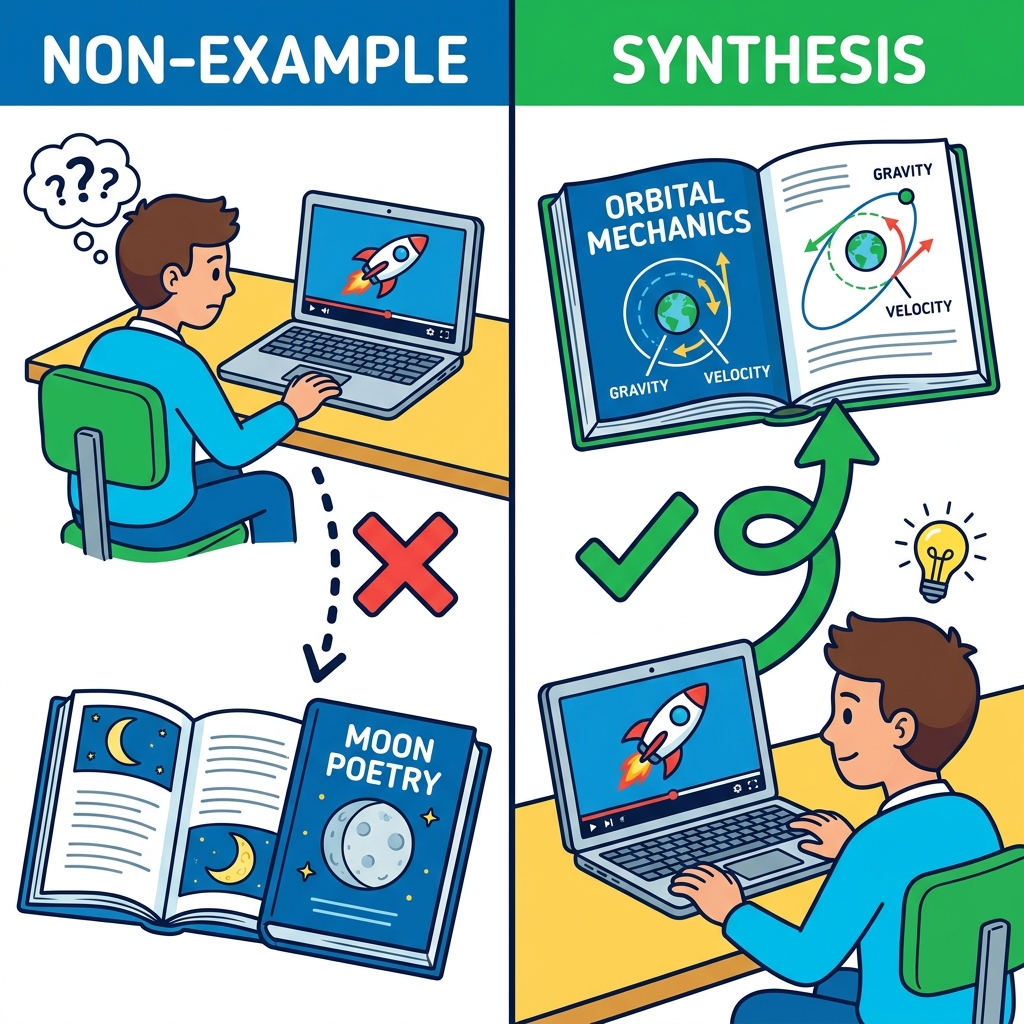
Synthesizing information is a heavy lift for many eighth graders. We often ask students to read a textbook and move on, but in our 8th grade English Language Arts classrooms, we need to push them further by having them compare what they see with what they read. When students look at a scientific video, like a chemical reaction bubbling away in a lab, and then pair that visual evidence with a technical text, they stop just collecting facts and start building actual understanding. The Comparing Scientific Information Across Media lesson gets right to the heart of this work.
The necessity of comparing scientific media and texts
This eighth grade ELA scientific synthesis lesson is built around CA.ELA.RST.6-8.9, which is the California-adopted standard for integrating knowledge in technical subjects. This standard asks students to compare and contrast information they pull from experiments, simulations, or multimedia with what they read in a text. It is exactly the same expectation for students in Corona-Norco Unified, Twin Rivers Unified, Salida Union Elementary School District, and Conejo Valley Unified.

The lesson does a great job of breaking down how to synthesize. It defines a technical text as a piece of writing that provides detailed, factual information, while a simulation acts as a digital or physical model imitating a real-world process. When students learn to synthesize, they take pieces from different sources to create a complete picture. The lesson uses a clear example: a video shows a reaction bubbling, and a manual explains that a catalyst increases the reaction rate. By putting those two together, the student understands the why behind the visual. If they miss this connection, later units on argumentative writing or technical research often fall apart because the students lack the ability to check one source against another. Teachers who prioritize this synthesis skill ensure students are not just reading, but actively interpreting technical data as well. This process is beneficial for the rigor required in higher grade levels, helping students manage technical reports with greater confidence and accuracy.
How the lesson structures practice
Students begin by considering how we observe a pendulum swinging from a fixed point. It is a simple enough starting point to ground them before they move into more abstract concepts. The guided practice is where things get interesting for the class. They work through a wind tunnel test and an engineering report that discusses aerodynamic drag. This is high-quality, focused practice that prevents the lesson from becoming just another reading assignment.
I appreciate that the lesson identifies why this matters immediately. Students need to know that when they watch a news clip about technology and then read a technical article about how that same hardware functions, they are performing a sophisticated cognitive task. It is the kind of real-world application that makes middle schoolers stop and think about their own media consumption. The total time for the lesson is about 45 minutes, making it a reliable choice for a substitute day, a quick intervention session, or as part of a larger unit for students who missed the week of instruction. By focusing on the pendulum experiment and the wind tunnel analysis, students engage in multiple modes of inquiry, which reinforces the connection between visual and textual data. This structure is effective for classroom management and ensures that even students who struggle with reading comprehension can grasp the scientific concepts through the accompanying visual media.
One caveat for your classroom
While the material is strong, I find that students often struggle with the vocabulary terms early on. They might understand the visual of the wind tunnel perfectly well but fail to articulate the synthesis of the text. Do not be afraid to stop them during the guided practice and have them verbalize the link between the simulation and the report before they write their responses. If you skip this check, you might find that your students are successfully identifying information in both places but failing to connect them into a single, cohesive explanation. Keep the focus on that act of combining the data, and the rest of the lesson should click into place for them. Teachers should encourage students to refer back to the specific definition of a technical text when they feel stuck on the reading. Clarifying that a technical text must provide detailed, factual information helps students narrow their focus when they synthesize. This simple reminder can be the difference between a student who feels overwhelmed by a text and one who is prepared to successfully compare it to a simulation.

Related lessons

Understanding Text Structure in Science, Teaches identifying organizational patterns in various scientific technical texts

Distinguishing Facts, Judgments, and Speculation, Helps students identify evidence versus opinion in scientific reports
Mastering Technical Texts, Focuses on comprehension strategies for complex scientific reading materials