


When we teach the Great Depression to eleventh graders, the most common trap is letting students treat 1929 as a sudden, isolated cliff. Most teenagers have internalized the story of the stock market crash as a singular event, believing that a bad Tuesday on Wall Street was the only thing that turned the lights out on the American economy. While the crash was a flashpoint, the actual history is much more tangled and structural. I have found that Causes and Responses to the Great Depression avoids the trap of oversimplification by forcing the class to look at the mechanisms of policy rather than just the imagery of breadlines.
This high school US history lesson is designed to move beyond the surface-level narrative. Instead of just listing what went wrong, it asks students to examine the tools used to manage the crisis. The material introduces key vocabulary such as the Great Depression, which it defines as a worldwide economic downturn spanning the 1930s, and the Federal Reserve, the central banking system responsible for managing money supply. It also covers the New Deal, which refers to the programs and reforms under Franklin Delano Roosevelt intended to restore prosperity, and the broader concept of economic policy, defined as the specific rules leaders use to shape the economy.
What the lesson actually asks students to do
The lesson opens with a reality check that grounds the abstract statistics in personal survival. It describes how families in the 1930s were forced to manage a monthly income of 200 dollars for all basic needs, and how, if the breadwinner lost their job, they were left relying on emergency savings of 500 dollars. This concrete math helps the class realize that the Depression was not just about ticker tape and stock prices; it was a daily calculation of survival for the average citizen. By starting here, students connect the human experience to the macro-economic shifts they will analyze next.

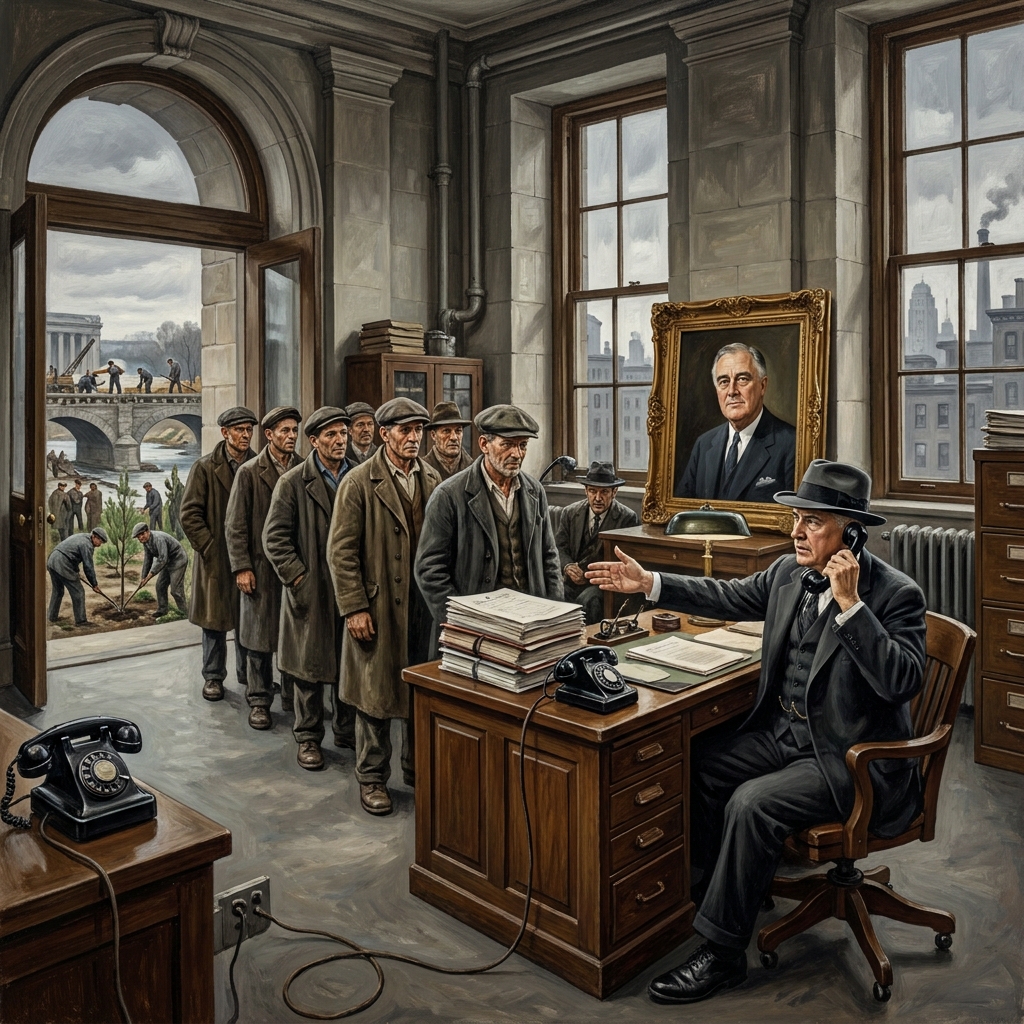
From there, the material walks the class through specific examples of governmental intervention. There is a clear worked scenario involving the Reconstruction Finance Corporation in 1932. The lesson explains that the government created this entity to provide emergency loans to failing banks and railroads, an attempt to use specific policy to jump-start stagnant institutions. Later, the guided practice brings in the Glass-Steagall Act. By focusing on how this reform separated commercial and investment banking to keep depositors safe, the lesson helps students see the government not as a passive observer, but as an active designer of financial stability. It is a solid high school US history lesson for teachers who want to move past generalities and get into the actual legislation that redefined the twentieth century.
The standard in practice
This content fulfills the requirements set out in CA.HSS-11.6.2. This standard asks that students understand the explanations for the principal causes of the Great Depression and the various steps taken by the Federal Reserve, Congress, and Presidents Herbert Hoover and Franklin Delano Roosevelt to combat the economic crisis. This is the California-adopted standard, and it is taught consistently across districts like Visalia Unified, William S. Hart Union High School District, Berkeley Unified, and Gridley Unified. It acts as a necessary anchor for any curriculum dealing with the shift in the government’s role in the national economy.
The standard is effective because it forces us to look at both the Hoover approach and the Roosevelt approach without defaulting to a binary good-or-bad judgment. It requires students to analyze the specific economic policy tools available to leaders at the time. When a student learns how a policy was crafted to prevent another banking collapse, they are learning to think like a historian and an economist simultaneously. The why-it-matters section in the lesson captures this well, noting that these decisions directly shape the world of jobs and savings that students will enter themselves.
Where the lesson fits in your week
I see this being a great tool for a variety of classroom needs. It works perfectly as a whole-class assignment when you are first introducing the unit on the 1930s. If you have a student who missed the week, the step-by-step logic makes it intuitive enough for them to catch up on the core ideas of systemic economic failure without needing a direct lecture. It also functions well for a substitute day because the instructions are clear and the concepts are well-defined. My one caveat is that the economic concepts, like the function of the Federal Reserve in an interest rate crisis, might require a bit of front-loading for students who have not had a basic civics background yet, so keep an eye on those learners during the independent sections.

By the time they finish the practice scenario on the Glass-Steagall Act, students should be able to articulate why the government decided to separate banking functions and how that action served as a response to the failures of the early 1930s. It moves them from simply knowing dates and names to understanding the mechanism of the New Deal as a permanent change in how our federal government interacts with the private sector. It turns a massive, intimidating period of history into a series of logical, if difficult, choices.
Related lessons
The Growth of Presidential Power in the Twentieth Century, Traces the expansion of executive influence throughout the twentieth century

Political Machines and Reformers in American Cities, Examines urban political organizations and the movements that challenged them

Constitutional Change and the Balance of Power, Analyzes legal shifts and institutional checks within the American government