

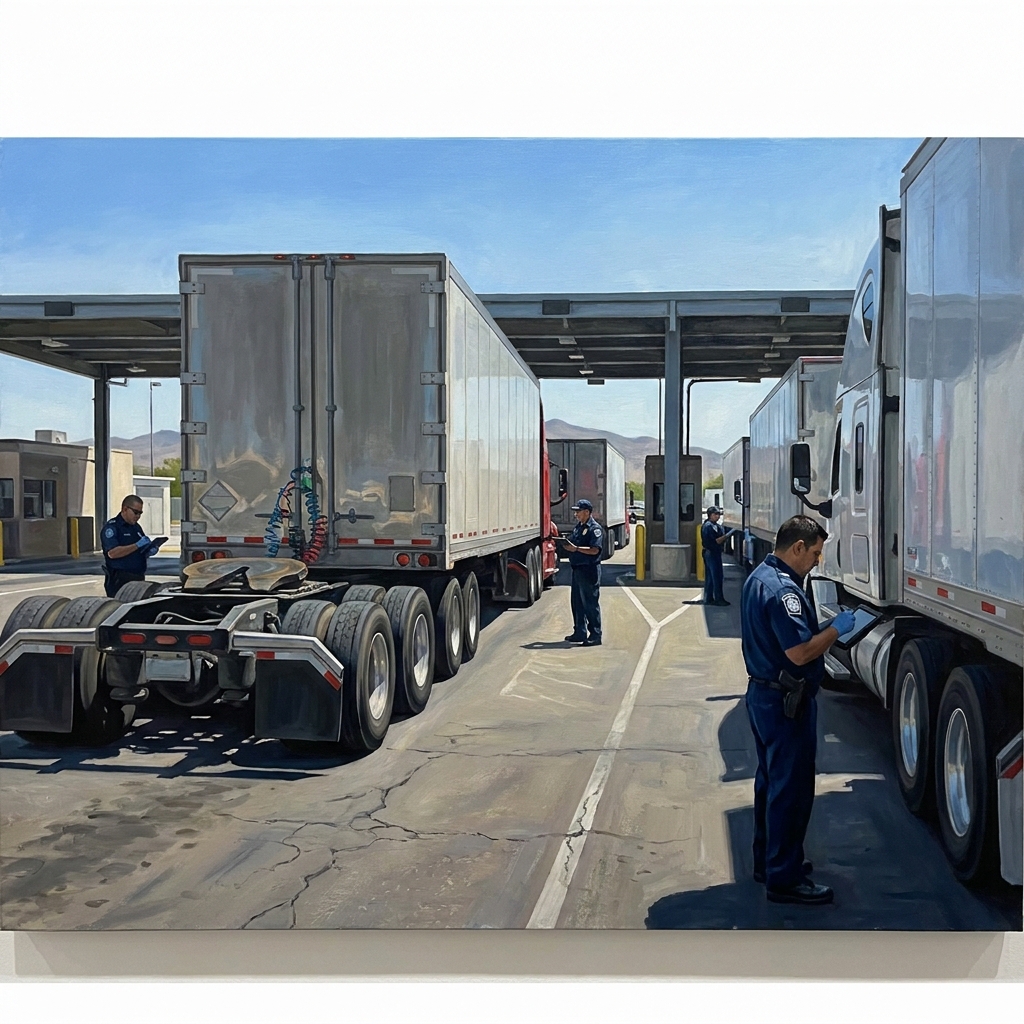
When we look at our twelfth grade government and economics curriculum, it is easy to forget that students need concrete frameworks to understand how global trade influences their local reality.
The Borders in a Global Economy lesson provides exactly that for your high school social studies students. It addresses the changing role of international political borders and how territorial sovereignty functions in a world connected by complex supply chains. This material is designed to hit the California-adopted standard CA.HSS-PoE.12.6.3, which requires students to analyze how the United States economy is influenced by global forces and how our trade policies interact with those of other nations. Educators in Porterville Unified, Corona-Norco Unified, Ceres Unified, and Ojai Unified all use this same standard to ensure students grasp the nuances of international relations. When you use this high school economics lesson on borders, you are giving your students a clear way to see why trade agreements like the US-Mexico-Canada Agreement exist and how they shift the function of a border from a simple line on a map into a conduit for commercial interaction.
What the lesson actually asks students to do
The lesson starts by asking students to reconsider their definition of a border. It introduces the idea that borders were once just hard lines where one government’s jurisdiction stopped and another’s started. To challenge this, the material walks them through the Schengen Area of the European Union, illustrating how internal borders can lose their restrictive nature to facilitate the flow of goods and people. The lesson defines key vocabulary to keep the conversation grounded, specifically: Territorial Sovereignty, the Global Economy, Economic Integration, the Supply Chain, and Special Economic Zones. Your students will learn that Special Economic Zones, or SEZs, are areas where governments offer tax breaks and regulatory flexibility to attract foreign investment and promote trade.

After building this foundation, the lesson brings in a concrete example with the US-Mexico-Canada Agreement. It explains that this treaty standardizes rules across three nations, which means that the border serves as a structured channel for commerce rather than an unpredictable obstacle. The most important part of this lesson is the guided practice. You will ask your students to take the lead by imagining a fictional nation that wants to build a Smart Trade Zone on its border to attract e-commerce companies. They have to evaluate the impact this project could have on their national sovereignty. They are not just memorizing terms; they are applying the concept of CA.HSS-PoE.12.6.3 by debating the trade-offs between attracting foreign investment and maintaining the ability to govern laws within their borders.
Where students slip
One common hurdle is that students often view sovereignty as a black-and-white issue. They might argue that any reduction in trade barriers or any tax break offered to a foreign company is a surrender of a nation’s power. Your job is to help them see the nuance in that balance. When they are working through the Smart Trade Zone prompt, press them on the specific types of laws they think a nation might be willing to loosen. Would they compromise on environmental regulations to bring in a major logistics hub? Would they relax labor standards? Pushing them toward these specific examples helps them realize that modern economic integration is a constant negotiation rather than a simple decision to open or close a border.

This lesson is a fantastic candidate for a whole-class assignment when you are introducing the unit on international trade. It also works quite well as a stand-alone lesson for a student who missed the week, as the concepts are self-contained and logical. If you have a substitute day, this is a reliable piece of curriculum because the fictional scenario provides an immediate entry point for student writing and discussion. The lesson is designed to be completed in about 45 minutes, which makes it easy to fit into a standard block. It helps them understand that the global economy is a complex system of international trade, production, and financial markets that has real-world consequences for their future job prospects and the availability of goods in their own communities.
Related lessons

Private Property and Resource Stewardship, Managing natural resources within the framework of private ownership laws

Global Trade and the U.S. Economy, Analyzing how international markets affect domestic production and trade policy

The Engine of the Economy: Financial Markets, Function and purpose of global financial systems in modern commerce