

Helping students move beyond simple summary is a primary goal for many 6th grade English Language Arts educators. As students engage with denser nonfiction, they require specific strategies to deconstruct arguments and historical explanations, making the analysis of informational text a central part of the mid-semester curriculum.
Breaking down complex text structures
Most of us start our year in 6th grade English Language Arts by helping students move beyond simple summary. When we get to the middle of the semester, that is usually when I reach for Analyzing Historical Ideas and Processes. At this stage, students are moving into more dense nonfiction, and they need a concrete way to see how an author pieces an argument or a historical explanation together. The lesson specifically targets the objective of identifying how authors introduce and explain key historical ideas, as well as the sequential steps found in a process.

Students start by reviewing how to identify a main topic, which they should have mastered by now. From there, the lesson moves them into the heavy lifting of looking for how an author elaborates on that topic. When I use this in my classroom, I find it useful to point out the vocabulary early on. Remind them that to elaborate means to add more details or examples to explain an idea more fully, and that a procedural text is simply a type of writing that lists the steps needed to complete a task or process. These are the tools they need to pull apart a passage about something like the feudal hierarchy system.
Aligning with standards across the state
This lesson is built to address CA.ELA.RI.6.3. This California-adopted standard asks students to analyze in detail how a key individual, event, or idea is introduced, illustrated, and elaborated in a text. Whether your students are in Fremont Unified, Pajaro Valley Unified, Modoc Joint Unified, or Hesperia Unified, this same standard helps them move from passive reading to active analysis. The lesson also incorporates CCSS.ELA-LITERACY.RI.6.3 as a connected part of this standard, which adds the specific requirement to identify key steps in a text describing a history or social studies process.

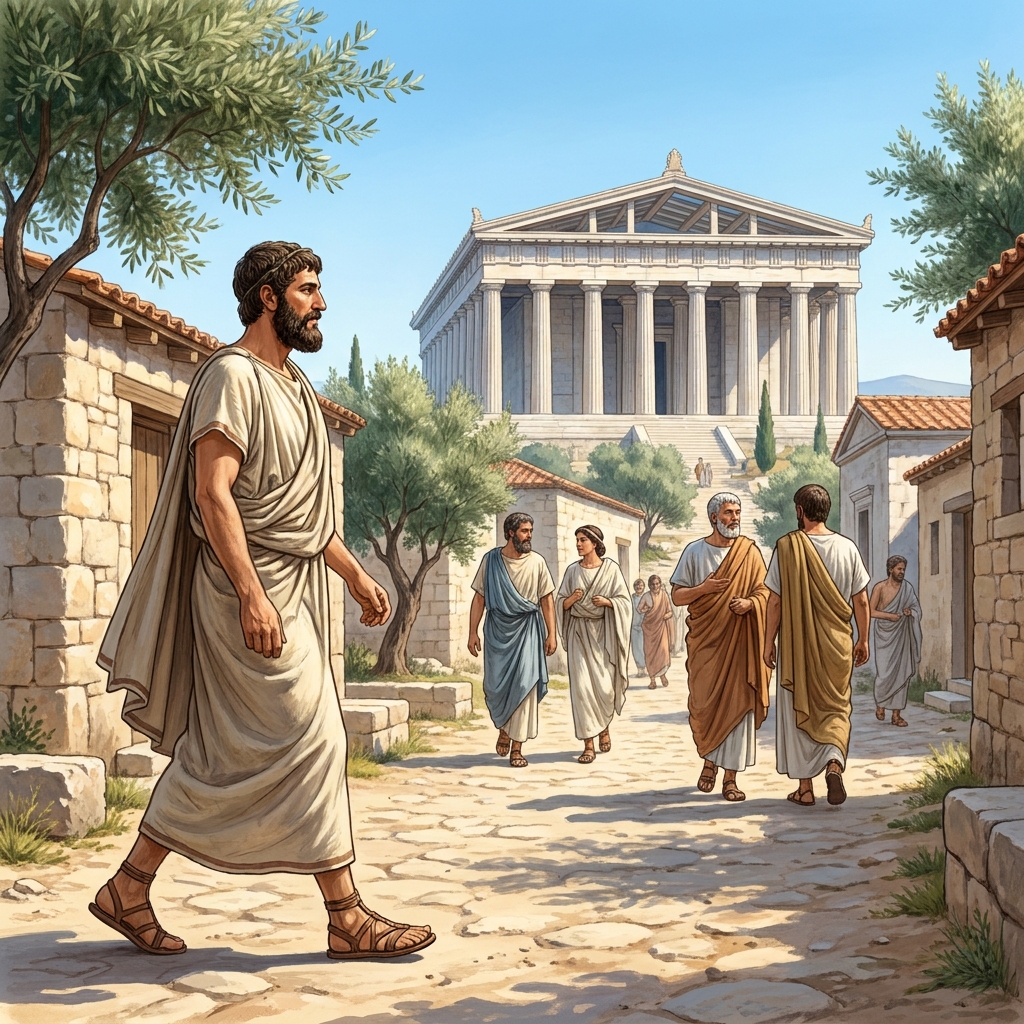
When you present this to the class, you will notice the lesson uses a worked example to bridge the gap. It walks students through a hypothetical story about a citizen named Aris in Athens, showing how an anecdote about voting can illustrate a complex concept like democracy. This is a great anchor for the class before they attempt the guided practice on the feudal hierarchy system. I usually warn my students that authors rarely just state the main idea once; they weave it through the anecdotes they choose. It is easy to miss the forest for the trees when students get caught up in the details of the story, so keep an eye on them during the independent portion of the 6th grade informational text analysis lesson to make sure they are connecting those anecdotes back to the broader historical idea.
This lesson takes about 45 minutes, which is just about the right amount of time to push through the initial theory and get to the practice. I find it works best as a whole-class assignment, but it is also a reliable choice for a student who missed the week and needs a quick way to catch up on this specific skill. If you have a substitute in for the day, this is self-contained enough that they can guide the students through the reading without you needing to prep a separate supplemental packet. Just make sure students have a highlighter handy to mark the specific examples and procedural steps as they find them.
One small caveat: the concept of procedural text can sometimes feel a bit dry to students if they only think of it as a recipe. I try to emphasize that history is often a series of processes, and understanding those steps is the difference between memorizing a timeline and actually understanding how a society functioned. Once they see that pattern, they start seeing it everywhere, from news articles to the instructions for a game they might play on the weekend.
Related lessons

Understanding Literary Nonfiction, Covers characteristics and analysis of literary nonfiction texts

Understanding Author Purpose and Point of View, Explores how authors communicate purpose and specific viewpoints
Finding the Big Idea, Focuses on identifying central themes and main ideas